Given the same body of evidence, can multiple testing use a single random draw to increase the chance of rejecting hypotheses while still controlling the false discovery rate? The 2026 preprint by Soumyabrata Bose and Jay Bartroff gives a definite answer: within the class of "conditionally certified" rules that they define, not only can the maximum rejection probability of each hypothesis be computed, but a rule that shares one random number attains all of these upper bounds simultaneously. The key to this conclusion is the restriction on the class of rules being compared.[1]
Suppose K null hypotheses are tested simultaneously, and the e-value for the i-th hypothesis is a nonnegative random variable Xᵢ satisfying E(Xᵢ)≤1 when that null hypothesis is true. The coordinates are not required to be independent. The false discovery rate (FDR) is the expectation of the ratio of false rejections to total rejections; when there are no rejections, this ratio is taken to be zero. For a randomized rule, the expectation covers both the data and the external randomization.[1]
Ordinary e-BH makes deterministic rejections based on the sorted e-values and the target level α. The new method introduces, in addition to the evidence, an independent U∼Uniform(0,1), drawn once according to a prespecified rule and then used to determine the rejection set; one may not redraw repeatedly until a satisfactory result is obtained. What the paper studies is this: with the observed evidence vector held fixed, how large a chance of inclusion in the rejection set can this single randomization give each hypothesis?[1]
First constrain the average certificate of each coordinate
For any rejection set A, the paper defines a certificate for the i-th coordinate, Zᵢ(A)=K/[α(|A|∨1)]·1{i∈A}, where |A|∨1 is the larger of the number of rejections and 1. If i is rejected, its certificate decreases as the total number of rejections increases; if it is not rejected, its certificate is zero.[1]
Conditional certification requires that, for every fixed nonnegative evidence vector x and every coordinate i, the randomized rejection rule D satisfy Eᵁ[Zᵢ(D(x,U))]≤xᵢ. The average here is taken only over the external randomization, and what the constraint checks is the certificate. It does not mean that the FDR is also at most α for each fixed x; nor is it the posterior probability that a hypothesis is true.[1]
How does this coordinate-by-coordinate constraint connect to the FDR? Summing the certificates of the true null hypotheses and multiplying by α/K gives the false discovery proportion for that realization. Taking the expectation over the randomization first, each certificate is bounded by the corresponding Xᵢ; taking the expectation over the data next, the expected e-value of each true null hypothesis is at most 1. Therefore, if there are K₀ true null hypotheses, FDR≤αK₀/K≤α.[1]
One random number attains every coordinate's upper bound at once
The paper proves that, within the conditionally certified class, the inclusion probability of the i-th hypothesis for fixed x is at most min{1,Gᵢ(x)}, where Gᵢ(x)=(α/K)∑ⱼ min(xᵢ,xⱼ). The construction simply compares all coordinates against the same independent uniform random number: D*(x,U)={i: U≤Gᵢ(x)}. Theorem 4.1 proves that this rule itself satisfies conditional certification, so it does attain the upper bound for every coordinate simultaneously.[1]
Gᵢ is nondecreasing in xᵢ, so once the e-values are sorted from largest to smallest, the rule always selects a prefix of that ordering; equal e-values are selected together or left out together. Having all coordinates share U is part of the result: this is not a matter of tossing a separate, independent coin for each hypothesis.[1]
Plugging four observed values into the formulas
Take the fixed observed vector x=(50,12,5,2), with K=4 and α=0.10. The thresholds of ordinary e-BH for sorted positions 1 through 4 are 40, 20, about 13.33, and 10, so it rejects only H₁. Substituting into the new rule gives G=(1.725,0.775,0.425,0.2), and the conditional inclusion probabilities of the four hypotheses are 1, 0.775, 0.425, and 0.2, respectively.[1]
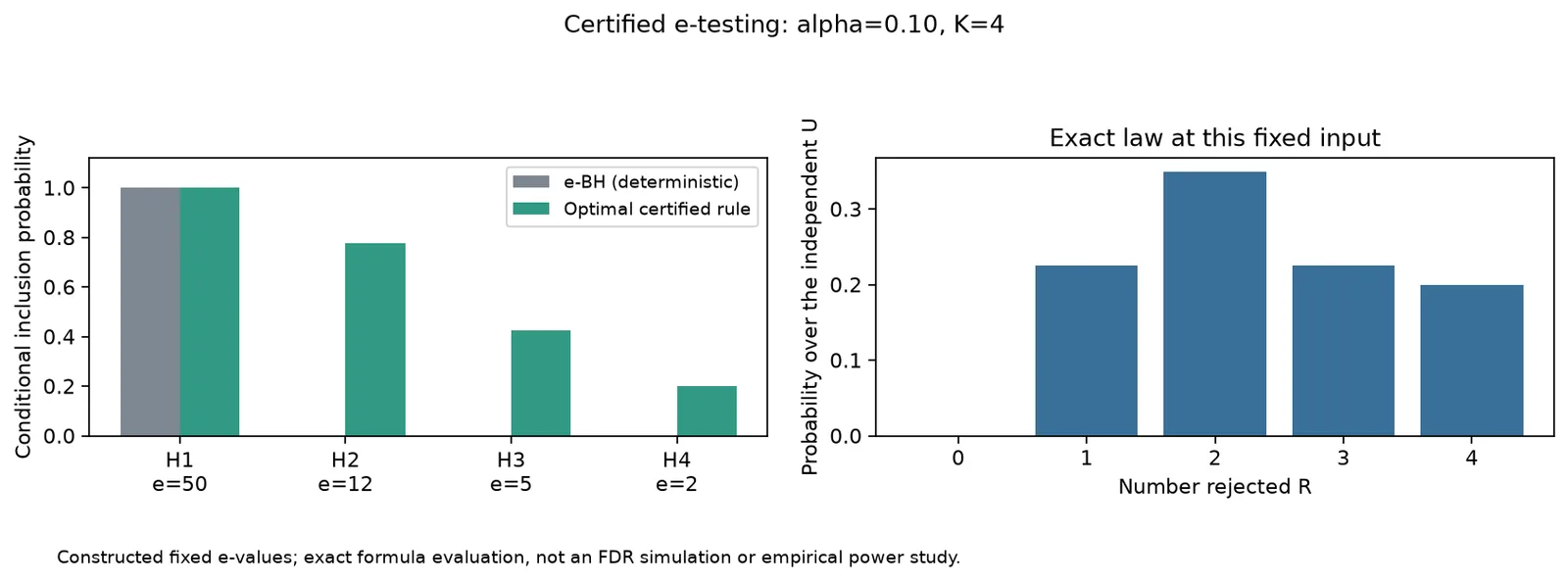
Computed from the formulas in the Bose and Bartroff preprint: constructed e-values (50,12,5,2), α=0.10; left, the conditional inclusion probabilities; right, the distribution of the number of rejections induced by the shared independent uniform variable. This is not an FDR or power simulation.
Because the four comparisons share U, the probabilities that the number of rejections R equals 1, 2, 3, and 4 are 0.225, 0.35, 0.225, and 0.2, respectively, so Eᵁ(R)=2.4. For example, when U=0.4 is drawn, the first three hypotheses enter the rejection set; another randomization carried out by the same rule can yield a different number. The 2.4 here is the average number of rejections with this set of observed values held fixed, not the number of correct discoveries.[1]
These numbers also allow the certification condition to be checked directly. The average certificates of the four coordinates are (21,12,5,2), each no greater than the corresponding input in (50,12,5,2). For example, H₄ is rejected only when U≤0.2, in which case all four are rejected and its certificate is 10, so its average certificate is 0.2×10=2.
Which rules does "optimal" compare?
The conclusion of Theorem 4.2 is stronger than "a larger average number of rejections": for any nonnegative weights, the new rule maximizes the weighted sum of the coordinates' conditional inclusion probabilities. When all weights are strictly positive, any rule that attains this optimum has, for fixed x, the same rejection-set distribution as D*. This is uniqueness of the distribution of the rejection set; it does not require the program code that implements the randomization to be unique.[1]
Ordinary e-BH belongs to the conditionally certified class and is a deterministic benchmark. The paper also proves that, when the comparison uses the same uniform random number, the rejection set of ordinary e-BH is contained in that of U-eBH, which in turn is contained in that of the new rule. Under this common randomization, therefore, the new rule keeps the rejections of the former two and may add more.[1]
But "optimal" does not mean unconditionally optimal among all randomized methods that control the FDR. The proof relies on the conditional certification constraint holding for every fixed evidence vector and every coordinate; the paper notes that methods such as compound e-values and e-value-based closure lie outside this class, and the resulting upper bounds do not constrain them. This advance should be read as a complete characterization of optimality for one specific constrained class, not as a ranking of all multiple testing methods.[1]
References
- [1] Bose, Soumyabrata, and Jay Bartroff. Optimal Certified Multiple Testing with E-values. arXiv:2611.01333v1 [math.ST], 2026.