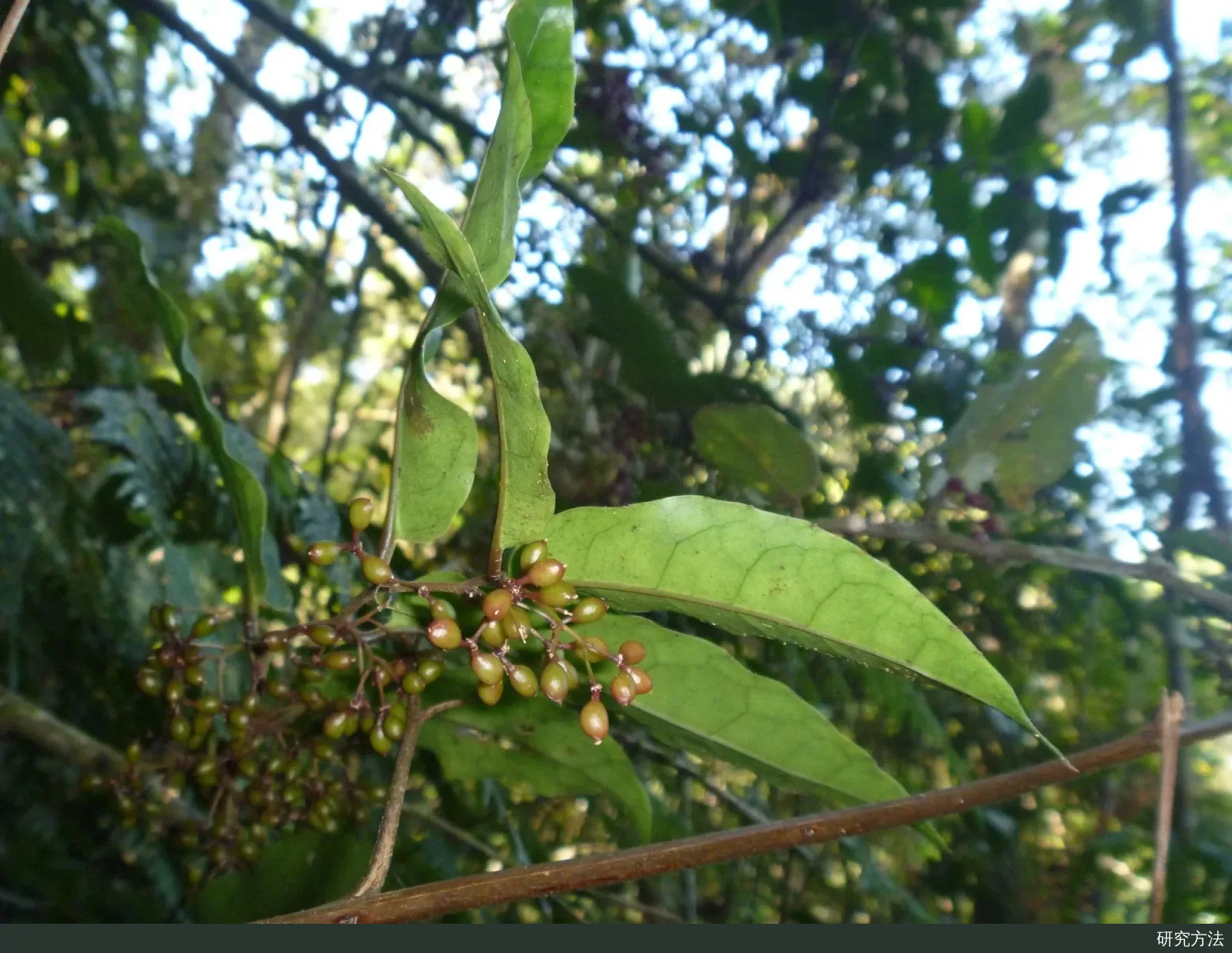
Plant mitochondrial genomes are often mixed with DNA from other species. Compared with prokaryotes, however, organelle horizontal gene transfer (HGT) has a more complex structure and lower sequence divergence, and a general-purpose whole-genome scanner has long been missing. On 11 October 2026, Cai and Cohen published HGTScanner in Methods in Ecology and Evolution. It is a Python tool that combines BLAST, phylogenetic and synteny evidence to report where foreign segments sit and which donor lineage they come from. This article walks through its workflow, its benchmark evidence and the limits of where it applies.
Why Organelle Horizontal Gene Transfer Is Hard to Detect
A plant mitochondrial genome is a bit like a junk room. In their blog post, the authors list what can be found inside: fungal DNA, selfish transposable elements, plastid (chloroplast) DNA and DNA from the host plant. Segments that have moved from the plastid into the mitochondrion are called MTPTs (mitochondrial plastid DNA); segments from other species are the product of horizontal gene transfer. Parasitic plants, which connect to host roots through haustoria, are a group where this kind of foreign DNA is especially common.
The difficulty comes down to two points. The first is structural complexity: plant mitochondrial genomes rearrange frequently, so a foreign segment may be broken into several pieces and land in intergenic regions, and comparing known genes one by one easily misses it. The second is low sequence divergence: a foreign segment differs very little from the species' own homologous sequence, as if a few pages from another edition of a book had been slipped in with almost identical wording, so judging by "does it look similar" rarely identifies it. The paper's abstract points to these two factors, together with the lack of a generalizable tool, as the reason organelle HGT has been hard to characterize systematically.
HGTScanner therefore aims to do more than label a genome "HGT or no HGT". It answers two questions at once: which stretch of the genome is foreign, and which donor lineage it most likely came from. The authors regard these two pieces of information as the prerequisite for understanding how HGT creates genetic novelty, how it shapes genome evolution, and which interactions between species produced it.
A Pipeline of Homology, Tree Building and Three Lines of Evidence
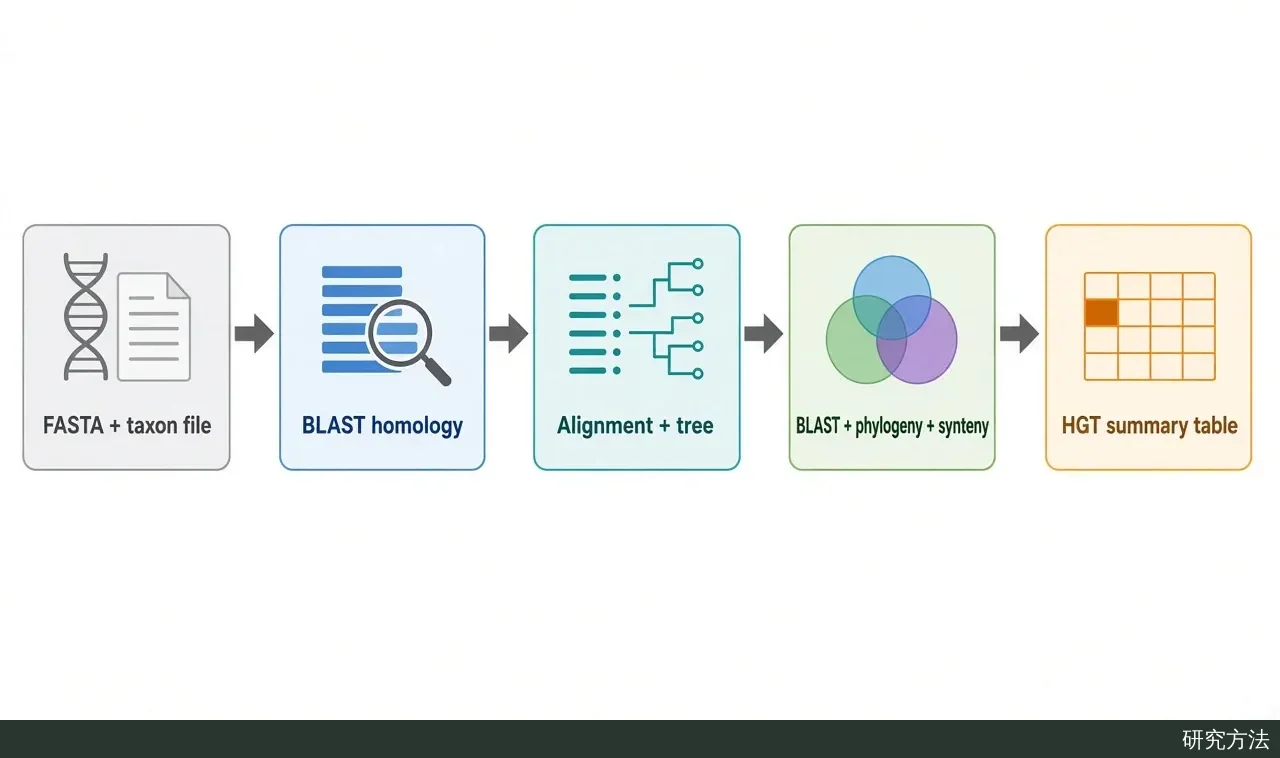
Users supply two things: an organelle genome assembly (FASTA) and a taxonomy file that gives the family of the query species and several closely related "ingroup" families. The program first runs BLAST between the query genome and a reference database and merges adjacent hits into candidate loci. For each locus it then extracts homologous sequences, builds a multiple sequence alignment and infers a phylogenetic tree. FastTree is the default; when accuracy matters, users can skip tree building at first, infer trees in parallel on a computing cluster with IQ-TREE or RAxML, and return to evaluation mode to summarize.
To call HGT, the program combines three kinds of evidence. BLAST evidence looks at the distribution of homologs, for example a sequence that can be found only in the query species and in one distantly related family. Phylogenetic evidence looks at where the query sequence falls in the tree: if it does not cluster with its own ingroup but nests, with sufficient support, inside a distant donor family, it is like finding the face of another family's child in a family portrait. Synteny evidence supplements the call from how segments are arranged along the genome; the specific rules are as stated in the full paper. The output table lists, locus by locus, the start and end coordinates, the classification, the donor's family, genus and species, the evidence used and the branch support, which makes manual review easy.
The key to reducing dependence on prior knowledge is the built-in reference library. The plastid library takes one representative species per genus from the NCBI plastid reference genomes, 3,722 genera in all, plus Viridiplantae mitochondrial sequences; adding the -fungi option also brings in a fungal mitochondrial library. Users can add their own sequences in the format "family|genus_species|accession". The tutorial in the README uses Aeginetia indica, an Orobanchaceae plant that specializes in parasitizing grasses: the program classifies loci 1, 15, 26 and 28 as local MTPTs and loci 14 and 18 as high-confidence foreign MTPTs from the grass family (Poaceae), consistent with its host group.
The Amborella Benchmark and the Orobanchaceae Cases
In their blog post, the authors explain that no existing HGT tool could handle genome rearrangement of the degree seen in plant mitochondria, so they chose a manually curated dataset as the benchmark: the 2012 study by Rice and colleagues of Amborella trichopoda. That study found that Amborella had taken in entire mitochondrial genomes from mosses, green algae and even other flowering plants, with supplementary material running to 147 pages. In the comparison, HGTScanner recovered 98.2% of the documented moss- and green-algae-derived HGT, in about 2 hours of computing, whereas the authors estimate manual searching would take about 200 hours. With the expanded GenBank, donor identities were also refined, including green algae of the family Watanabeaceae, which often live on the leaves of tropical trees as lichen photobionts.
More surprising was the HGT from flowering plants. Among 24,661 candidate species, the top-ranked donor was Hachettea austrocaledonica (family Mystropetalaceae), a root parasite endemic to New Caledonia, and Amborella is likewise found only in New Caledonia. The author searched the literature and digitized specimens and found no record of a parasitic relationship between the two, so the finding is framed as a DNA-derived prediction of an "underground" parasitic relationship that still awaits field verification.
Orobanchaceae is another group of cases. The paper's abstract reports that non-local MTPTs in these parasitic plants are strongly associated with co-distributed host plants, and the supporting data package on Zenodo includes MTPT analyses of Mannagettaea hummelii, Aeginetia indica, Alectra sessiliflora and Rehmannia glutinosa. In the blog post the author also describes Aphyllon cooperi: field excavation had only ever seen it parasitizing Viguiera (Asteraceae) in Austin, USA, yet HGTScanner shows that Asteraceae contributed more than half of its HGT, with Solanaceae and Rosaceae also contributing substantially, many of the segments being shared with related Aphyllon species, which suggests that the ancestral host range may have been wider. A field observation is a snapshot of one time and place, whereas HGT may record interactions over a longer time scale.
Read these numbers with their scope in mind. 98.2% is the recovery rate against a manually curated reference standard and is limited to HGT of moss and green-algae origin; it is not overall accuracy, and the blog post does not report false positives. The 200 hours is the authors' estimate of manual effort. Because there is no comparable tool, the benchmark shows "agreement with expert manual curation", not "better than other software".
The Limits of the Reference Library, the Priors and Ecological Inference
The resolution of donor inference is constrained by the reference library. The plastid library has only one representative species per genus, and the README states that donors can be resolved to family but with lower confidence at genus level, and explicitly discourages species-level donor conclusions. Hachettea "ranking first" among more than 24,000 candidate species is a relative ranking, and taxa missing from the library could change the result. "No prior knowledge of the donor is needed" also does not mean zero priors: users still have to provide the list of ingroup families for the query species, and a poorly drawn ingroup directly affects the calls.
There are problems it is simply not good at. The README discourages using it to judge HGT between two closely related sister lineages, because foreign sequence is then hard to tell apart from vertically inherited sequence; it also does not recommend using it on nuclear genomes, since all-versus-all BLAST is not optimized for genomes of billions of bases. The default FastTree is fast but less accurate than IQ-TREE or RAxML, and the choice of branch-support threshold also changes how many high-confidence HGT calls there are.
Going from HGT to ecological interaction adds another layer. A donor and recipient that are co-distributed and share many transferred segments allow the hypothesis that the two once interacted, but when and how the interaction happened must be checked against field surveys, specimen records and other evidence from the field; the relationship between Amborella and Hachettea is, for now, still at the stage of prediction. It is a screening tool for narrowing the search, cannot replace field observation, and is not a universal replacement for every HGT analysis pipeline.
Two practical points remain. The Zenodo record of software v1.1 is under embargo and will open only on 23 January 2027, so for now the code is obtained through GitHub (GNU license; the authors say it has been tested on macOS and Linux); the supporting data have been released under CC BY 4.0. This article is based on the paper's abstract and publication metadata, the authors' blog post and the software documentation. The publisher's full-text page could not be accessed this time, so benchmark details should be checked against the full paper.
References
-
Cai, L., & Cohen, R. O. (2026). HGTScanner: Detecting horizontal gene transfer at the fine scale using whole organelle genomes. Methods in Ecology and Evolution. Published online 2026-10-11. https://doi.org/10.1111/2041-210X.70419
-
Wiley Online Library full-text page: https://besjournals.onlinelibrary.wiley.com/doi/10.1111/2041-210X.70419
-
Cai, L. (2026-10-14). Dead alien DNA tells the story of underground ecological interactions. Methods Blog. https://methodsblog.com/2026/10/14/dead-alien-dna-tells-the-story-of-underground-ecological-interactions/
-
lmcai/HGTScanner (GitHub repository and README): https://github.com/lmcai/HGTScanner
-
Cai, L., & Cohen, R. O. (2026). HGTScanner v1.1 [Software]. Zenodo. https://doi.org/10.5281/zenodo.18355950
-
Cai, L., & Cohen, R. O. (2026). Supporting data for: HGTScanner [Dataset]. Zenodo. https://doi.org/10.5281/zenodo.22033346
-
Research Methods · Rituals can be imitated; understanding cannot be faked
-
Compiled and published by the Scholay all-in-one academic platform; if any rights are infringed, please contact us and we will take the content down.
-
Also published at Enter Scholar, a scholar community for the age of intelligence