After the results of an intervention are in, researchers still need to work out what participants actually came into contact with, how change might have come about, and what conditions influenced that change. Process evaluation collects evidence around the intervention's implementation, mechanisms of impact and context, and combines it with outcome evaluation to explain the study's findings.[1]
First write down how the intervention is expected to work
The National Exercise Referral Scheme (NERS) in Wales offers an example: health professionals refer eligible people to exercise professionals, and the scheme includes 16 weeks of supervised exercise, motivational interviewing, goal setting and follow-up contact. The scheme hopes that professional support and opportunities to exercise will help participants build confidence, sustain exercise, and raise their long-term level of physical activity.[2][3]
In this scheme's randomized trial, 2,160 people were allocated to exercise referral or usual care. At 12 months, the researchers graded weekly time spent in physical activity, and the overall between-group comparison gave an odds ratio of 1.19 with a 95% confidence interval of 0.99–1.43. This result summarizes the between-group difference after allocation; to understand it, one also needs to know which parts of the scheme people actually received.[2]
In designing a process evaluation, one can first write the scheme as a path that can be checked: whether referral took place, whether participants showed up, what the professionals provided, how participants responded, and how those responses connect to later activity. The arrows on the path stand for expectations the researchers are going to test, not causal relationships already confirmed.[1]
Then choose the few questions that most affect interpretation. For example, whether goal setting was actually carried out, whether participants received continuing support, and which people had more difficulty attending. The evaluation team can work with the scheme's designers and implementers to clarify the key links, and then arrange the data sources, collection times and analysis methods for each question.[1]
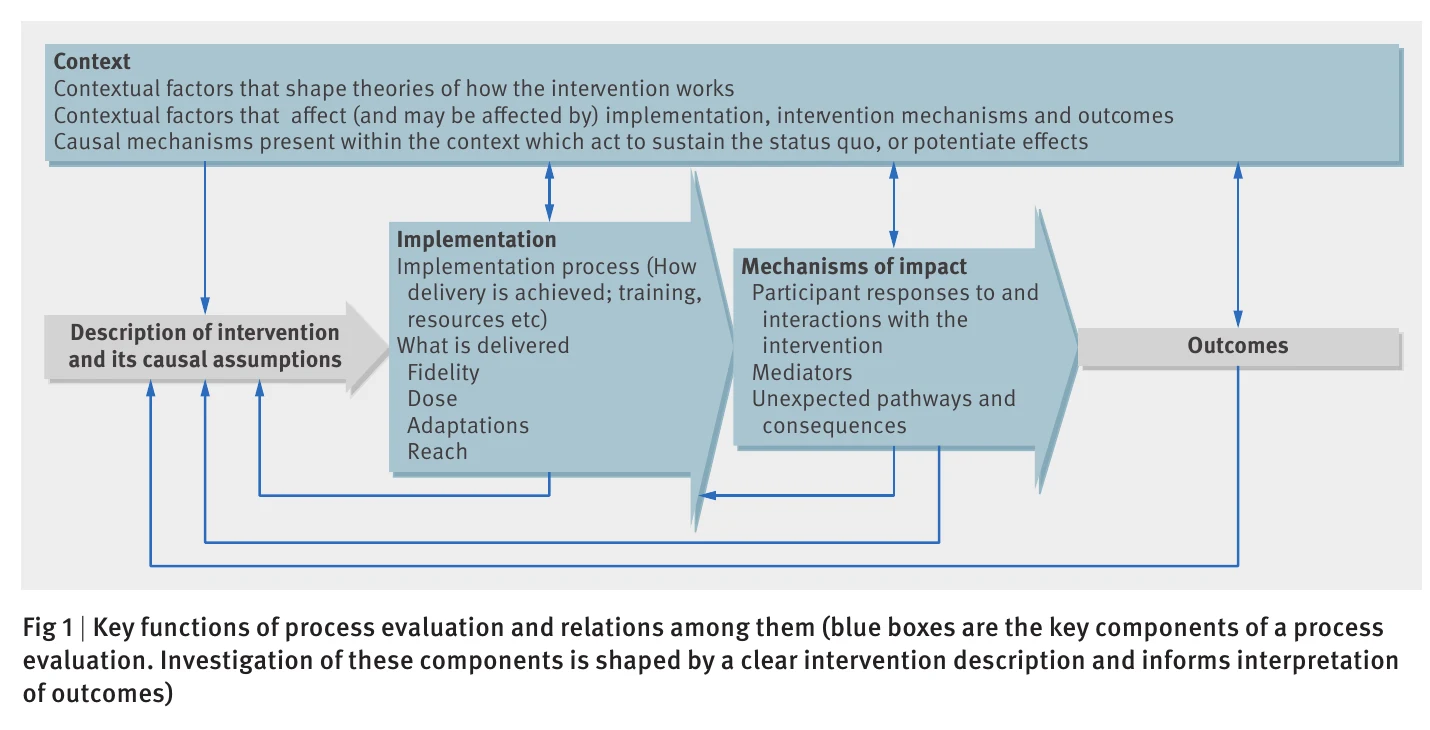
Figure 1 | The main components of a process evaluation and their relationships: the description of the intervention and its causal assumptions runs through implementation and mechanisms of impact, while the context of the study interacts with each component, and together they help explain outcomes. Source: Moore et al. (2015), Figure 1, CC BY 4.0. License
Delivery: what was planned versus what participants actually received
Implementation needs to be examined along several dimensions at once: fidelity concerns whether actual delivery matched the protocol, dose concerns how much of the service was provided and received, reach concerns how many people in the target population came into contact with the intervention, and adaptation records where the scheme was changed. They answer different questions: how many sessions were offered does not equal how many sessions each participant attended, nor does it mean the sessions ran as planned.[1]
The NERS trial reported attendance for the 1,080 people allocated to the intervention group: 473 (43.8%) completed the 16-week programme, 446 (41.3%) started but did not complete, and 161 (14.9%) did not attend. Putting the three groups under the same denominator is what reveals the attrition from allocation to sustained participation; this completion proportion describes the trial's intervention group, not all potential service users.[2]
An examination of NERS delivery also found that discounted prices and professionally supervised group exercise were the common content actually delivered, while elements such as motivational interviewing and goal setting were under-implemented. This offers another clue for interpreting the results: what the trial tested was the scheme as it actually ran, which is not entirely the same as the scheme as originally envisaged.[1][3]
In practice, one can record the numbers, corresponding denominators, counts and times separately for referral, first contact and continued participation, and record missing data in its own category. Assessing delivery quality also requires observing the content of the service: for example, using a uniform standard to check whether the planned goal setting appears in recorded consultations, rather than concluding that content was delivered simply because a consultation was logged. Data from different sites and different periods should be stored separately.[1]
Changes to the scheme should also be judged together with the original pathway of effect. Suppose a group programme changes its session times so that more people can attend; the core interaction may still be preserved. If all group activity is replaced with one-way reading, the part that relied on peer interaction has changed. Recording what changed, when and by whom, why it was changed, and which link it might affect is more useful than logging every difference as one vague deviation.[1]
Mechanisms: how participants respond to the intervention
In the NERS process study, the researchers conducted semi-structured telephone interviews with 38 exercise professionals in 12 local health board areas. The interviewees thought that the professionals' company, explanations and encouragement could help some people adapt to an unfamiliar exercise environment, and that patient-only groups might provide peer support and role models to look to. These interviews made the processes that might be at work concrete.[3]
If the scheme assumes that support will strengthen confidence, the researchers can measure confidence before and during the intervention and measure activity outcomes afterwards; at the same time, they can interview people with different levels of participation to learn how they understood and used the support. If the control group also has the corresponding measurements, this can help the researchers compare the two groups' change over time, and then use the interviews to judge which pathways deserve further testing.[1]
For example, people who attend classes often being more active later could be related to the classes, but could also be related to pre-existing health status, time, or motivation to take part. To interpret confidence or peer support as a mechanism of impact, one needs to explain the order of measurement, the comparison groups, and other possible influences; interviews, changes in scale scores and their association with outcomes can jointly support an explanation, but they do not automatically prove a causal role for the intermediate link.[1]
Process data can also reveal consequences that the original plan did not fully consider. Some NERS implementers thought that a patient-only exercise setting helped reduce anxiety about taking part; others worried at the same time that participants might still be unwilling to enter ordinary gyms after the scheme ended. The evaluation can therefore keep asking: can the support formed during the scheme carry on beyond it?[3]
Context: what the same scheme meets in different places
Context includes external conditions that affect delivery or impact, such as staffing and venue arrangements, available transport, existing services, costs, and participants' living conditions. It can change who has access to the intervention, and can also make the same intervention produce different responses; once the intervention enters a locality, it may in turn change existing ways of working.[1]
In the NERS interviews, some professionals mentioned that costs after the discount period ended might prevent people from continuing to exercise. For those planning to use a similar scheme elsewhere, what needs to be understood is therefore not only the class schedule within the 16 weeks, but also whether there are activities participants can afford afterwards and whether the necessary support can be retained.[3]
When recording context, one can put each site's staffing, service hours, costs and their changes on the same timeline as the referral and participation records. When comparing sites, then ask at which link the difference appears, who is involved, and how implementers and participants explain it. Such records can help researchers judge which conditions may need to move together with the scheme.[1]
Connecting process data with outcomes
When collecting data, one can keep a shared set of basic indicators at all sites and select sites with different conditions and different participation for in-depth observation and interviews. Interviewees should include implementers, participants, and any non-starters or early dropouts who can be reached; otherwise the experience of those who stayed can easily mask the difficulties in access and sustained participation.[1]
Fix the main process questions and recording conventions before the project starts, collect data early, midway and at the end of implementation, and set up identifiers that allow process records and outcome data to be linked safely. Evaluators should also agree in advance with the implementing side on when findings are fed back: feedback may help solve problems, but it can itself change later implementation, and what changed needs to be recorded.[1]
In the analysis, first describe delivery, dose and reach, and then compare sites, participation processes and outcomes together. Quantitative records can show where differences appear, and interviews and observations can explain how the differences arise; when the two kinds of data disagree, this inconsistency should also be retained. Questions that could be set in advance and new explanations proposed after seeing the results should be presented separately.[1]
The overall results of a randomized trial are interpreted by the original allocated groups; comparisons between completers and non-completers are grouped by actual participation, and these two groups did not form at random, so the difference in their results cannot be taken directly as the causal effect of completing the programme. The value of process evaluation is to put such differences back into delivery, participants' responses and context, and to propose more specific explanations that can continue to be tested.[1][2]
Finally, what is reported should be more than outcome numbers: it should also account for the original plan, the actual delivery, who was reached, the possible pathways of effect and the conditions of implementation. The next researcher or decision-maker can then see clearly which actually operating intervention is to be replicated, what needs to be prepared, and which questions still deserve study in a new setting.[1]
References
-
[1] Moore GF, Audrey S, Barker M, et al. Process evaluation of complex interventions: Medical Research Council guidance. 2015-03-19.
-
[2] Murphy SM, Edwards RT, Williams N, et al. An evaluation of the effectiveness and cost effectiveness of the National Exercise Referral Scheme in Wales, UK: a randomised controlled trial of a public health policy initiative. 2012-05-10.
-
[3] Moore GF, Moore L, Murphy S. Facilitating adherence to physical activity: exercise professionals' experiences of the National Exercise Referral Scheme in Wales. a qualitative study. 2011-12-15.
-
Research Methods · Rituals can be imitated; understanding cannot be faked.
-
Compiled and published by the Scholay All-in-One Academic Platform. If any infringement is found, please let us know and the item will be taken down.
-
Also published at EnterScholar, the scholar community for the age of intelligence.