When several endpoints are tested together, a maximum statistic can summarize the results within a single permutation. With small-sample binary outcomes, however, different permutations often yield the same maximum: some share that maximum yet carry different information in the remaining endpoints. Classical maxT folds all such ties into the tail and can therefore leave unused Type I error. A 2026 preprint by Corradini and coauthors proposes two refinements: coordinate the handling of ties with one shared uniform random number, or further separate permutations that tie on the maximum by using the second-largest statistic.[1]
Local tests first, then closure
Suppose there are several elementary hypotheses, and each nonempty endpoint set I corresponds to an intersection hypothesis H_I: every elementary hypothesis in the set holds at once. For each allowed permutation, take the maximum of the endpoint statistics inside I and write it M_I; larger values are stronger evidence against the null. Let a_I be the proportion of permutations whose maximum is strictly larger than the observed maximum, and b_I the proportion where the two are equal. The classical local maxT p-value is p_I=a_I+b_I, counting every permutation that ties on the maximum into the tail.[1]
Closed testing does not merely check the intersection that contains every endpoint, nor does it compare each single-endpoint p-value to the significance level on its own. To reject the elementary hypothesis H_j, every intersection hypothesis that contains j must be rejected; equivalently, the adjusted p-value is p̃_j=max_{I containing j} p_I. The more conservative a local test is, the more likely it becomes the bottleneck in the closed chain.[1]
Refinement one: one shared uniform draw for every intersection
The first method draws a single U ~ Uniform(0,1) and reuses it across all intersections. Each local p-value becomes p_I=a_I+b_I U: every strictly more extreme permutation is counted in full, and the tied mass is counted only in the shared random proportion. This value never exceeds the classical local p-value on the same permutation list, so after closure it also preserves every rejection the classical method already made.[1]
The gain from sharing comes from the closed-testing requirement that several local tests pass at once. With the data and permutation list fixed, each local rejection corresponds to an interval for U; a shared U makes those intervals nested, and the probability that they all pass equals the smallest local rejection probability among them. The paper proves that, among couplings whose conditional marginals for the intersection random numbers remain uniform, sharing U simultaneously maximizes the conditional rejection probability of every elementary hypothesis.[1]
Refinement two: splitting ties with the second-largest value
The other method is called two-endpoint augmentation, or tea. For each intersection and each permutation, sort that intersection's statistics from largest to smallest, form the pair (largest, second-largest), and compare it lexicographically with the observed pair: compare the maxima first, and only when they tie compare the second-largest values; permutations whose pairs still match are counted fully in the tail. When an intersection has a single endpoint, the comparison reduces to that scalar.[1]
For example, if the observed pair is (3,2), a permutation that yields (3,1) ties the observed maximum but is moved out of the tea tail because its second component is smaller; (3,2) remains in the tail, and (4,0) remains because its maximum is larger. After this refinement, every local p-value and its closed adjustment is no larger than classical maxT. Fixing in advance a component count k yields the generalization kea that uses the k largest statistics.[1]
A seven-intersection fully closed example
The constructed 6-unit, 3-binary-endpoint array below illustrates the difference. The first three units form the observed treatment group; each endpoint statistic is the number of treatment units equal to 1, so the observed statistics for A, B, and C are 3, 1, and 2. Enumerating all 720 unit permutations is equivalent to 20 equally weighted three-unit treatment assignments, each appearing 36 times in the permutation list. Local p-values are computed for all 7 nonempty intersections of A, B, and C, then closed.
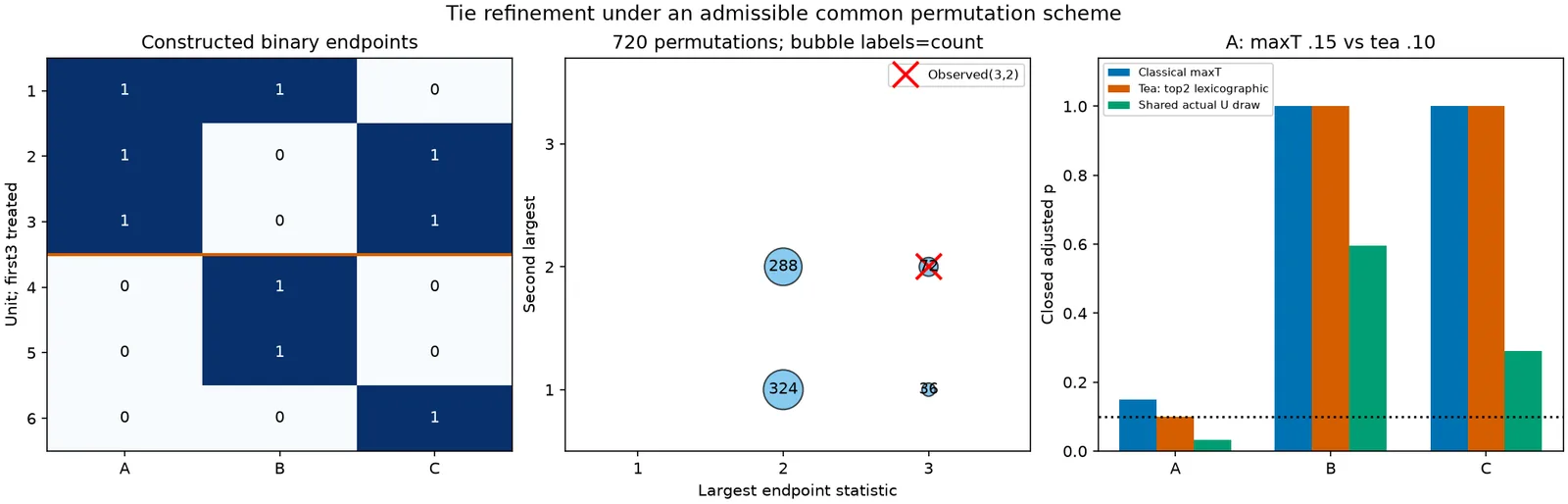
Actual computation of 720 allowed permutations and full closure over 7 intersections for a constructed 6×3 binary array; after splitting tied maxima by the second-largest value, the adjusted p for A falls from 0.15 to 0.10. The shared U is a real fixed-seed draw; this figure is not a reproduction of the authors' simulations.
A's classical closed adjusted p-value is 0.15; tea gives 0.10. At an illustrative α=0.10, tea rejects A's elementary hypothesis and the classical method does not. The difference comes from the full intersection: the classical local p-value is 0.15, while tea excludes some permutations that tie on the maximum and obtains 0.10; the other intersections containing A do not push tea's closed value higher again.
B's single-endpoint classical local p-value is 0.95, but the intersection that contains B and C has local p-value 1, so B's classical closed adjustment is 1 rather than 0.95; tea's adjustment for B is also 1. Both adjustments for C are likewise 1. The example separates changes in local tails from taking the maximum across intersections, and shows that a single local result cannot replace full closure.
A shared random number can be used on the same family of intersections. Drawing U=0.2115784470 with seed 2026111751 yields shared-U closed adjustments for A, B, and C of about 0.0317, 0.5952, and 0.2904. Another auxiliary draw can change the numbers; the figures here record one explicit randomized calculation.
Where the guarantees and computational cost come from
Strong finite-sample familywise error control hinges on this: under each intersection null, that intersection's joint endpoint vector is invariant in distribution under the common allowed permutation group, and the invariance must still hold when hypotheses outside the intersection are false. Endpoints may be dependent, but equality of marginal distributions one endpoint at a time is not enough. Every intersection uses the same allowed permutation list, which includes the identity; if the list is sampled with replacement from the group, repeated items keep their multiplicity.[1]
Full closure appears to require checking 2^m−1 nonempty intersections. The paper shows that shared U still admits the exact linear shortcut that corresponds to classical closed maxT; tea's exact shortcut needs m(m+1)/2 local tests, and kea with fixed k also has a polynomial-sized exact shortcut. These counts describe the number of local tests; generating permutations and computing each endpoint statistic still carry their own costs.[1]
Both refinements preserve classical closed maxT rejections, but neither dominates the other in power in general. Shared U spends the tie probability through randomization; tea uses information from the second-largest statistic within the same intersection. In sparse binary-outcome simulations the paper observes power gains for both relative to the classical method, and reports that tea often outperforms shared U in multi-endpoint settings; which is preferable depends on the alternative and on the remaining tie structure.[1]
References
- [1] Corradini G, Wright M N, Foraita R, Finos L. Power improvements and exact shortcuts for closed permutation maxT testing with discrete data. arXiv:2611.09231v1, 2026-11-06.