Many remember that “most people went to the top voltage” without asking how obedience was operationalised. Milgram (1963) at Yale wrote “obedience to authority” as an observable path: in a paired-associate task, the participant followed an experimenter in delivering escalating simulated shocks; the measurement hinge was four ordered prods spoken at hesitation, plus a stop rule after the fourth refusal.[1] Below: setting and script, variables and scoring, results and later checks. A prior column piece covers the 0–30 level distribution; this one stays on how the prod script makes the measure.Reading the four prods as a standardised manipulation and stop rule clarifies what later archival work and partial replications actually test—the outcome counts, or whether the script was followed and which line moved people on.
Setting: rigged draw, sample shock, 30-step generator
Participants were 40 men aged 20–50 from New Haven and nearby towns, recruited by newspaper ads and mail; jobs ranged from postal clerks and high-school teachers to engineers and laborers.[1] The draw was rigged so the real participant was always the “teacher” and a confederate the “learner.” The teacher read word pairs and punished errors; the generator had 30 switches from 15 to 450 volts, labels from Slight Shock to Danger: Severe Shock, with XXX at the top; a 45-volt sample shock and a 10-word practice series preceded the run.[1] Each error raised one step and the voltage was announced—intensity reminder and escalation in one act.The generator is part of the measure: escalation plus spoken voltage embeds an intensity reminder in each punishment act, rather than a separate attitude item.[1]
Learner script and the four prods
In this condition the learner answered on a roughly three-wrong-to-one-right schedule; there was no protest until about 300 volts, when the learner pounded the wall and then stopped answering; at 315 volts another pound, then silence.[1] On hesitation the experimenter used four prods in order: Prod 1 “Please continue / Please go on”; Prod 2 “The experiment requires that you continue”; Prod 3 “It is absolutely essential that you continue”; Prod 4 “You have no other choice, you must go on.”[1] Only a failed prod licensed the next; refusal after Prod 4 ended the session; each new hesitation restarted at Prod 1.[1] Special prods were also scripted: if asked about lasting injury, the experimenter said shocks may be extremely painful but cause no permanent tissue damage and to please continue; if the learner “doesn’t want to go on,” the teacher was told to continue until all pairs were learned whether or not the learner liked it, then Prods 2–4 as needed.[1]
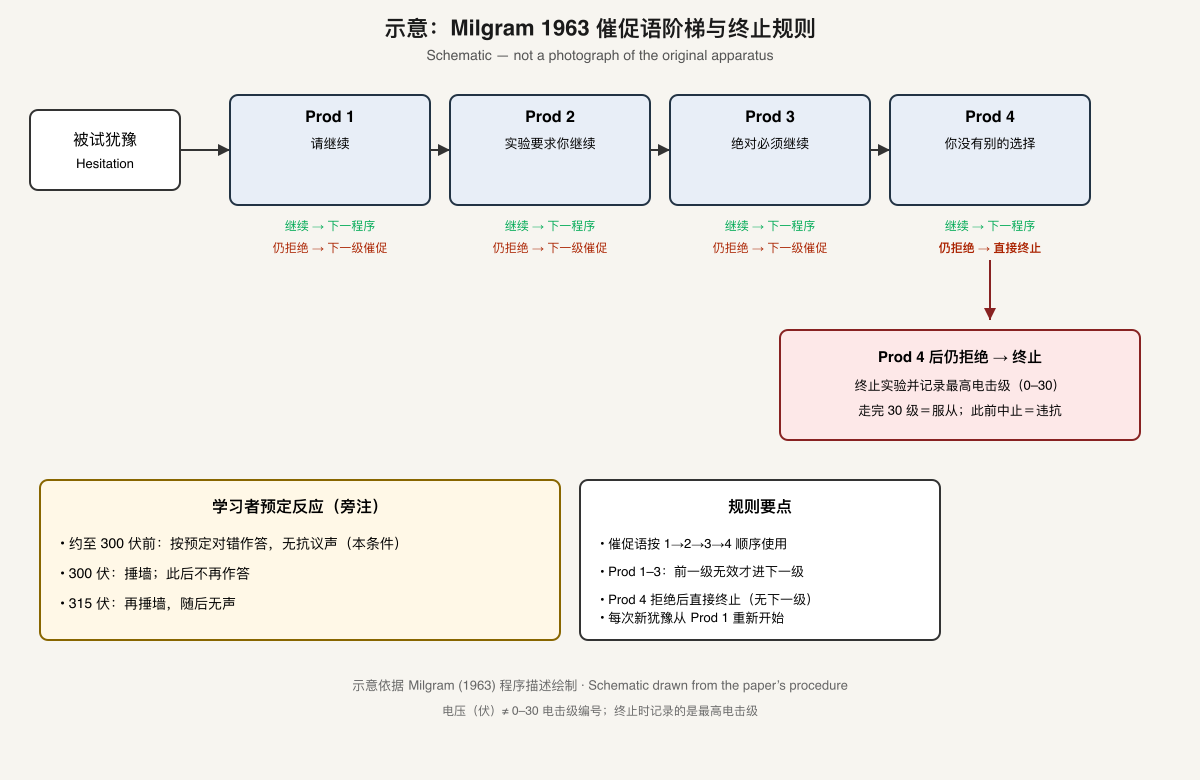
Figure: Schematic four-prod ladder; refuse Prod4 stops and records max level. Drawn for this article, Milgram 1963 PDF[1]
Outcome: maximum shock before refusal
The primary dependent variable is the highest shock level the participant will administer before refusing—from 0 (refuses the first shock) to 30 (top switch). Completing all 30 levels counts as obedience; stopping earlier counts as defiance.[1] Sessions were also recorded, photographed through a one-way mirror, described by observers, and followed by a 14-point pain rating—ancillary records that do not by themselves rewrite the operational definition.[1]
Results and later checks on the script
Of 40 men, 26 went to the highest shock; 14 broke off after the learner’s protests, in roughly the 300–375 volt range; Milgram described sweating, trembling, and nervous laughter.[1] The 1963 report is one condition and must not be merged casually with later cross-condition averages.Defiance was not uniform across the scale: Milgram’s table concentrates break-offs after pounding and silence, so the learner script and the prod ladder share one timeline.[1]
Burger (2009) partially replicated Milgram’s Experiment 5, stopping at the learner’s first verbal protest (150 volts) to protect participants and to estimate continuation; an open textbook paraphrases the key contrast as about 70% passing 150 volts versus about 82.5% in Milgram’s comparable condition, a nonsignificant difference.[2][4] Haslam, Loughnan, and Perry (2014) pooled 21 conditions coded by whether teachers reached 450 volts (N=740; overall 43.6%) and, drawing on Yale archive tapes, note that experimenters often went beyond the published four prods; informed consent as known today was not required then.[3] FORRT also paraphrases later work (including Burger et al., 2011) that more forceful command-like prods can trigger resistance—so which line does the work is itself measurable, not assumed identical to the printed script.[4] Gibson, Perry, and Burger et al. 2011 are mentioned here only via that paraphrase.
The measurement core of Milgram 1963 is escalating simulation plus an ordered prod-and-stop rule: obedience/defiance is defined by completing 30 levels, not by questionnaires alone.[1] Later partial replications and archival checks treat script fidelity and which prod matters as empirical questions; conflating the 1963 single-condition 26/40, Burger’s 150-volt truncation rates, and Meta-Milgram’s 43.6% pooled rate as “the same obedience rate” blurs the measure.[1][2][3] When reading results, first ask whether the comparison is the 1963 condition, a 150-volt truncation, or a cross-condition pool. The procedure is widely criticised ethically; this article explains how it measured, not how to reuse it.
References
-
Milgram, S. (1963). Behavioral study of obedience. Journal of Abnormal and Social Psychology, 67(4), 371–378. https://www.psy.miami.edu/_assets/pdf/rpo-articles/milgram-1963.pdf
-
Burger, J. M. (2009). Replicating Milgram: Would people still obey today? American Psychologist, 64(1), 1–11. https://doi.org/10.1037/a0010932
-
Haslam, N., Loughnan, S., & Perry, G. (2014). Meta-Milgram: An empirical synthesis of the obedience experiments. PLOS ONE, 9(4), e93927. https://doi.org/10.1371/journal.pone.0093927
-
FORRT. Open Social Psychology — Obedience to Authority. https://forrt.org/open-social-psychology/chapter4.html