Blind spots in array localization are not always fixed by adding channels. Ravi Umadi's WAH-i reverses the design order: specify the three-dimensional space and accuracy to observe, then search for microphone layouts that meet field constraints. Comparisons in the paper show that an optimized few-channel array can match a poorly laid-out array with more channels.
From accuracy maps to inverse design
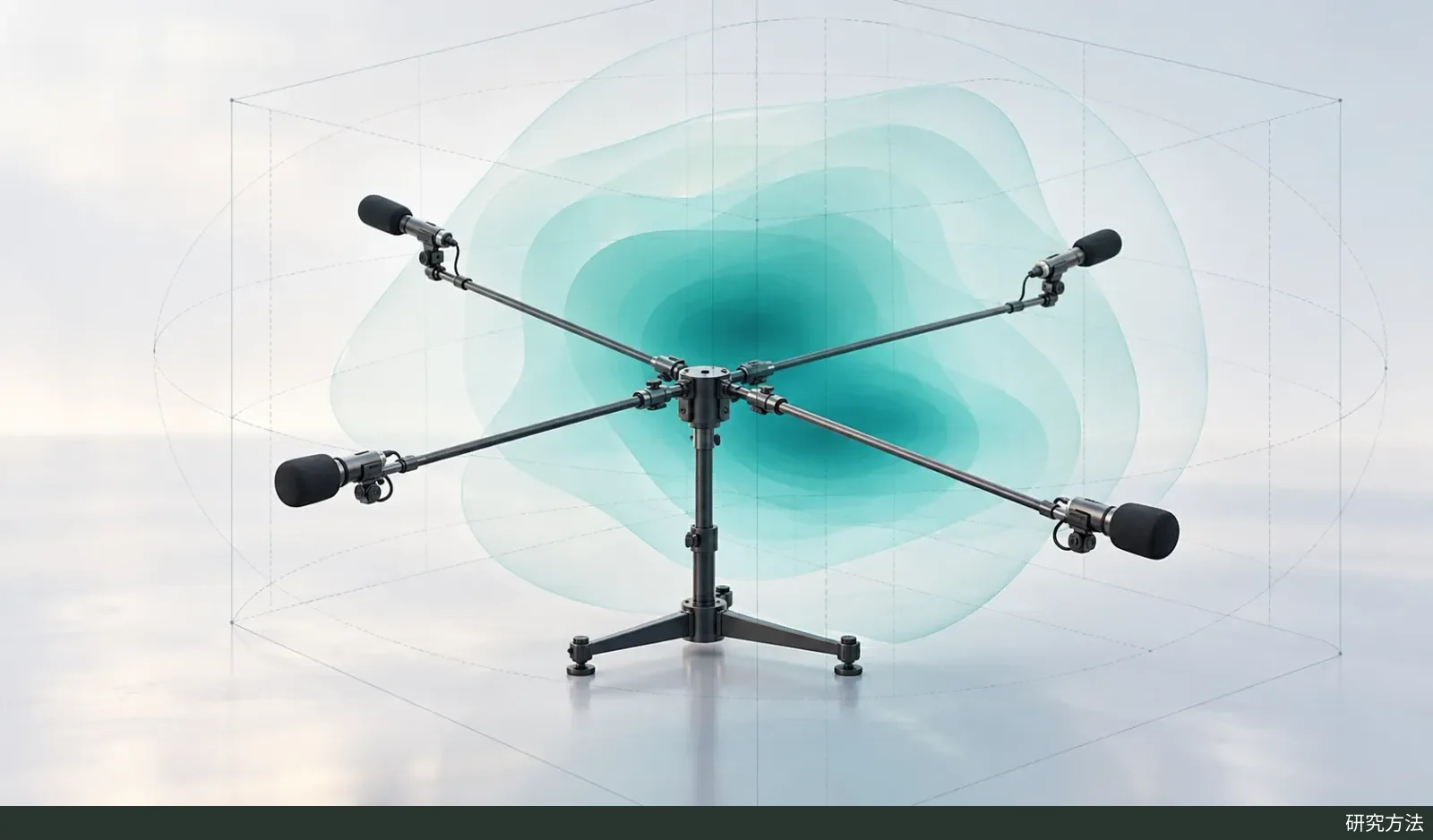
Spatial bioacoustics reconstructs source locations from time differences of arrival across microphones. Localization error for a given array is uneven in three-dimensional space, and animals do not avoid regions where localization is weak. Earlier Array WAH work can draw an accuracy map for a fixed layout; researchers still have to decide how to move microphones so that the space they care about meets the requirement.
In a paper published on 7 September 2026 in Methods in Ecology and Evolution, Umadi recasts the problem as a constrained search: first define the field of accuracy (FoA) of interest, a position-error threshold, and the array's physical limits, then treat each microphone's coordinates as adjustable variables. The main evaluation metric is volumetric pass rate—the share of test locations in the specified space whose localization error stays within the threshold.
Iterative search and comparative evidence
WAH-i repeatedly moves microphones, evaluates candidate layouts with a forward localization pipeline, and keeps moves that improve the objective; early search steps are larger and later ones grow finer. Search is constrained by array scale, minimum spacing, and three-dimensional structure. The paper's objective emphasizes pass rate while adding a weaker penalty on mean localization error, so it does not chase best accuracy at a single location alone.
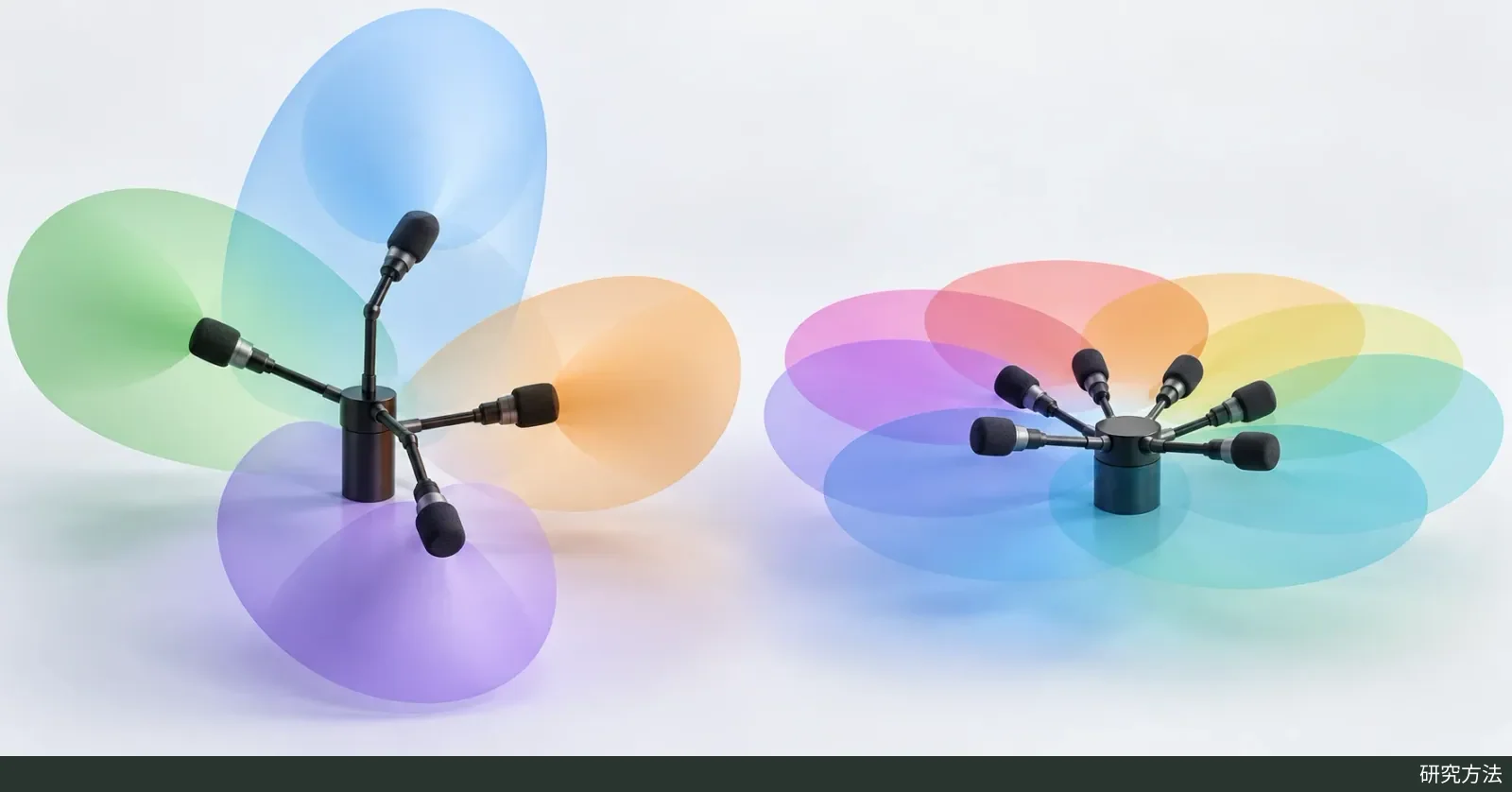
Using signal parameters that represent aerial predatory bat calls, the paper compares six typical polyhedral initial layouts with random initials and reruns the optimization. Median position error for four-microphone pyramid and tetrahedron layouts falls from 11.6 cm to 3.8 cm and from 13.0 cm to 4.2 cm, respectively. These are before-versus-after comparisons on the same test grid under the paper's stated conditions.
In fixed-aperture comparisons, adding microphones usually still raises pass rate, but with diminishing returns; a lower-order array after layout optimization can match or exceed a higher-order array with poor geometry. The author also summarizes this result in a Methods Blog post on 15 September. That changes the order of equipment trade-offs: first check whether array geometry can make good use of the target space, then judge whether extra channels are worth the added cost, synchronization, and power burden.
From optimization output to field setup
The author notes that WAH-i microphone coordinates can be turned into length and orientation commands for adjustable arms and combined with the four-channel BATSY4-PRO, forming a path from computed layout to field mounting. FoA and error thresholds must be set by the research question: if the flight region of interest or the required accuracy is wrong, the algorithm may efficiently optimize the wrong target.
These results do not mean four microphones are always enough. The paper notes that signal bandwidth, duration, directionality, and signal-to-noise ratio affect time-difference estimates and layout rankings; real deployments also face propagation, noise, source motion, and synchronization. Search yields a locally optimized plan under given conditions and does not establish a single best shape for every setting.
References
-
Umadi, R. (2026). WAH-i: Optimising microphone array geometry for customised localisation accuracy. Methods in Ecology and Evolution.
-
Umadi, R. (2026-09-15). The Baby and the Teddy Bear: The Flash of Insight Behind the WAH-i Algorithm. Methods Blog.
-
WAH-i-Optimiser. BiosoniX.
-
Research Methods · Rituals can be copied; understanding cannot be faked
-
Information compiled and published by the Scholay academic one-stop platform; please report infringement for takedown.
-
Also published on Enter Scholar, a scholars' community for the intelligent era