When the word "blue" is printed in red ink and a person is asked to say the ink colour, the answer is "red," yet the habit of reading "blue" interferes with the naming. In 1935, Stroop arranged this conflict in lists that could be timed, used colour patches and colour words as controls, and swapped the tasks of reading words and naming colours, turning interference into completion times that could be compared.
Stimuli and controls
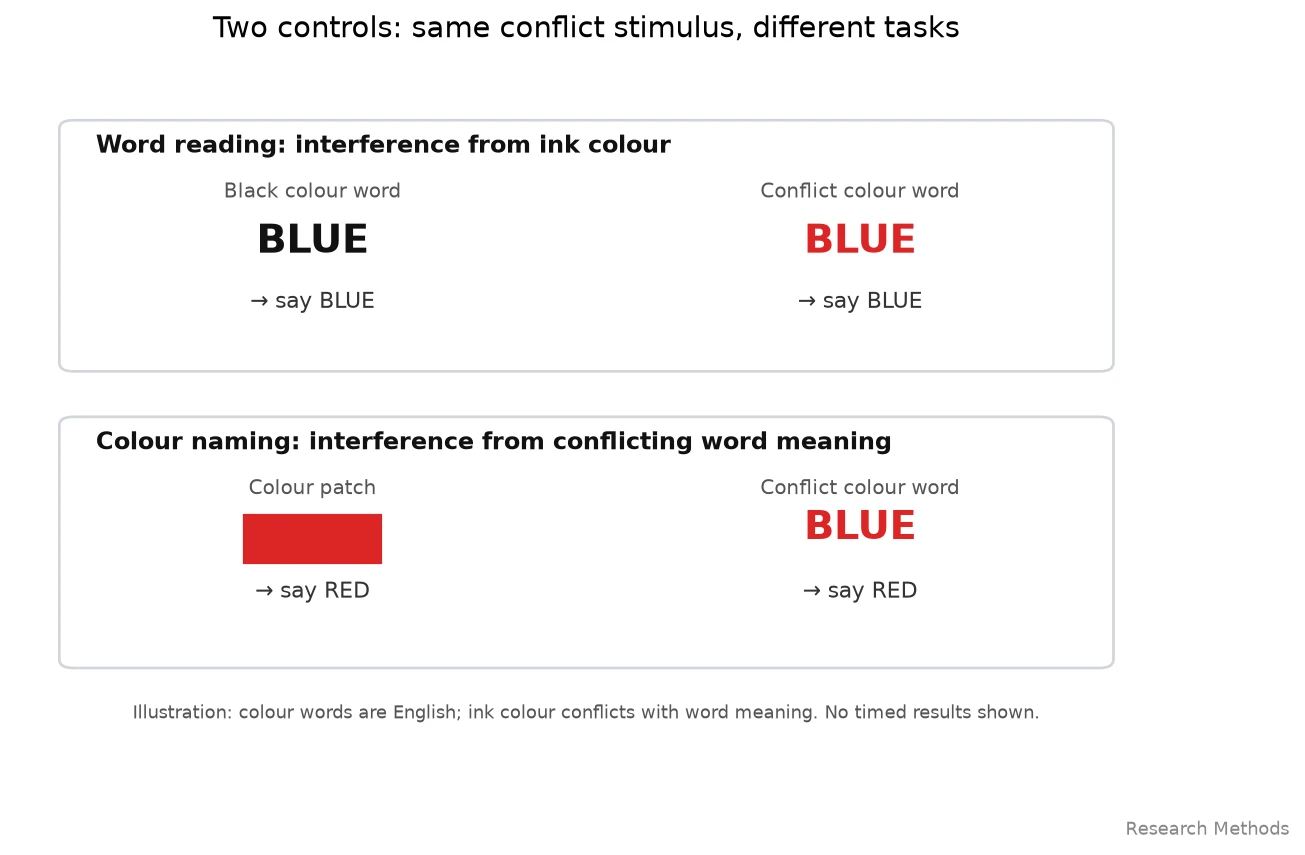
Stroop put word meaning and print colour on the same stimulus: the English colour words red, blue, green, brown, and purple were each printed in the other four colours, so that the meaning of the word and the colour of the ink never matched. For example, for the word red printed in blue ink, the response when reading the word is red, and the response when naming the ink colour is blue. The two rules face the same list yet require different answers.
The study set up two comparisons with controls: the word-reading experiment compared colour words printed in black with the same set of colour words printed in incongruent colours; the colour-naming experiment compared solid colour squares with the ink colours of incongruent colour words, the colours and arrangement of the squares being the same as in the word list. The former estimates the interference of colour with reading words, and the latter estimates the interference of conflicting word meaning with naming colours. The key comparison in the original paper is between incongruent words and wordless colour squares, not a direct comparison between congruent and incongruent words.
Lists, timing, and error correction
Each list had 100 items arranged in rows and columns. Participants first read ten sample items and then responded aloud in the usual reading order, with instructions to go as fast as possible and to correct their own errors; the researcher used a stopwatch to record the time for the whole list and checked for errors. The colour-naming experiment had 100 students, each of whom completed two lists of each of the two forms; half followed the order colour squares, conflicting words, conflicting words, colour squares, and the other half the reverse order, to balance the effects of practice and fatigue across conditions.
The main outcome measure is the completion time per 100 items, not item-by-item reaction time. Errors that were not self-corrected were also recorded, and for each uncorrected error the researcher made a time adjustment of twice the average time per item on that list. The comparison therefore depends on list length and on the error-correction rule; if the procedure is changed to item-by-item computer presentation or key-press responses, the resulting values cannot be treated directly as whole-list scores from the original experiment.
The asymmetry of interference
In the colour-naming experiment, the mean completion time for 100 colour squares was 63.3 seconds and that for the ink colours of incongruent colour words was 110.3 seconds, a difference of 47 seconds and an increase of about 74.3%. In the word-reading experiment, incongruent ink increased the mean time for 100 words by 2.3 seconds relative to black print, about 5.6%, a difference the original paper considered not reliable. The interference in the two tasks is thus clearly asymmetric in direction: the effect of conflicting word meaning on colour naming is far greater than the effect of conflicting colour on word reading.
One explanation is that skilled word reading has built up a stronger, more automatic response tendency, which competes with the current demand to name the colour. This explanation helps make sense of the asymmetry, but it is not the same as having directly measured activity in some brain region. The original study also included practice over several days: practice can change performance, and the gap produced by conflict is not fixed.
Generalization and limits of use
The participants were mainly students of the time, the materials were English colour words, and naming a whole list aloud is just one specific laboratory task; extending the findings to other languages, cultures, or everyday decisions requires new evidence. Practice and individual differences both affect performance, and a single time difference cannot be taken as a complete score of executive function, nor used on its own for clinical diagnosis of conditions such as ADHD. The emotional Stroop, the spatial Stroop, and the like are later variants and should not be conflated with the 1935 colour–word manipulation. In research applications, the task should be explained clearly to participants and individual results protected, and a single performance should not be turned into a label of ability or disease.
References
-
Stroop, J. R. (1935). Studies of interference in serial verbal reactions. Journal of Experimental Psychology, 18(6), 643–662.
-
Research Methods · Rituals can be imitated; understanding cannot be faked.
-
Compiled and published by the Scholay one-stop academic platform. If anything here infringes your rights, please report it and it will be taken down.
-
Also published on Enter Scholar, a community for scholars in the age of AI.