When several hospitals must roll out the same intervention in sequence, a lasting parallel control arm is often impossible: sites cannot stay untreated forever, and staffing may support only one go-live at a time. A stepped-wedge cluster randomised trial (SW-CRT) lets every cluster receive the intervention eventually, but crosses them over in a randomised order so that “not-yet-started sites” and “pre-crossover months within started sites” jointly supply control information.[1][3] The CONSORT stepped-wedge extension states that time is a potential confounder needing attention at both design and analysis, and that choosing the design requires justifying staggered exposure—not merely noting that rollout would be phased anyway.[3] Using Guo and colleagues’ (2022) protocol and (2026) results abstract for a four-site medical safety-huddle trial, this note shows where the controls come from, how time enters the plan, and what four clusters can support.[1][2]
Four clusters, randomised start order, and cluster-months
Inpatient oncology, surgery and rehabilitation programmes at four Toronto academic hospitals each form a cluster (sequence). The intervention is physician medical safety huddles: a standardised script, teleconference, and 5–20 minutes; sites may choose weekly or biweekly cadence, learner/manager involvement, and whether a medical leader or front-line physician chairs, while keeping those core elements.[1][2] Start order follows a computer-generated random sequence; after a shared 4-month control period, one site crosses every 2 months across 19 months, each remaining in intervention for at least 9 months.[2] The protocol counts 4×19 = 76 planned cluster-months—28 control and 48 intervention.[1] ClinicalTrials.gov lists NCT05365516 as a stepped-wedge cluster randomised study with outcome-assessor masking; the protocol text also cites NCT03062670, which does not match the results abstract or registry entry—this article follows the results and NCT05365516 and does not speculate why.[1][2][4] The protocol also states that Excel’s random-number generator produces the start order and that huddles are refined after each site starts based on participant feedback.[1]
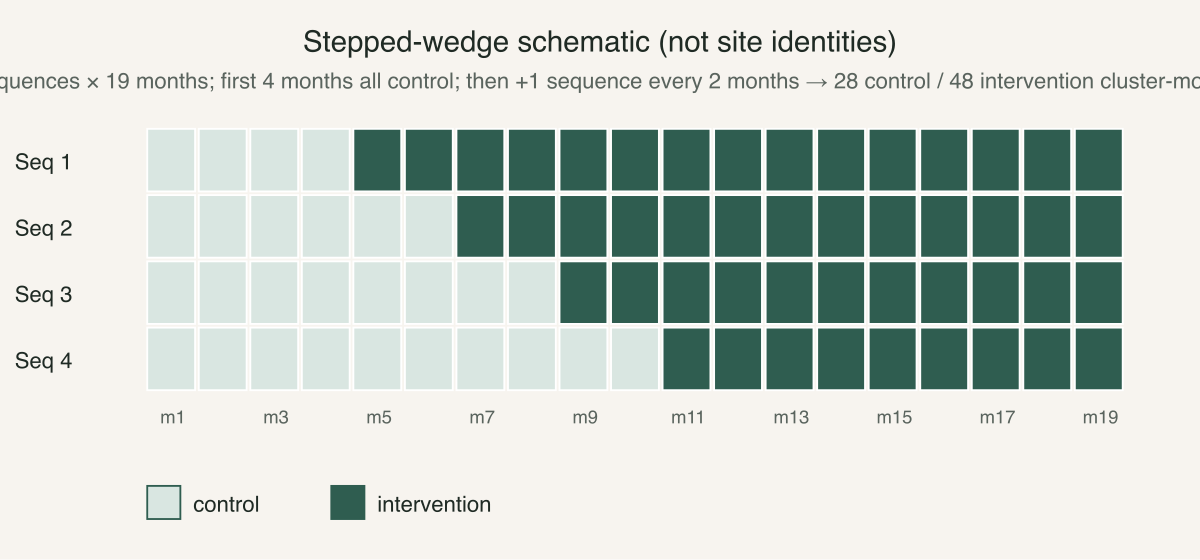
Figure: stepped-wedge schematic (not site identities). Four randomised sequences × 19 months; all control for 4 months, then one additional sequence every 2 months—matching the protocol’s 28 control and 48 intervention cluster-months.[1][2]
Where controls arise, and why time confounds
Within a calendar month, sites already crossed and sites still in control form contemporaneous comparisons; within a site, pre- and post-crossover months form before–after comparisons. Exposure therefore tracks calendar time: later months have more sites in intervention.[1][3] The CONSORT extension requires analyses and sample-size plans to address that confounding.[3] The protocol plans a Poisson generalized linear mixed model for the overall intervention effect, AIC comparison of models with versus without calendar-month random intercepts (preferring a drop of 2 or more AIC points), and Box–Ljung checks of residual autocorrelation per site, with an AR structure if any site yields p<0.05—The protocol also plans statistical process control charts comparing adverse-event frequency before and after crossover at each programme; these remain analysis plans in the protocol.[1] The primary outcome is adverse events per 1000 patient-days from blinded physician chart review of 12 randomly sampled charts per site-month (912 total), after a 30–40 chart training/reliability phase.[1][2] Process measures track attendance, issues raised, and actions per huddle.[1] Reading “not-yet-started sites” as a permanent parallel control misleads: late in the wedge, control cluster-months thin, and more information comes from within-site before–after contrasts plus short overlaps with remaining controls.[1][3]
What power planning and the abstract support
Sample size used Monte Carlo simulation (R 4.2.1, lme4::glmer): the protocol borrowed prior figures of about 93.6 AEs/1000 patient-days pre-intervention and a 26.7% post-intervention reduction, and under data-generating processes with and without site heterogeneity set 12 charts per month to yield at least about 90% power.[1] The results abstract reports a 12% lower adjusted adverse-event rate after crossover (RR 0.88, 95% CI 0.80–0.98; p=0.016) and about 17% lower odds of an adverse event (OR 0.83, 95% CI 0.80–0.87) and mean attendance by site from 30% to 85%, with mean issues and actions per huddle about 1.6–3.1; the abstract also reports physician patient-safety culture via the AHRQ Hospital Survey on Patient Safety.[2] With only four clusters and local adaptation of cadence and chairing, the “still-control” contemporaneous arm thins late in the wedge, and site heterogeneity versus time trends are hard to separate; the abstract’s overall rate ratio and process ranges are not proof of homogeneous site effects.[1][2]
When rollout must be staggered, a stepped wedge uses randomised start order so not-yet-started sites and pre-start months jointly supply controls; reading results means holding contemporaneous and before–after contrasts together while treating time as a confounder. The four-site huddle example shows a design that can document 28/48 cluster-months and blinded chart audits, and pin monthly sampling via simulation—while interpretation remains limited by few clusters and local adaptation. Justifying the design per the CONSORT extension and writing how calendar time will be handled is closer to that guidance than saying only that everyone will eventually implement.[1][2][3] Calling staggered rollout a stepped wedge still requires saying which cluster-months supply controls and how calendar time enters the model; the four-cluster example puts those questions on the table rather than hiding control structure behind eventual full implementation.[1][3]
References
-
Guo et al. (2022). Protocol… Contemporary Clinical Trials Communications. https://doi.org/10.1016/j.conctc.2022.100996
-
Guo et al. (2026). Impact of medical safety huddles… BMJ Quality & Safety (abstract). https://doi.org/10.1136/bmjqs-2025-019170
-
Hemming et al. (2018). CONSORT extension for stepped-wedge cluster randomised trials. https://doi.org/10.1136/bmj.k1614
-
ClinicalTrials.gov. NCT05365516. https://clinicaltrials.gov/study/NCT05365516