A patient has already been followed for several years without an event, and the clinician now wants to predict when an event might occur. The population faced by that prediction is no longer everyone who entered the study: some people have already had events, and those who remain have accumulated follow-up information such as test results and treatments. Building an interval from enrollment-time covariates alone and calibrating it on the whole baseline cohort may not answer the question that matters now. Wang and coauthors propose History-Aware Prediction Sets (HAPS) in a 2026 preprint, bringing the survivors at the prediction time and their observed history into both prediction and calibration.[1]
First change whose coverage is being described
Let T be the event time from a time origin, τ a prechosen decision time, and Hτ the covariate history observed up to τ. HAPS returns an interval C(Hτ) for a new person who has lived past τ, with the target P{T ∈ C(Hτ)|T > τ} ≥ 1−α. Coverage is averaged over the population that survives to τ: if the target is 90%, one wants at least about nine in ten of such people to have their true event times fall inside their own intervals.[1]
The interval may change with history, but this target does not guarantee 90% coverage for every specific medical history; nor is it a posterior probability that a given patient experiences the event inside the interval. When updating a prediction one may use only history already available at that moment; covariates that appear only after τ must not enter that patient's prediction. Changing the decision time changes both who survives and what history is available, so the prediction problem updates with it.[1]
Interrupted follow-up means calibration cannot count only complete cases
Event-time studies usually have right censoring: some people still have no event at the last observation time, so their true event time is known only to be later than that endpoint. Write C for the censoring time; what is observed is X=min(T,C), and Δ indicates whether the event was seen first. If follow-up interruption is tied to changing health, people whose events are eventually observed need not represent all survivors at τ; simply computing their interval-coverage rate introduces selection bias.[1]
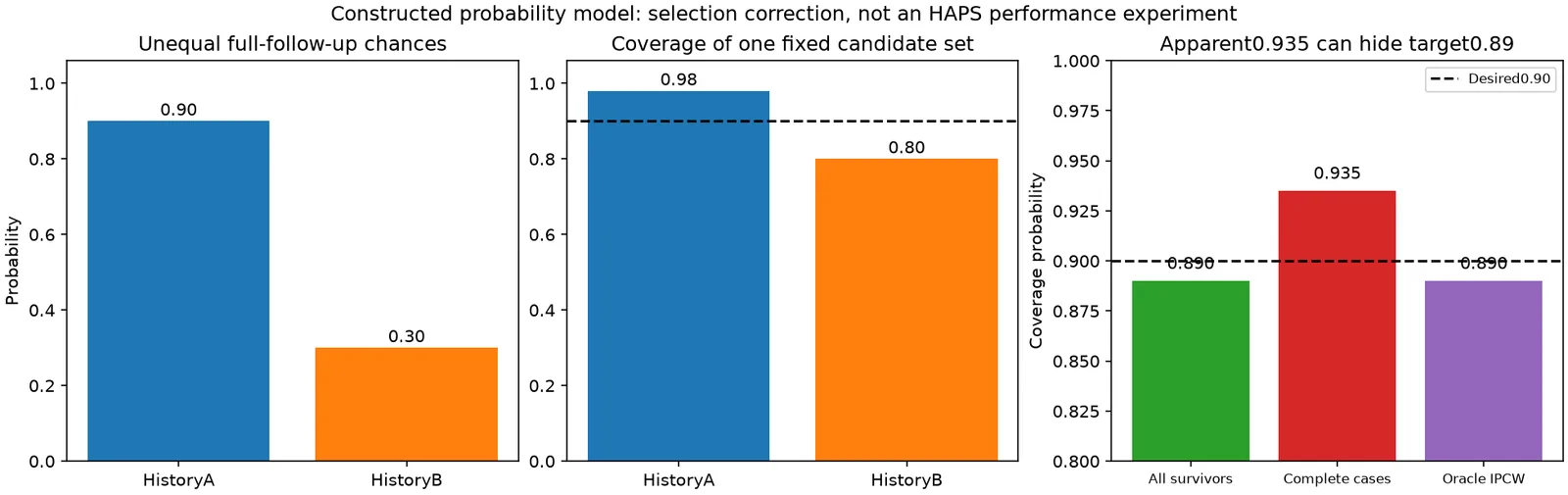
A constructed probability example with two survivor histories: unequal chances of complete follow-up can push complete-case apparent coverage to 0.935 while the overall survivor coverage is 0.89; inverse weights based on the known probabilities recover 0.89.
In this example the two history types each make up half the survivors at τ, with complete-follow-up probabilities 0.9 and 0.3 and fixed-candidate coverage rates 0.98 and 0.80. Complete cases over-represent the first type, so apparent coverage reaches 0.935; weighting by the reciprocal of each type's complete-follow-up probability yields 0.89, matching the constructed survivor-average coverage. If the target is 0.90, looking only at complete cases would wrongly suggest the target has already been met.
Build candidate intervals from history, then calibrate with a weighted equation
HAPS first estimates the event-time distribution given history Hτ and T>τ, and uses its conditional quantiles to form a nested family of candidate intervals. For example, take the estimated 1−θ and θ quantiles as the upper and lower endpoints; as θ grows from 0.5 toward 1, the candidates widen. History shapes where the interval sits and how wide it is; calibration then chooses a size from that family.[1]
Without censoring, calibration would seek the smallest θ that makes average survivor coverage reach 1−α. HAPS rewrites that condition as a weighted inequality estimable from the observed data. Let G(t|H_t) be the probability of remaining uncensored given history up to t; each calibration sample receives weight Δ·1{X>τ}/G(X|H_X). The weighted contribution is that weight times [1{X falls in the candidate interval}−(1−α)]; summing across people, one chooses the smallest θ that makes the result nonnegative.[1]
The numerator keeps only people whose events are observed after τ; the denominator uses history up to their observed event time X, not a common baseline or history only up to τ. Intuitively, records that were harder to keep uncensored yet were still fully observed stand in for more similar records. The history used to estimate the censoring process for calibration samples may extend to their X; the prediction interval given to a new person still uses only that person's history up to τ.[1]
The paper's split algorithm randomly divides i.i.d. samples into a training set and a calibration set. On the training set one fits the event-time prediction model and the censoring model G and forms nested candidates; on the calibration set one computes the weighted sum above and searches for the first θ that reaches nonnegative; finally the chosen rule is applied to a new survivor's Hτ. The event prediction model helps form informative candidates; coverage calibration is completed by the weighted equation.[1]
What the guarantees depend on
This correction requires that, given the observed time-varying history, censoring risk does not further depend on future covariates or the event time; that survival to τ is possible; and that the probability of observing an event under each relevant history has a positive lower bound. If unmeasured factors jointly affect censoring and the event, those conditions do not become true merely because weighting is used. Sparse follow-up or very small G also produces large weights that amplify estimation error and can destabilize calibration.[1]
The paper calls the basic HAPS guarantee PAAC—probably asymptotically approximately correct. The coverage lower bound in its Theorem 3.2 includes an estimation-error term for the censoring model G and a term that shrinks like the reciprocal square root of the calibration sample size; under the corresponding conditions those bias terms approach zero only as G is estimated consistently and the sample grows. A nominal 90% therefore does not mean exact 90% coverage unconditionally in every finite sample.[1]
Two doubly robust extensions
HAPS-DR uses a post-processing step: take the union of the basic HAPS set with another predictive conditional-quantile interval. Under the paper's conditions, asymptotic coverage is obtained if either the censoring model or the corresponding conditional-quantile estimator is consistent. The union helps robustness but can also make intervals wider and coverage more conservative; there is no guarantee when both models are wrong.[1]
HAPS-A takes another route: it rewrites the calibration equation with augmented inverse probability of censoring weighting (AIPCW), estimating additional conditional expectations to reduce reliance on the censoring model alone being correct. It is not merely a rename of HAPS-DR; the extra estimation steps also bring computational and small-sample stability costs. The double robustness of both extensions is for the model combinations and asymptotic conditions stated in the paper; neither turns average survivor coverage into a per-person coverage guarantee.[1]
How large are the gains in the paper?
On two public data sets—colon cancer and primary biliary cholangitis (PBC)—the authors construct intervals with an 80% target coverage, evaluate them over 200 random splits, and estimate coverage with IPCW. The main text and Figure 3 report that, for predictions at year 5, median HAPS interval length relative to the compared baseline methods falls by 9%–22% on PBC and by 13%–60% on colon cancer. Those figures belong to the paper's data, prediction times, and comparators; they cannot be generalized to the same shortening for every disease.[1]
The novelty of HAPS is linking two changes: the predictive distribution updates with history up to the decision time, and coverage calibration also turns toward the survivors at that time, handling incomplete observation through censoring weights that respect time-varying history. Whether it fits a given study hinges on whether that study can record history relevant to censoring, retain enough later events, and reliably estimate the needed censoring probabilities.[1]
References
- [1] Wang Y, Levis A W, Yang S, Han L. History-Aware Conformal Prediction Sets for Censored Time-to-Event Outcomes. arXiv:2605.06581v1, 2026-05-07.