How can a sheet of transparent glass turn depth perception into a choice that can be observed? In 1960, Gibson and Walk built the visual cliff out of checkerboard patterns and glass: both sides are supported, yet one side looks like a chasm. The researchers observed how infants and young animals chose their path, in order to separate a visual drop from the real danger of falling.
The apparatus and the design question
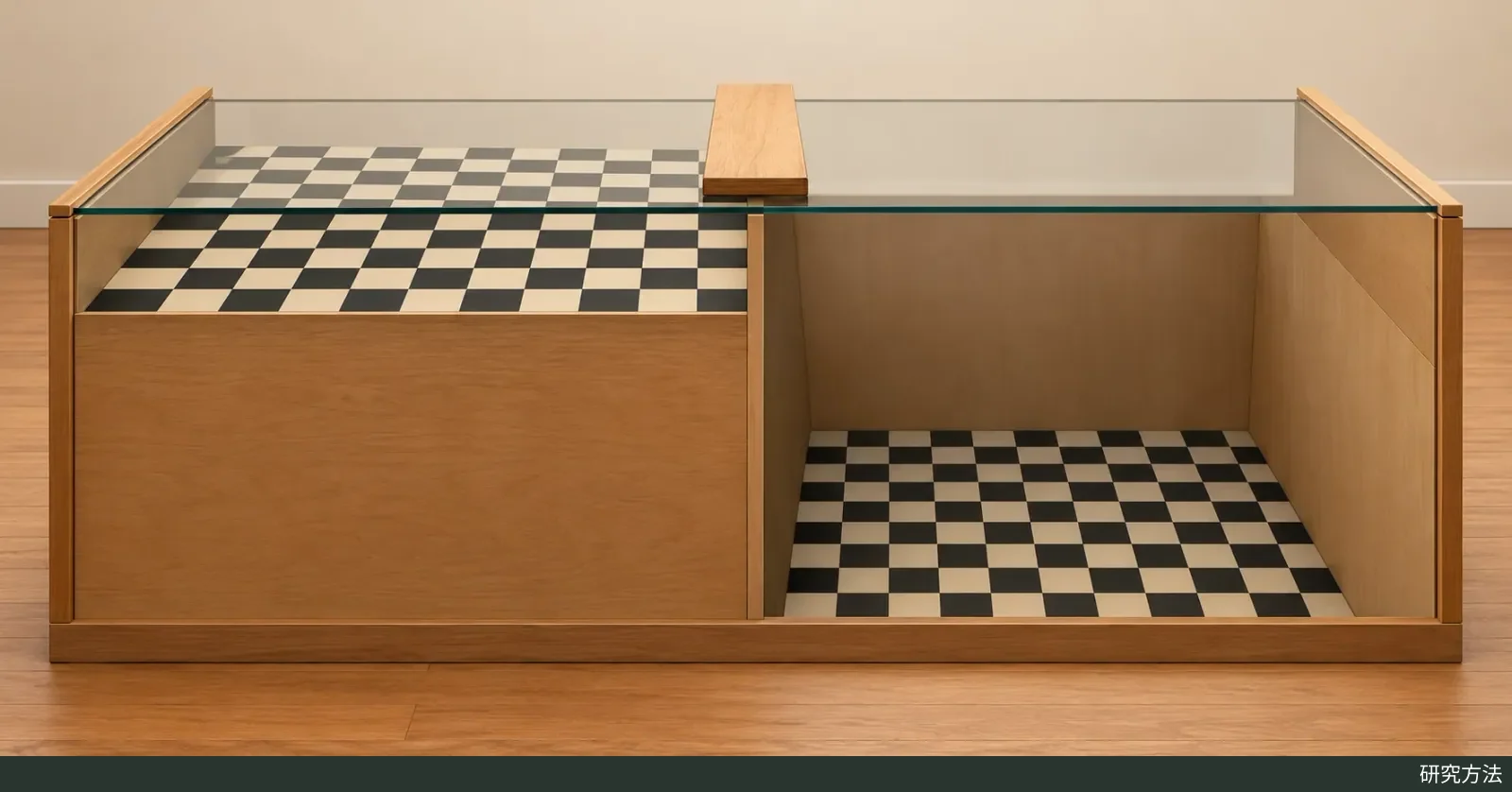
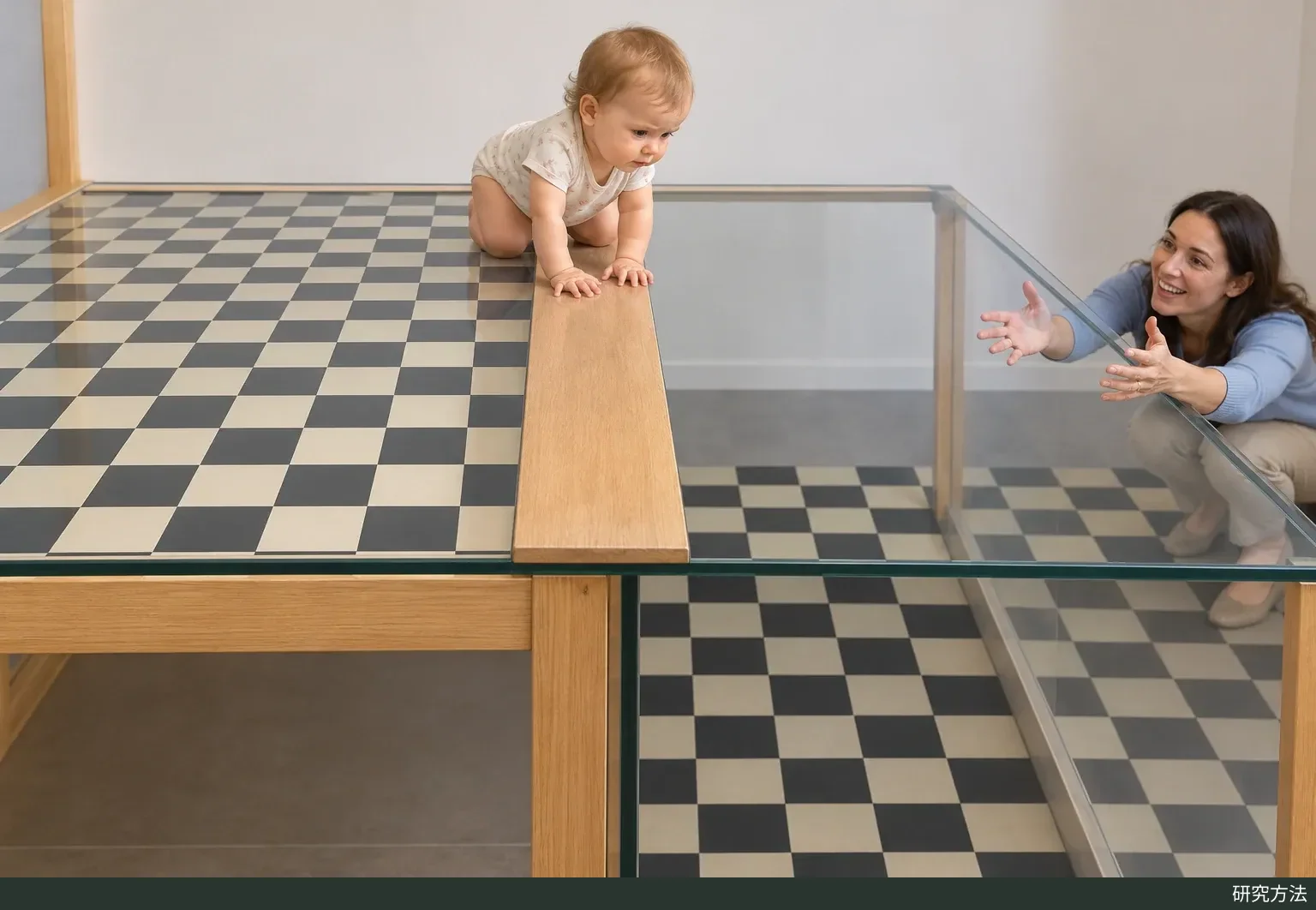
The researchers wanted to know whether subjects who cannot yet report in words are able to use visual cues to tell deep from shallow. At the centre of the apparatus is a starting board, laid across sturdy glass raised at least about a foot above the floor. On the shallow side the checkerboard pattern lies directly beneath the glass; on the deep side the same pattern is placed on the floor below. The infant sees an obvious drop, yet what its hands and knees touch is glass on both sides. In this way the apparatus keeps the difference in visual depth while providing continuous support, and avoids making a real fall one of the test conditions.
Procedure and observations
The authors placed 36 infants aged six to fourteen months on the centre board, had the mother call from the deep side and then from the shallow side, and observed whether the infant left the centre board and in which direction it moved. Of the 36, 27 left the centre board at some point; all of these 27 crawled toward the shallow side at least once, and only 3 crawled onto the glass of the deep side. Some infants looked down on the deep side and then backed away, and some patted the glass and still refused to cross; some children also cried because the mother was standing on the deep side. What the original article reports are choices and observations; it does not give statistical results from which crawling speeds could be compared.
The animal series provided comparisons across different developmental experience. The original article states that chicks less than 24 hours after hatching hopped toward the shallow side in the test, and that one-day-old kids and lambs also did not step onto the glass of the deep side. Species differ in maturity and in how they move; the comparison shows that some animals can use depth cues very early, but it does not directly imply that avoidance in human infants is entirely independent of experience.
Manipulations and mechanisms
Three knobs in the design are worth noting. First, the glass gives tactile support on both sides, separating the visual drop from a real absence of support. Second, the mother's position supplies a social incentive to approach: calling from the deep side lets the researchers observe whether this incentive is enough to prompt the infant to cross. Third, the cross-species comparison lets the researchers examine young animals that differ in locomotor ability and experience. The researchers also varied the size and spacing of the checkerboard texture to examine texture density and motion parallax separately; they found that rats and chicks still preferred the shallow side under conditions in which only motion parallax was retained. Behavioural choices can show that a cue is usable for telling deep from shallow, but they are not a complete map of the mechanism giving the weight of each cue.
Generalization and ethics
The visual cliff is a controlled laboratory situation and cannot be equated directly with real heights in the home; the mother's calling also changes the infant's motivation to move. The sample was limited, and the 1960 account cannot stand in for today's requirements for statistical precision and replicability. Later research has shown that locomotor experience affects how infants behave at the edge of a drop, so this experiment cannot be summed up as a settled conclusion that "babies are born afraid of heights." The glass reduced the danger of falling, but infants could still be frightened; contemporary research must also attend to informed consent from guardians, minimal risk, and stopping promptly.
References
-
Gibson, E. J., & Walk, R. D. (1960). The “visual cliff”. Scientific American, 202(4), 64–71.
-
Adolph, K. E., & Kretch, K. S. (2015). Fear of heights in infants?. Current Directions in Psychological Science, 24(1), 60–66.
-
Research Methods · Rituals can be imitated; understanding cannot be faked.
-
Compiled and published by the Scholay one-stop academic platform. If anything here infringes your rights, please report it and it will be taken down.
-
Also published on Enter Scholar, a community for scholars in the age of AI.