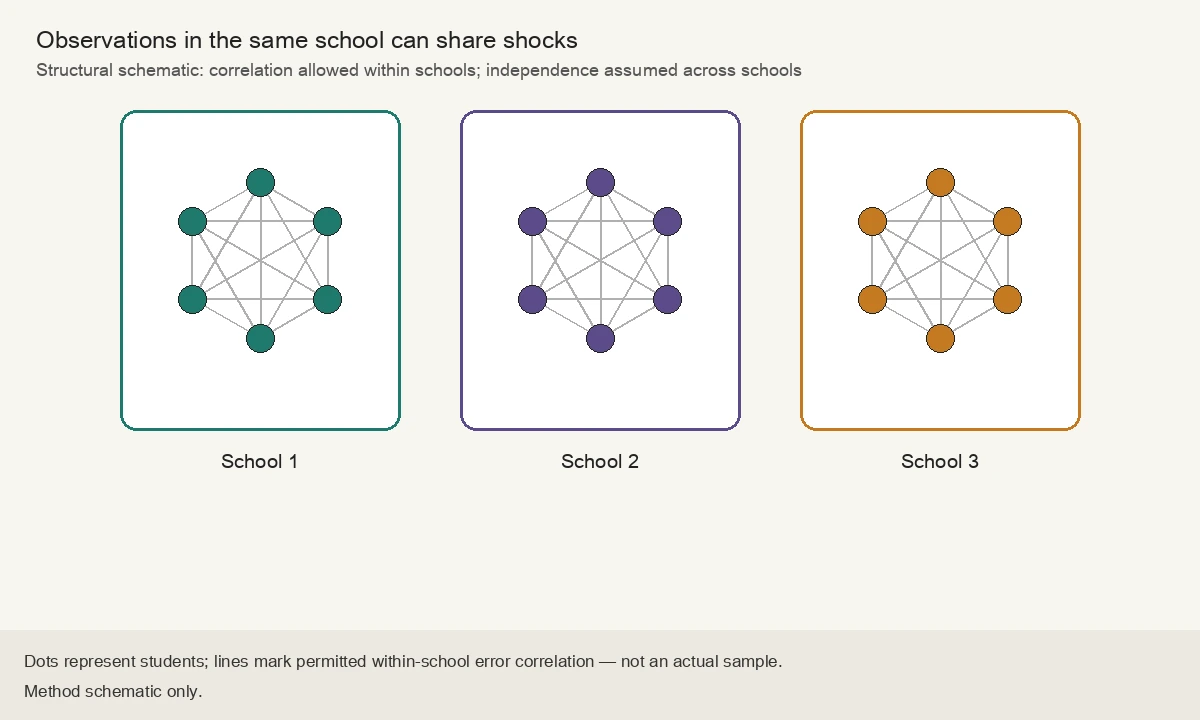
Observations on students in the same school, or on the same state across years, may be hit by common shocks and cannot all be treated as independent pieces of information. Cluster-robust standard errors re-estimate the uncertainty of regression coefficients while allowing errors to be correlated within groups. They usually leave the OLS coefficients of a given model unchanged, yet they can change confidence intervals and judgements of significance; reliable use also depends on the level of clustering, independence between groups and the number of clusters.
Within-group correlation and precision
Cluster-robust standard errors are used for regression inference that allows errors to be correlated within the same cluster. Students may share school-level shocks, and different years in the same state may share persistent shocks; treating all these observations as independent information can understate standard errors and make confidence intervals too narrow.
Cluster-robust versus heteroskedasticity-robust
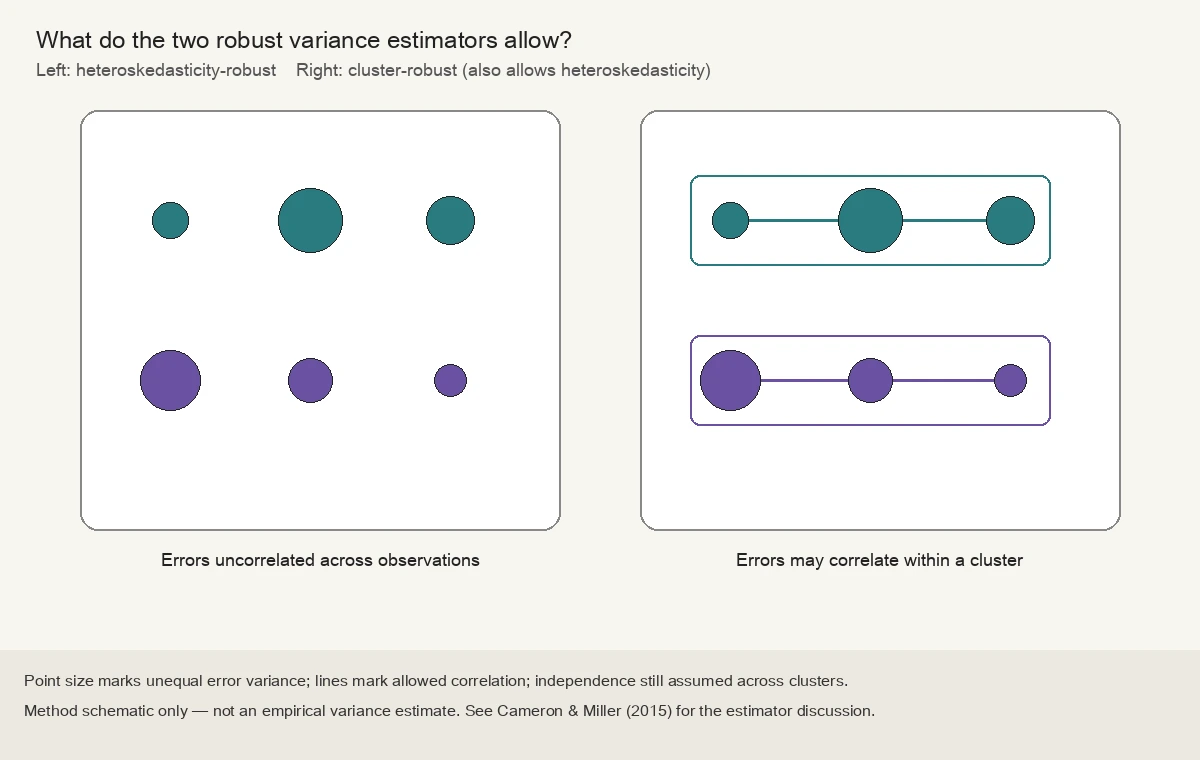
Huber–White heteroskedasticity-robust standard errors allow the error variance to differ across observations but usually still require errors to be uncorrelated across observations. The cluster-robust variance keeps the covariance contributions between observations in the same cluster and then sums across clusters; it allows heteroskedasticity at the same time and does not require the form of the within-cluster correlation to be specified. It adjusts the uncertainty without changing the OLS coefficients for the same sample and the same model; nor are the standard errors guaranteed to increase.
Level of clustering and conditions for use
The basic framework requires independence between clusters and relies on a large-sample approximation in which the number of clusters grows. A large total number of observations is no substitute for having enough independent clusters. In a state–year panel for a state policy, if errors within the same state are correlated across years, clustering should be by state rather than slicing by state × year; fixed effects do not automatically remove this correlation either.
A teaching example and common misuses
A teaching scenario: the coefficient in a school-policy regression is 2 points, the conventional standard error is 0.8, and after clustering by school it is 1.2. Only the variance estimate has been swapped, so the coefficient is still 2. Using the large-sample normal approximation for illustration, the 95% interval changes from about [0.43, 3.57] to [−0.35, 4.35]; the latter includes zero, which does not mean the policy is ineffective. The numbers are made up, and no data analysis was run. Common misuses are choosing the wrong level of clustering, carrying on with the usual z test despite having few clusters, and treating robust standard errors as a fix for endogeneity. Few clusters can lead to over-rejection, and there is no universally safe threshold; reports need to state the clustering variable, the number of clusters and the inference method.
References
-
Cameron, A. C., & Miller, D. L. (2015). A Practitioner’s Guide to Cluster-Robust Inference. Journal of Human Resources, 50(2), 317–372. DOI; full text on the author's website.
-
Research Methods · Rituals can be imitated; understanding cannot be faked
-
Information compiled and published by the Scholay academic one-stop platform; report infringement for takedown.
-
Also published on Enter Scholar, a scholars’ community for the intelligent age