A crossover lets the same students meet both teaching modes in turn, gaining precision from within-person comparison—not assuming a parallel randomised trial is inevitably drowned by individual differences.[1] Kestin et al. (2025) ran a two-week crossover in Harvard’s life-sciences introductory physics course PS2: order randomised, topics fixed—surface tension in week 9, fluids in week 10—so each student rotated through an AI tutor and in-class active learning.[1] Below: design, measures, and reading of results—what the crossover controls, how topic–week–instructor binding works, and how treatment effects should be reported.
Two weeks, two topics: everyone rotates conditions
In fall 2023, 233 students enrolled in PS2; 194 entered the analysis (consent, both conditions, complete pre/post tests). Students were randomised to two groups, keeping regular peer-instruction partners together so intact active-learning groups were not split.[1] In week 9 one group used the AI tutor at home while the other had in-class active learning; week 10 swapped—so every week and every topic had both an AI arm and a classroom arm at once.[1] Handouts and exercises matched; introduction format is one difference (live explanation in class versus a pre-recorded video for the AI arm), and the core also includes AI individual feedback versus classroom peer discussion plus instructor interaction; the two lessons were taught by the two co-instructors.[1] Randomisation governs condition order, not “what is taught this week”: surface tension and fluids are nailed to the calendar. Switching topics does not prove that learning-strategy or expectancy carryover is absent; CONSORT’s crossover washout aims to reduce period-1 effects entering period 2. This trial omitted a drug-style washout, so sequence and carryover still need appropriate analysis and reporting by sequence and period—not a claim that changing topics causally eliminated carryover.[2] The groups were comparable on demographics and prior physics measures; the in-class arm kept the usual student–staff ratio and peer-instruction groups.[1]
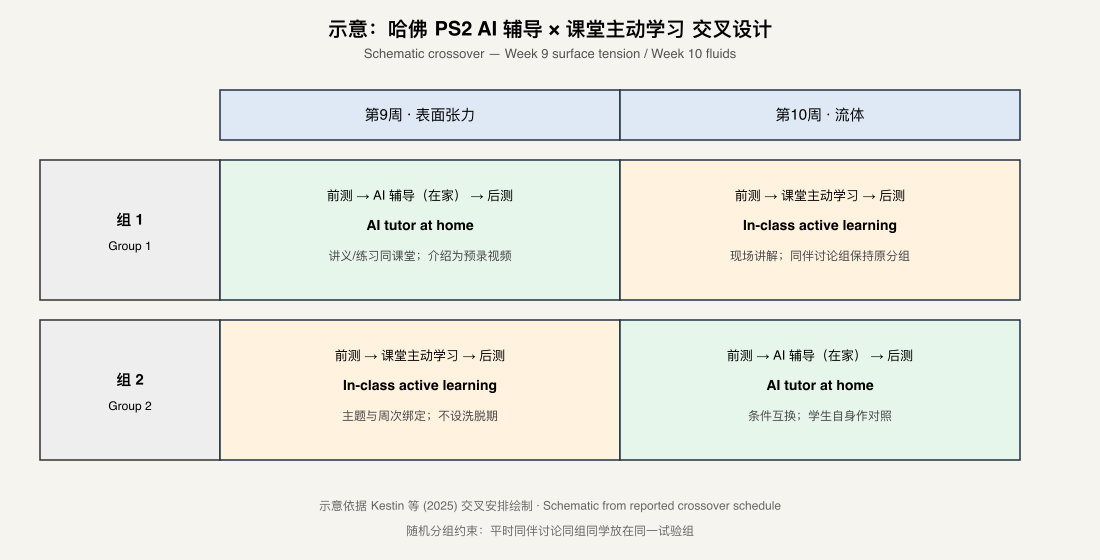
Figure: Schematic two-group crossover swapping AI tutoring and in-class active learning across week-9 surface tension and week-10 fluids. Drawn for this article, Kestin et al. 2025[1]
Pre/post tests, perception items, and controls
Each lesson had a pre-test and post-test (forms A/B written by staff uninvolved in the course or AI design) plus four perception items (engagement, enjoyment, motivation, growth mindset). The AI platform logged time-on-task; class time counted about 60 of 75 minutes as learning. Both conditions awarded participation credit only; quiz scores did not enter the course grade.[1] Regressions controlled pretest, midterm, FCI, ChatGPT experience, topic, test form, and time, clustering on student (with a robustness check clustering on discussion groups). Sequence was not entered as a covariate.[1] Topic is bound to week, and instructors to topic, so topic, week, and instructor effects cannot be separately identified—but because both teaching modes appear in every week, AI versus class can still be compared within the same week. Sequence effects, carryover, and treatment heterogeneity still need appropriate modelling and reporting by sequence and period; the treatment contrast is not “fully confounded” with the calendar.[1][2] The AI system used a prompt for active engagement, cognitive load, and growth mindset, and a step-unlock interface for multi-part problems—the contrast is a designed tutor versus in-class active learning, not unfettered chat versus lecture.[1]
Reading immediate gains and stated limits
Pooling weeks, the AI arm’s median post-score was 4.5 versus 3.5 for in-class active learning; relative to a combined pretest median of 2.75, the authors report more than double the median learning gain on the AI side, with a significant Mann–Whitney test.[1] After covariates, a linear regression effect is about 0.63 SD; because of post-test ceiling, quantile regression yields about 0.73–1.3 SD. Time-on-task was uncorrelated with post-score; about 70% of AI users spent under 60 minutes.[1] On perception items, the AI group scored higher on engagement and motivation on average; enjoyment and growth mindset did not differ significantly.[1]
Stated limits include two introductory lessons only, immediate mastery only, tutoring that depends on pre-written solution steps, some authors’ role in developing the comparison pedagogy, a single-institution sample, and ceiling effects.[1] CONSORT’s crossover extension asks for counts and results by sequence and period, and for carryover/period assumptions—this trial omitted washout; switching topics does not by itself cancel sequence or carryover concerns, and reporting still needs to show who received which condition in which week.[2] Reporting only a pooled main effect without sequence–period headcounts leaves readers unable to verify that week-2 class students are the swapped week-1 AI students.[2]
The crossover’s strength is within-person precision: every student meets both modes.[1] Binding topic, week, and instructor blocks separately estimating those factors’ main effects—not the same-week AI-versus-class contrast. Sequence, carryover, and between-sequence heterogeneity still need analysis and reporting by sequence and period.[1][2] Align units first—median posts, regression SDs, perception means—then ask what the design can identify. A topic-switch crossover can omit a drug-style washout; that must not be read as proof that carryover was ruled out.
References
-
Kestin, G., et al. (2025). AI tutoring outperforms in-class active learning. Scientific Reports. https://doi.org/10.1038/s41598-025-97652-6
-
Dwan, K., et al. (2019). CONSORT extension for reporting randomised crossover trials. BMJ, 366, l4378. https://doi.org/10.1136/bmj.l4378