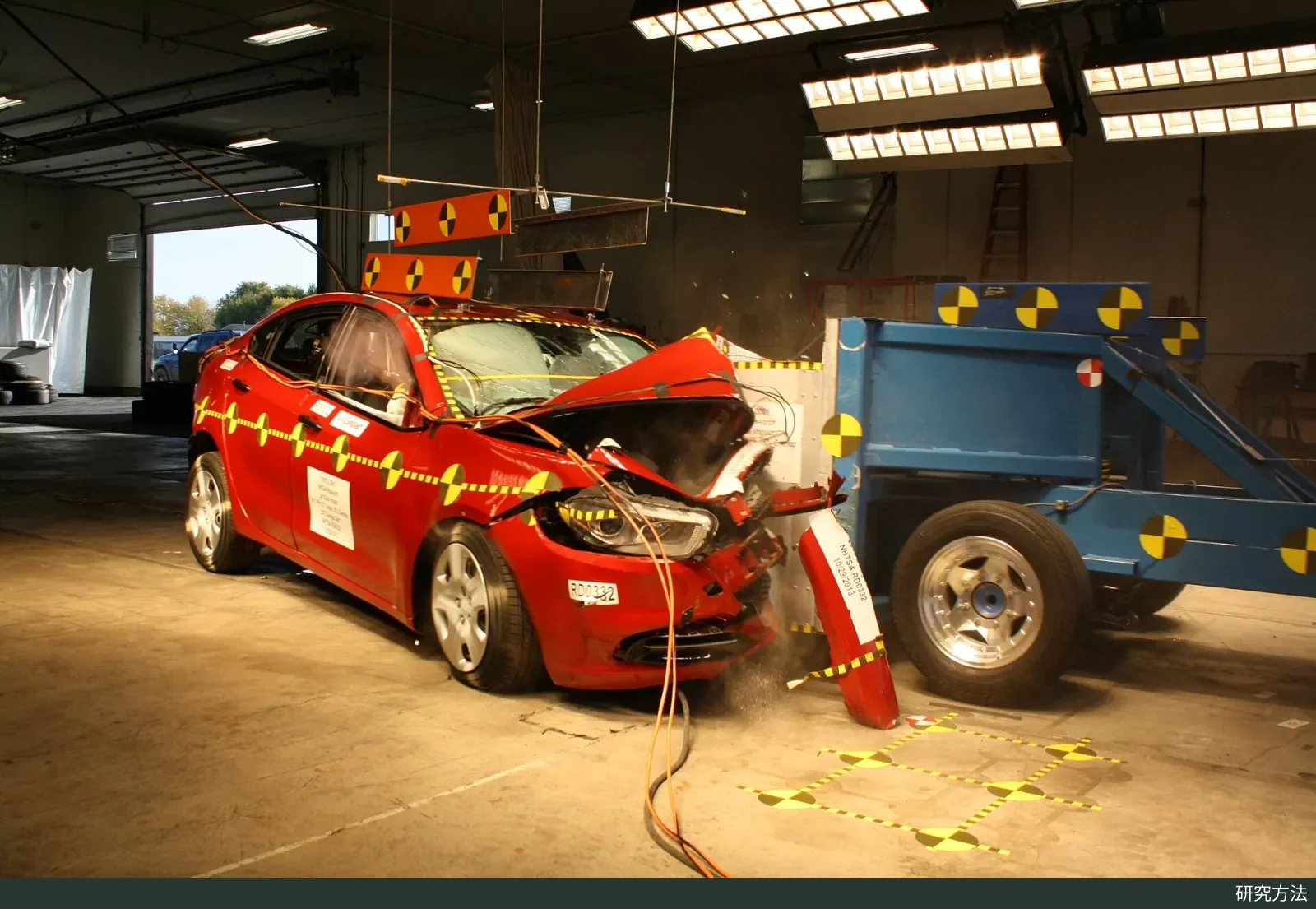
Oblique frontal crash test of a Dodge Dart commissioned by the U.S. National Highway Traffic Safety Administration (NHTSA) from Calspan Corporation, photographed at the 2013 impact moment. Four of the seven films in Loftus and Palmer's Experiment 1 were likewise real crashes with known impact speeds. Image: Calspan Corporation / NHTSA, via Wikimedia Commons, public domain.

In 1974, Elizabeth Loftus and John Palmer had students watch car-crash films, then changed only one verb on the questionnaire: how fast were the cars going when they "smashed" or "hit" each other. In Experiment 1, the contacted group estimated 31.8 mph on average and the smashed group 40.8; a week later in Experiment 2, when asked about broken glass that was not in the film, 16 of 50 in the smashed group said they had seen it, versus 7 in the hit group and 6 in a control group not asked about speed. The design's key move was to make post-event question wording an independent variable.
Design problem: one verb after viewing
In the discussion, Loftus and Palmer grant that "how a question is asked affects the answer" was already well known. They push one step further: after an event is over and witnesses have formed their own impressions, can a single word in a question change not only that item's answer but later reports of other details? To put the question into an experiment, three conditions must hold at once: every participant sees the same visual event; the manipulation occurs only in questionnaire wording after viewing; and at least one outcome is not the answer to the manipulated item itself.
Speed was chosen as the first dependent measure because people are poor at estimating it. Four of Experiment 1's seven films were traffic-safety education crashes with known impact speeds: one at 20 mph, one at 30 mph, and two at 40 mph. Mean estimates for those four were 37.7, 36.2, 39.7, and 36.1 mph—true speed barely separated the estimates. The authors wrote that true speed explained little of the variance in reports, while question wording explained a substantial share. A quantity whose judgment base is already thin is well suited to testing where external language can push it.
The structure differs from social-influence experiments in the Asch or Sherif tradition: there is no group present, no confederates, and no pressure during viewing. Participants fill out questionnaires alone; the only influence source is the verb describing the collision. The manipulation comes after the event—post-event information—not as a condition of witnessing.
After Experiment 1, the authors offered two interpretations. One is response bias: unsure whether to say 30 or 40 mph, the participant is nudged toward a higher number by smashed, without a change in memory. The other is a change in representation: smashed makes the accident the participant "sees" more severe than it was. Speed numbers alone cannot separate the two, because both predict higher reports in the smashed group. Experiment 2 therefore adds a question off the speed scale: if the remembered accident truly became more severe, participants should more readily "remember" details that fit a severe crash but never appeared in the film.
Procedures for the two experiments
Experiment 1 had 45 students, run in unequal-sized groups. Each group watched seven traffic-accident films lent by the Seattle Police Department and the Evergreen Safety Council for driver education, each 5 to 30 seconds long, with film order varying across groups. After each film, participants first "described the accident you just saw," then answered specific questions, the critical one being: "About how fast were the cars going when they hit each other?" The verb was a between-subjects factor: 9 saw the hit version; the remaining 36 were split evenly across smashed, collided, bumped, and contacted. The session lasted about an hour and a half.
Experiment 2 had 150 students, also in groups, watching a single multi-car accident film: under one minute overall, with the impact itself about 4 seconds. The post-viewing questionnaire matched Experiment 1—free description, then specific items. The critical item had three versions: 50 asked the smashed version, 50 the hit version, and 50 not asked about speed. A week later, participants returned without rewatching and answered 10 questions about the accident. The critical item was "Did you see any broken glass?", yes or no, placed randomly among the 10. There was no broken glass in the film.
| Design element | Experiment 1 | Experiment 2 |
|---|---|---|
| Participants | 45 students | 150 students |
| Stimulus | 7 accident films, 5–30 s each | 1 multi-car accident film, under 1 min, impact ~4 s |
| Independent variable | Speed-question verb: smashed / collided / bumped / hit / contacted, 9 per group | smashed / hit / no speed question, 50 per group |
| Immediate measure | Speed estimate after each film (mph) | Speed estimate (smashed and hit groups only) |
| Delayed measure | None | One week later, "any broken glass?" (yes/no) |
Together the experiments isolate four design knobs. First, event fixed, wording variable: participants in a given experiment see the same films; the only systematic between-group difference is the critical verb, so speed differences cannot be attributed to different visual content. Second, immediate and delayed measures are separated: immediate speed estimates capture wording's effect on on-the-spot numeric judgment; the week-later broken-glass item tests whether influence extends to another detail that is not a restatement of the speed question. Third, a no-speed control supplies the baseline for how many misreport glass a week later with no speed wording at all, clarifying whether elevated false reports track smashed specifically or any speed question. Fourth, a detail truly absent from the film anchors objectivity: every "yes" to broken glass is an error against the film, independent of confidence or rater judgment; mixing the item among 10 fillers also keeps it from standing out by position.
Experiment 1's statistics are also worth borrowing. Following Clark (1973), the authors treated verb as a fixed effect and both participants and films as random effects, computing a quasi F ratio. Treating films as random means conclusions target "this class of accident films," not only these seven clips.
Speed estimates and broken-glass reports
Mean speed estimates in Experiment 1 by verb were smashed 40.8, collided 39.3, bumped 38.1, hit 34.0, and contacted 31.8 mph, with a significant quasi-F test (p < .005). The most "violent" and most "mild" verbs differed by 9 mph; by contrast, mean estimates for the four known-speed films floated only between 36.1 and 39.7 mph, and true speed doubling from 20 to 40 mph did not produce a comparable gap.
Experiment 2's speed results went the same way: smashed averaged 10.46 mph, hit 8.00 mph, t(98) = 2.00, p < .05. On the week-later glass item, 16 of 50 smashed participants said they had seen glass, versus 7 hit and 6 no-speed controls; the three-group independence chi-square was χ²(2) = 7.76, p < .025. As proportions, smashed was .32, hit .14, and control .12. Hit and control were nearly level; the rise in false reports concentrated in smashed.
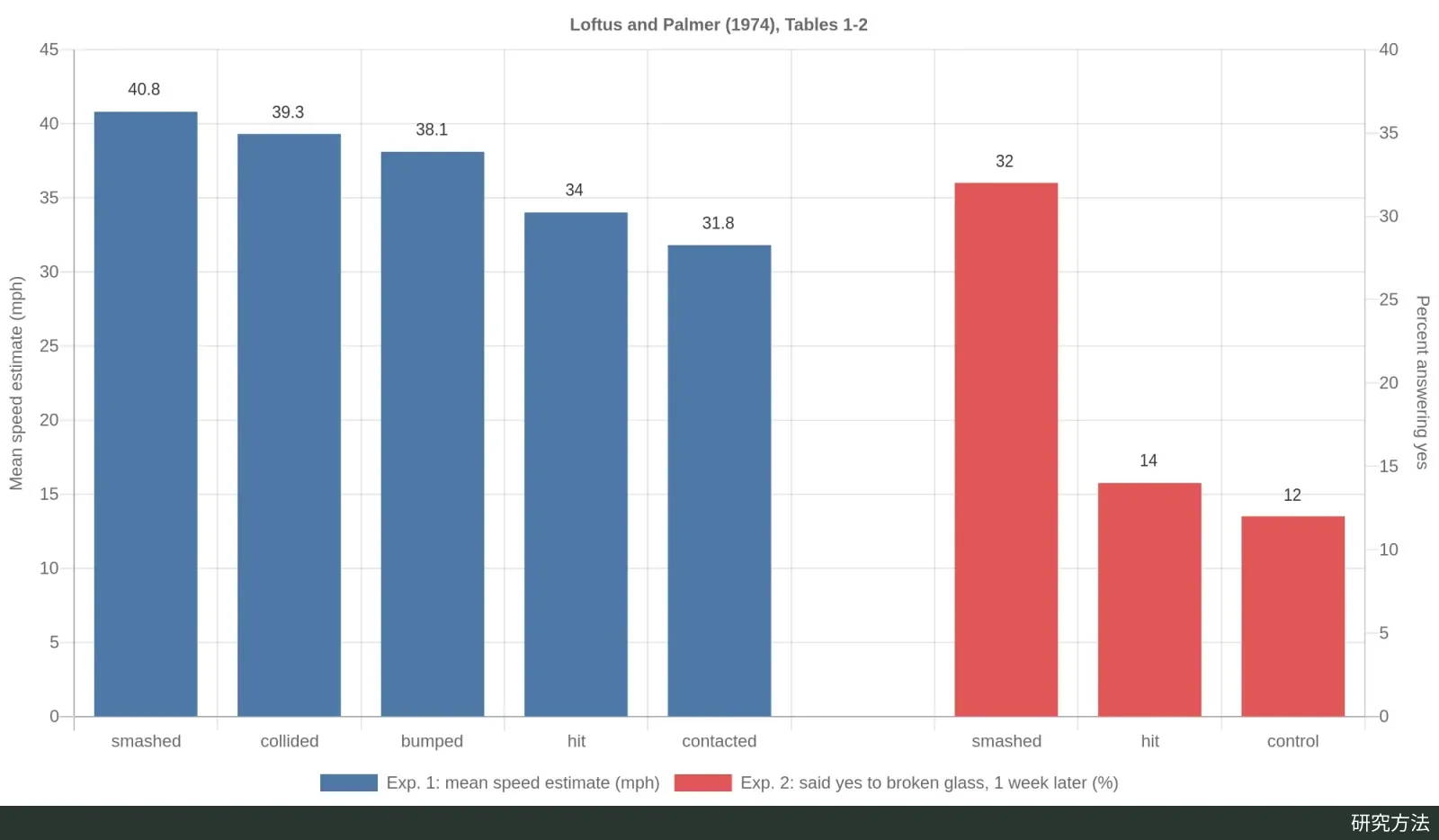
Left axis (blue): Experiment 1 mean speed estimates (mph) for five verb groups; right axis (red): Experiment 2 week-later proportion (%) answering that they saw broken glass; control was not asked about speed. Data from Loftus & Palmer (1974) Tables 1 and 2; the original reports no error bars; chart drawn here with QuickChart (Chart.js).
The authors then ran a conditional analysis asking whether smashed's effect travels entirely through "higher speed estimates." If so, among people with the same speed estimate, the two groups should report seeing glass at the same rate. Original Table 3 gives results by speed-estimate bin:
| Speed estimate (mph) | 1–5 | 6–10 | 11–15 | 16–20 |
|---|---|---|---|---|
| Probability of "yes" in smashed | .09 | .27 | .41 | .62 |
| Probability of "yes" in hit | .06 | .09 | .25 | .50 |
In every speed bin, smashed proportions were higher; the mean gap between the two curves was about .12. Without stratification the groups differed by .18; after controlling speed estimates the gap shrank but did not vanish. The authors therefore argued that smashed's influence partly travels through speed estimates and partly through other routes.
Their interpretive frame is that memory for a complex event comprises two kinds of information—one gained while viewing, one supplied afterward by external sources; over time the two may integrate so that people cannot tell where a detail came from and are left with a single "memory." Asking how fast the cars were going when they smashed supplies, along the way, the external information that the cars truly smashed together. Once integrated with the original representation, the remembered accident is more severe than it was; broken glass fits a severe crash and is more likely to be reported as seen. This describes post-event information integrated into memory reports, not knowing fabrication. Meanwhile 34 smashed participants still answered "no"; the effect is a systematic shift in group proportions, not a rewrite of every individual's memory.
Measurement scope, generalization, and ethics
What the design measures is reportable answers: a number, a yes/no. After Experiment 1 the authors already listed response bias as an alternative; Experiment 2's conditional analysis weakens "only the number was pushed up," but the design still cannot decide whether a week-later "yes" comes from an altered original memory trace or from inference at report time—"I remember a hard crash, so there should have been glass." The study did not ask about detail source, nor use a recognition test that excludes the misleading option. As Loftus (2005) reviews, McCloskey and Zaragoza (1985) used such a "modified test" to argue that misleading information may mainly affect reports of people who never encoded the original detail, without requiring damage to original memory; Zaragoza and Lane (1994) later found, by asking source directly, that people sometimes misattribute suggested content as seen, but such source misattribution is not inevitable.
Generalization also depends on sample and setting. Both experiments used students watching driver-education accident clips, with no stake in the crash and none of the fear of real witnessing; the manipulation was one word on a written questionnaire. Real questioning is often repeated and interactive; suggestion strength may be higher or lower, and witnesses' situations differ entirely. Effect sizes in the original were modest: Experiment 2's speed means differed by 2.46 mph, and two-thirds of the smashed group still denied broken glass. Converting those figures directly into courtroom error rates is not appropriate.
Later work neither turned the finding into an iron law nor overturned it. Reviewing 30 years, Loftus (2005) wrote that comparable memory distortions appear across hundreds of studies and many materials; effect size varies with conditions: warning participants before misleading information that they may be misled can sometimes aid resistance, while post-warnings help only under limited conditions; children and older adults are usually more susceptible than young adults.
On ethics, the methods sections of both experiments report only numbers, films, and questionnaire flow, with no description of informed consent or debriefing. The misleading here is relatively mild: questions presuppose that the cars smashed, and the target is an unrelated film rather than participants' own lives. Under contemporary review standards, such work still requires telling participants afterward that wording was manipulated.
To borrow the design for other post-event influences, five elements transfer: fix the viewed event and manipulate only one wording site on a later questionnaire; include a control that never meets that wording as a baseline; beyond the manipulated item, add a delayed detail whose correct answer can be checked objectively against the stimulus—absent details are ideal; mix that item among fillers; and in analysis treat stimulus materials as random effects and use conditional analysis to test whether effects travel entirely through the first dependent measure.
References
-
Loftus, E. F., & Palmer, J. C. (1974). Reconstruction of automobile destruction: An example of the interaction between language and memory. Journal of Verbal Learning and Verbal Behavior, 13(5), 585–589. DOI; full PDF (UC Irvine faculty site)
-
Loftus, E. F. (2005). Planting misinformation in the human mind: A 30-year investigation of the malleability of memory. Learning & Memory, 12(4), 361–366. DOI; journal full text
-
Reconstruction of automobile destruction: An example of the interaction between language and memory
-
Research Methods · Rituals can be copied; understanding cannot be faked
-
Information compiled and published by the Scholay academic one-stop platform; please report infringement for takedown.
-
Also published on Enter Scholar, a scholars' community for the intelligent era