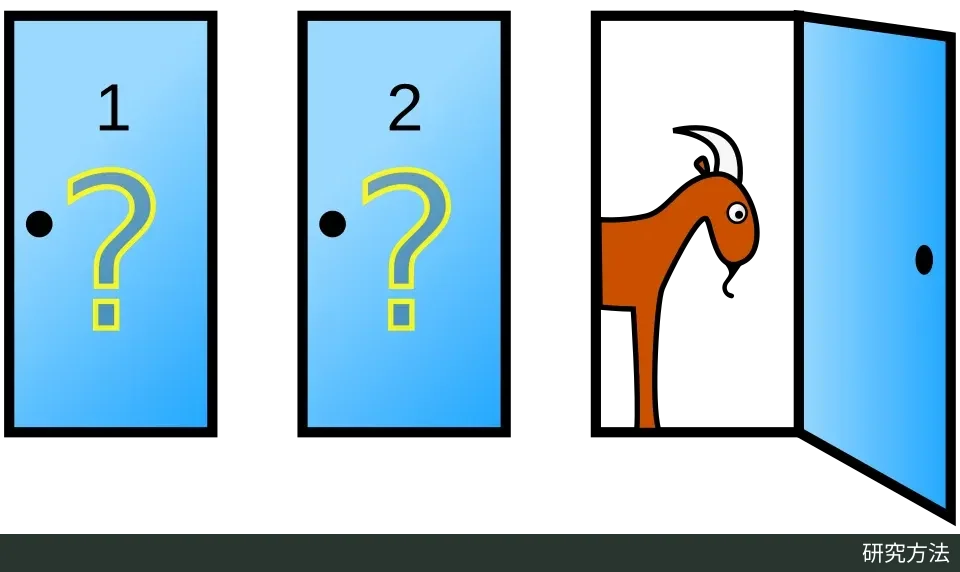
Behind three doors are one car and two goats. After you pick one, a host who knows what is behind them opens another door with a goat and then lets you decide whether to switch. It looks as though two doors remain with even odds, but under a fixed hosting rule, switching wins the car with probability two thirds. The key is not the number of doors but how the host chooses which door to open.
The Rules and the First Pick
The car is equally likely to be behind any of the three doors. You pick one; the host knows where the car is, always opens a door that is neither your pick nor hiding the car, and always offers the chance to switch. If your first pick happened to be the car, the host opens one of the other two goat doors with equal probability.
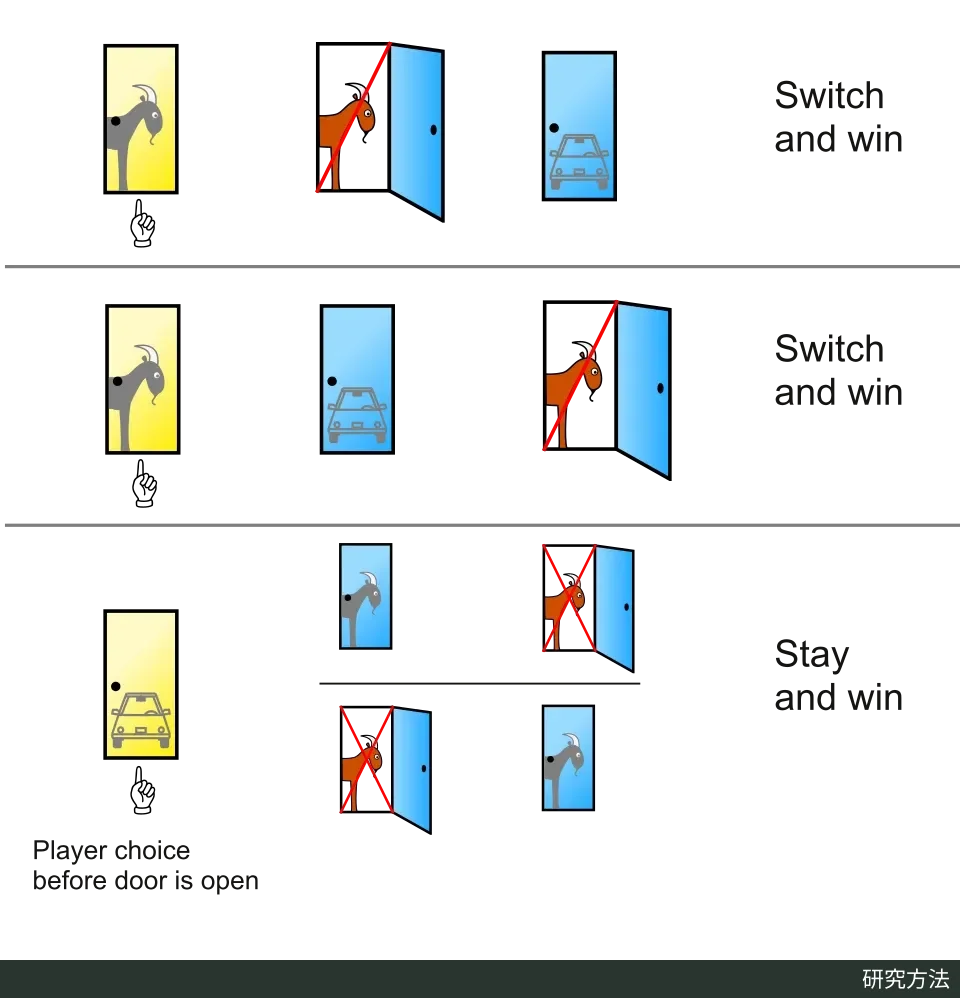
At the first pick, you have a 1/3 probability of choosing the car and a 2/3 probability of choosing a goat. Staying wins only if the first pick was right; switching is exactly the opposite: when the first pick was wrong, the host has eliminated the other goat, so the one door that is neither picked nor opened must hide the car. Staying therefore wins with probability 1/3 and switching with probability 2/3. The 2/3 that originally sat on the two unpicked doors was not split evenly between the two remaining doors just because a goat door was deliberately opened.
Enumeration and Conditional Probability
Fix the car behind door 1 and suppose the first pick is equally likely among the three doors. Pick 1: the host opens 2 or 3, and switching loses. Pick 2: the host must open 3, and switching to 1 wins. Pick 3: the host must open 2, and switching to 1 wins. Among the three equally likely first picks, switching wins in two. The same holds when the car is behind door 2 or 3. You can also fix the first pick at door 1 and let the car be equally likely behind any of the three doors, which gives the same two wins and one loss.
Now consider a specific condition: you pick door 1 and the host opens door 3. The joint probability that the car is behind door 1 and the host opens 3 is 1/3 × 1/2 = 1/6; if the car is behind door 2, the host must open 3, so the joint probability is 1/3; if the car is behind door 3, it could not have been opened this way. After normalizing, the probability that the car is behind door 1 is 1/3 and behind door 2 is 2/3. This update uses the rule that the host chooses with equal probability between the two goat doors.
Changed Rules and Updating on Information
“Two are left, so it's half and half” overlooks that the host's action is not a random draw from all the doors: he avoids your pick and he avoids the car door. What an observation means depends on how likely it is to occur under each of the possible true situations. If the host did not know where the car was and opened an unpicked door at random, he might reveal the car; given that he happens to reveal a goat, each of the two remaining doors has a 1/2 probability of hiding the car.
Consider yet another rule: the host knows and always opens the lower-numbered door that can be opened onto a goat. If you pick 1 and he opens 3, the car must be behind 2; if he opens 2, the car is behind 1 or 3 with conditional probability 1/2 each. The overall win rate of always switching is still 2/3, but the probability after seeing a specific door number is not necessarily 2/3. A simulation must likewise fix the car's position, the host's choice of door and whether the switch is always offered; otherwise, however many trials are run, it is merely answering a different question.
The real-world lesson is that evidence does not appear out of nowhere. How the person who filters, flags or discloses information acts affects how the observation should be interpreted. When updating a judgment, besides asking “what did I see?”, also ask “how likely was I to see it under each possible situation?”
References
-
Morgan, J. P., Chaganty, N. R., Dahiya, R. C., & Doviak, M. J. (1991). Let’s Make a Deal: The Player’s Dilemma. The American Statistician, 45(4), 284–287.
-
Research Methods · Rituals can be imitated; understanding cannot be faked
-
Compiled and published by the Scholay all-in-one academic platform. Please contact us to have it taken down in case of infringement.
-
Also published at Enter Scholar, a scholar community for the age of intelligence