In 1968, John Darley and Bibb Latané ran a bystander intervention experiment at New York University with 72 students from an introductory psychology course. Using individual booths linked by a one-way intercom, the study simulated a discussion partner suffering a sudden epileptic seizure and, with communication among bystanders cut off, manipulated the perceived number of people present (2, 3 or 6) to test how diffusion of responsibility lowers the probability of emergency help and slows reporting.

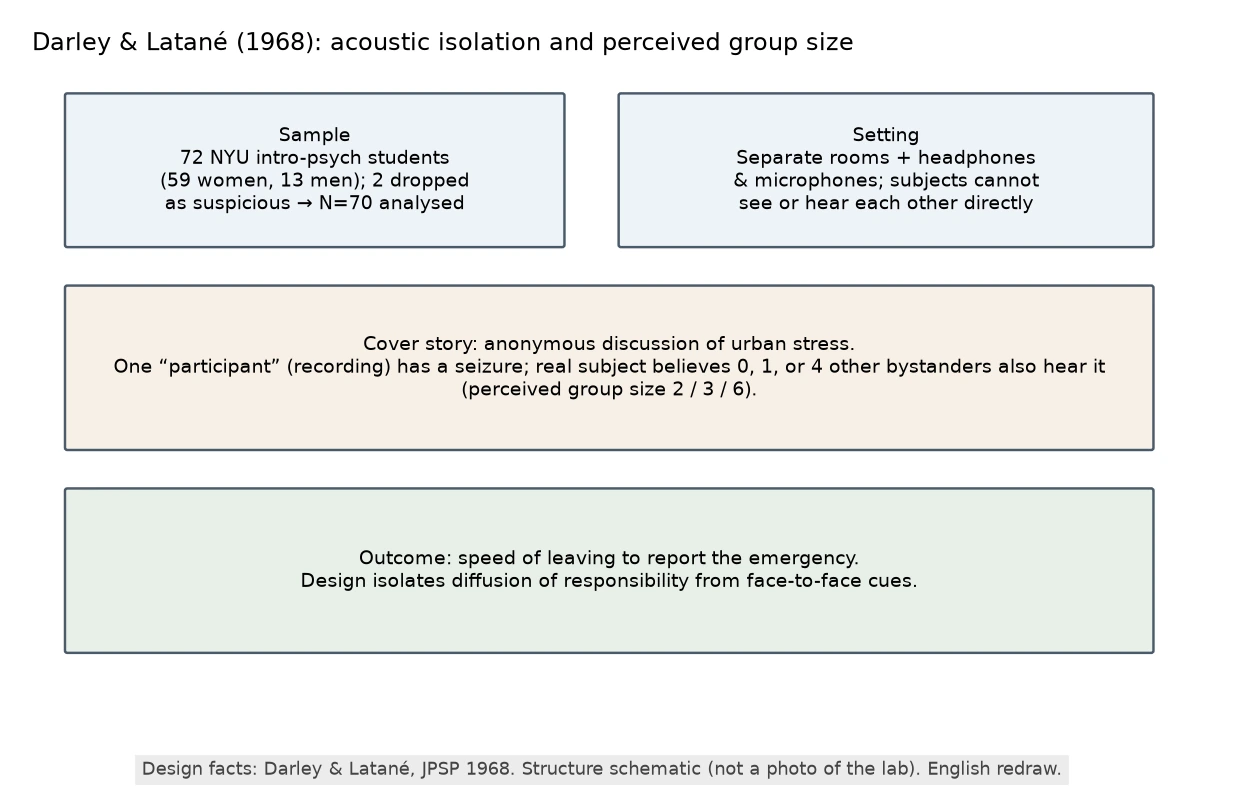
AI-generated schematic: layout of the single-person booth and intercom system in the Darley and Latané (1968) bystander intervention experiment. The participant sits alone in the room wearing headphones and a microphone and cannot learn how the other bystanders are reacting during the seizure.
Separating “diffusion of responsibility” from on-the-spot social influence: framing the problem and the one-way intercom cover design
After the 1964 murder of Kitty Genovese in New York became widely known through news reports and the book Thirty-Eight Witnesses (Rosenthal, 1964), the public and commentators generally put the story that “38 neighbours watched the attack for more than half an hour and none of them called the police” down to urban apathy, alienation or anomie. In their study published in the Journal of Personality and Social Psychology in 1968, John M. Darley and Bibb Latané argued that an “apathetic personality” alone cannot explain bystander inaction, and that the more important mechanism lies in the situational conflict of a sudden emergency and the effect of other people's presence. Faced with an emergency, a witness is bound by humanitarian norms of helping, yet also has misgivings: fear of getting entangled in trouble, worry about misjudging the situation and looking foolish, or concern about disrupting established procedures. When there is only one bystander on the scene, the pressure to help and the potential guilt for doing nothing fall entirely on that individual. When several bystanders are perceived to be present and cannot observe one another's actions, the responsibility for helping and the potential blame are shared among everyone, which is “diffusion of responsibility”; the individual also finds it easier to infer that “someone has probably gone for help already”, which weakens the motivation to intervene and delays action.
To test in the laboratory, in pure form, the diffusion of responsibility triggered by “the perceived number of others present”, the design first had to separate completely “the psychological perception that others are present” from “the social influence of others' visible behaviour”. In face-to-face scenes such as a fire or a street confrontation, bystanders can watch the expressions and movements of the people around them, so staying put may stem from diffusion of responsibility, or it may stem from taking others' outward calm as a cue that “nothing serious is going on”. Darley and Latané (1968) therefore built an experiment with single-person booths that blocked lateral communication among bystanders. The study recruited 72 undergraduates (59 women and 13 men) from the introductory psychology course at New York University, who took part as a course requirement. On arriving at the laboratory, each participant was led by an experimental assistant down a long corridor lined on both sides with small rooms, was seated in an individual booth, filled in a background information form, and then put on headphones with an attached microphone. At no point could the participant see any other participant.
Over the intercom, the experimenter gave the participant the cover story: the study aimed to learn about the personal adjustment problems that college students face in a high-pressure urban environment; to spare everyone the embarrassment of discussing private problems with strangers, all participants were placed in separate booths to remain anonymous (the real purpose of this arrangement was to allow tape recordings to simulate all the other discussants and the emergency that followed); and, so that an outside listener would not inhibit the discussion, the experimenter claimed not to be listening in on the first round and said reactions would be collected only afterwards by questionnaire (the real purpose was to remove from the scene the experimenter, who would obviously be responsible for dealing with the situation). The experimenter further explained that, since no one would be moderating on the spot, a mechanical switching device would control the order of speaking automatically: each member would in turn talk for about 2 minutes about his or her personal problems, then comment in sequence on what the others had said, and finally there would be a free discussion. At any given moment only the current speaker's microphone would be on in the network, with all other microphones switched off automatically. This acoustic design meant that when participants later heard the seizure, they clearly understood that only the victim's microphone was on at that moment, so that they could neither call out to the other bystanders to confer nor tell whether anyone else had already got up to seek help.
Drawn in code: the manipulation of perceived group size, the composition variants of the 3-person group, and the measurement timeline for the seizure in the second intercom round in the Darley and Latané (1968) bystander intervention experiment (data and design based on Darley & Latané, 1968).
Manipulating the independent variable and measuring over time: the prerecorded seizure, group-size variants and the speed transformation
In the first round of discussion, the future “victim” (a prerecorded male voice) spoke first. He admitted that he found it hard to adjust to life in New York City and to his heavy coursework and, with obvious hesitation and embarrassment, mentioned that he had a history of seizures resembling epilepsy, which were especially likely to be set off when he was studying hard or under exam pressure. The other prerecorded peers and the real participant then took turns talking about their own academic and personal problems, with the real participant scheduled to speak last in the first round (in the 6-person groups, the researchers also deliberately varied the speaking order of the first round to test for order effects, and the results showed that speaking order had no significant or noticeable effect on speed of reporting). When the discussion came back to the victim for his second turn, he made a few relatively calm remarks, then grew louder and increasingly incoherent, haltingly calling for help: “I... er... I think I need... if somebody could... give me a little help... because I'm having a real problem right now... I've got one of those seizures coming on... I'm gonna die... help... seizure...” (accompanied by choking sounds, followed by dead silence). The experimenter started a stopwatch when the signal for the victim's second turn sounded (0 seconds). Judges who listened to the tape estimated that the victim's increasingly loud and disjointed speech had clearly become a complete breakdown by about 70 seconds; at 125 seconds the victim's voice was cut off abruptly, which to the participant sounded as if the speaker's 2-minute allotment had run out and the mechanical switching device had automatically moved on to the next channel.
The main independent variable was the size of the discussion group that the participant believed was hearing the seizure at the same time. Through the experimental assistant's advance briefing and the number of prerecorded peers heard in the first round, female participants were randomly led into one of three perceived group-size conditions: (1) the 2-person group (only the victim and the participant; the participant believed that she alone in the whole discussion group knew of the emergency, ); (2) the 3-person group (the victim, the participant and 1 prerecorded peer; the pooled main-analysis sample without a medical background was ); and (3) the 6-person group (the victim, the participant and 4 prerecorded peers, ). In addition, to test whether a bystander's gender role and medical background would change the weight of responsibility the individual perceived, the researchers set up four composition variants within the 3-person group (in which the victim was always the prerecorded male voice): a female participant with a female bystander (); a female participant with a male bystander (); a female participant with a male premedical bystander who said he worked part-time in the emergency ward at Bellevue Hospital (); and a male participant, drawn from the same introductory course pool, with a female bystander ().
The main dependent variable was the time (in seconds) from the start of the victim's second turn (the onset of the seizure) to the moment the participant opened the door and left the booth. On stepping out of the room, the participant could at once see the experimental assistant seated at the end of the corridor and go up to report the emergency; if the participant had still not left the room after 6 minutes (360 seconds), the experimenter terminated the session. Because the raw response times were censored at 6 minutes and markedly skewed in the tail, the researchers, besides analysing “the percentage reporting before the seizure was cut off (within 125 seconds)” and “the cumulative percentage reporting within 6 minutes”, also took the reciprocal of each participant's response time in seconds and multiplied it by 100, converting it into a “speed score” (; those who had not reported within 6 minutes were scored on the basis of 360 seconds, giving ). This reciprocal transformation shrinks the extreme gaps between long response times and reduces the distortion of statistical tests by the arbitrary 6-minute ceiling; the higher the score, the faster the report. As soon as the participant came out to report, or the session was terminated at 6 minutes, the experimental assistant immediately debriefed the participant, disclosing the true nature of the experiment and calming the participant's emotions. Finally the participant was asked to fill in a 15-item checklist of thoughts during the seizure, together with scales of Machiavellianism, anomie and authoritarianism (Christie, 1964), a social desirability scale (Crowne & Marlowe, 1964), a social responsibility scale (Daniels & Berkowitz, 1964) and personal background information (16 individual-difference measures in all).
Results, the estimated probability of rescue, and methodological limitations
The manipulation check showed that, apart from 2 participants in different experimental conditions who suspected the seizure was faked and whose data were excluded, the remaining 70 participants included in the analysis all took the prerecorded seizure for a real emergency. Many of them, believing their own microphones were off, blurted out “My God, he's having a fit!” or anxiously said to themselves “Oh God, what should I do?” The main-effect analysis in Table 1 shows that the perceived number of people present significantly lowered the rate of reporting and slowed the response. In the 2-person group (the participant perceived herself as the only bystander), 85% of participants had already rushed out of the booth to report before the voice was cut off at 125 seconds, the cumulative reporting rate within 6 minutes reached 100%, and the mean time to report was only 52 seconds (speed score ). In the 3-person group (1 other bystander perceived), the rate of reporting before the cutoff fell to 62%, and the mean time to report was 93 seconds (speed score ). In the 6-person group (4 other bystanders perceived), the rate of reporting before the cutoff plunged to 31% (), only 62% of participants ever left the room within the 6 minutes, and the mean time to report lengthened to 166 seconds (speed score ). A one-way analysis of variance on the speed scores confirmed that the effect of group size was highly significant (), and Duncan's multiple range test showed that the 6-person group differed significantly from both the 2-person and the 3-person groups (). In addition, 95% of all participants who eventually reported did so within the first 3 minutes, and none of those who had not reported within 3 minutes of the seizure's onset left the room in the second half of the period, which indicates that simply extending the observation time would not noticeably increase the number of people intervening.
The table below brings together the complete measurements and statistical test results from Table 1 (effects of perceived discussion-group size) and Table 2 (effects of composition variants within the 3-person group) of the original Darley and Latané (1968) paper:
| Dimension of analysis and experimental condition | Valid sample size () | Reporting rate before the end of the seizure (within 125 seconds) | Cumulative reporting rate within 6 minutes | Mean response time (seconds) | Mean speed score () | Statistical test results (original Tables 1 and 2) |
|---|---|---|---|---|---|---|
| Table 1: 2-person group (female participant + victim; perceives herself as the only bystander) | 13 | 85% | 100% | 52 | .87 | Reporting rate before cutoff: |
| Table 1: 3-person group (female participant + victim + 1 peer; pooled) | 26 | 62% | about 81% (Figure 1) | 93 | .72 | ANOVA on speed scores: |
| Table 1: 6-person group (female participant + victim + 4 peers) | 13 | 31% | 62% | 166 | .51 | Duncan test: 6-person group significantly slower than 2- and 3-person groups () |
| Table 2: 3-person variant A (female participant + male bystander) | 13 | 62% | — | 94 | .74 | No significant difference from the female-bystander group |
| Table 2: 3-person variant B (female participant + female bystander) | 13 | 62% | — | 92 | .71 | No significant difference from the male-bystander or premedical groups |
| Table 2: 3-person variant C (female participant + male premedical bystander working part-time in an emergency ward) | 5 | 100% | 100% | 60 | .77 | Increase in speed score not statistically significant |
| Table 2: 3-person variant D (male participant + female bystander) | 13 | 69% | — | 110 | .68 | No significant effect of participant gender |
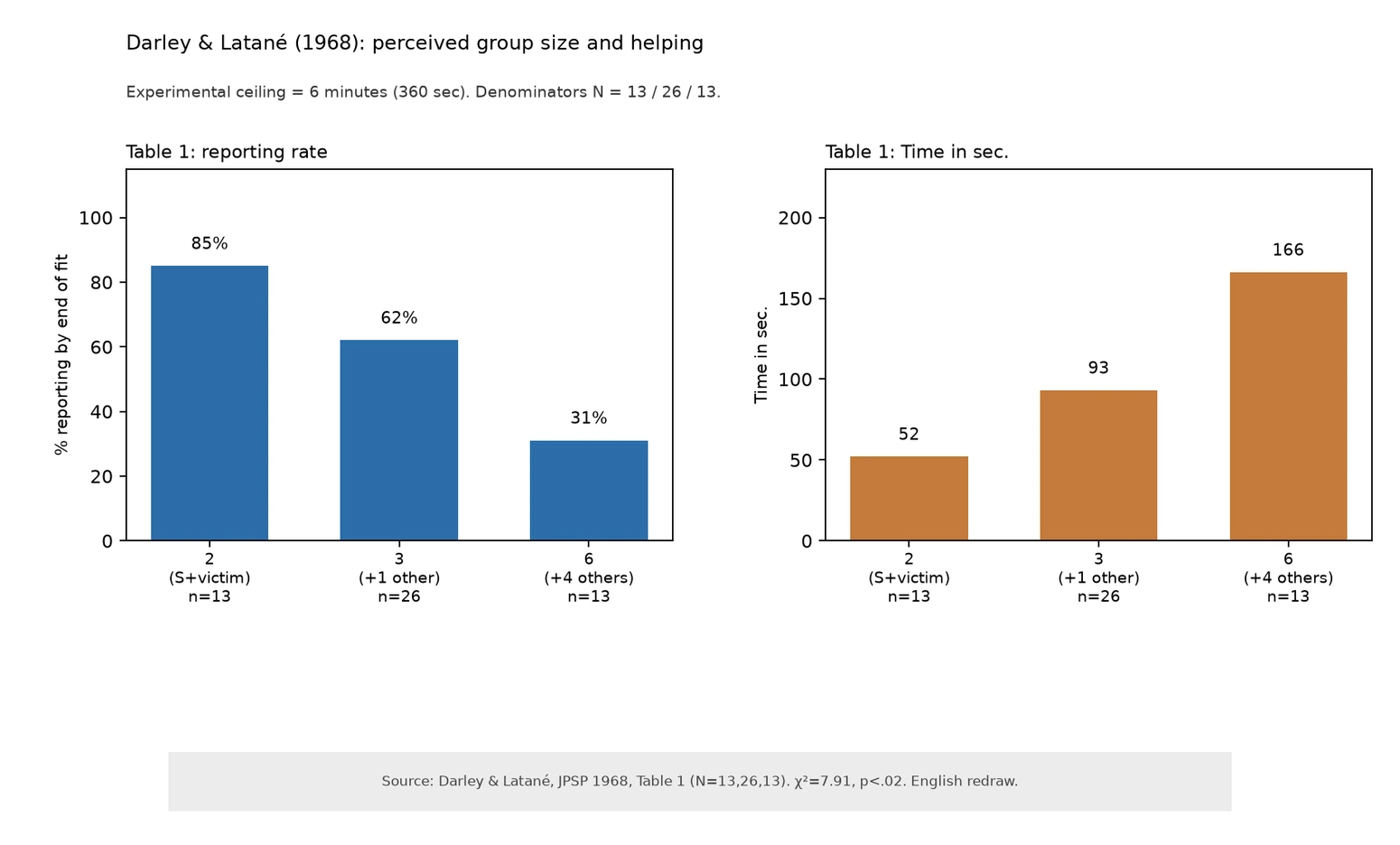
Drawn in code: effects of perceived discussion-group size (Table 1) and of 3-person group composition variants (Table 2) on the rate of reporting the seizure, mean response time (seconds) and speed score. Data source: Darley & Latané (1968), Table 1 & Table 2.
From the victim's point of view, although an individual bystander's probability of responding falls as the number of people rises, can the fact that “5 times as many people are available to help” make up for the inhibition at the individual level? Using the formula for independent events, (where is the number of bystanders, 1, 2 or 5, and is the measured probability that a single bystander in a group of that size has reported by a given point in time), the authors estimated the composite probability that “at least one person comes forward to report” if there really were bystanders. The calculation shows that within the first minute after the seizure began, the victim's probability of getting help with 1 or 2 bystanders was in fact far higher than with 5: at 45 seconds after onset, for example, the victim's probability of being helped was about 50% in the single-bystander condition and still 0% in the five-bystander condition. Among the 3-person composition variants in Table 2, speed of reporting did not differ materially whether the other bystander was a woman, a man or a premedical student with emergency experience at Bellevue Hospital, or whether the participant was male or female. The authors point out that emergency intervention can be divided into “direct intervention” (such as fighting a fire or breaking up a fight, which calls for special skills or physical strength and is more strongly prescribed by social norms for men) and the “reportorial intervention” measured in this study (leaving the booth to find the experimental assistant, or calling the police, which anyone can do, so that gender and medical background do not alter where responsibility lies). Likewise, after speed scores were normalized within groups and pooled (), none of the personality scales, Machiavellianism, anomie, authoritarianism, social desirability and social responsibility, predicted speed of helping; of the 16 individual-difference measures, the only one to show a significant correlation was the size of the community in which the participant grew up (; those who grew up in smaller communities reported faster). Post-experiment interviews and behavioural observation further undercut the “apathy hypothesis”: when the experimenter entered the room to end the session, participants who had not reported typically had trembling hands and sweating palms and asked urgently whether the victim was all right, and their emotional arousal was if anything higher than that of those who had reported. They had not coldly decided “not to respond”; rather, they were wavering, caught in an “avoidance-avoidance conflict” between “the guilt and shame of not helping” and “the fear of misjudging and looking foolish, or of violating the experiment's anonymity rules”.
Viewed as a matter of experimental design methodology, this classic study has four limitations and boundaries of inference that need to be clearly marked. First, its high internal validity depends on laboratory deception and acute psychological stress: the experiment created an emergency with realistic prerecorded sounds of a seizure and choking, subjecting participants to considerable tension and conflict. Although the post-experiment questionnaire showed that, after debriefing and reassurance, all participants rated the experiment “interesting” or “very interesting” and accepted that the deception was necessary, high-stress deception designs of this kind, without prior informed consent, are now strictly limited under the ethical review standards of modern institutional review boards (IRBs). Second, the sample structure is limited: all 72 participants were New York University introductory course students taking part as a course requirement, with as many as 59 women and only 13 men (male participants were tested in just one variant of the 3-person group), and the premedical-bystander subgroup had a sample size of only , so the statistical power for subgroup differences is weak. Third, while the one-way intercom booths neatly removed the confounding influence of bystanders observing one another, they also artificially cut off the eye contact, reading of facial expressions and verbal coordination that exist among witnesses in real public places; extrapolating the conclusions to face-to-face group settings needs to be weighed carefully alongside later experiments with visible bystanders. Fourth, regarding the Genovese case that this study cites as the background to its question, later archival historical research (Manning, Levine, & Collins, 2007) pointed out that the 1964 media narrative of “38 witnesses who watched with indifference throughout and none of whom called the police” was clearly inaccurate: the number of people who actually saw the whole attack was far smaller than 38, and some neighbours had at the time shouted to stop it or tried to contact the police. That said, the historical correction of a news narrative aims to restore the historical facts, and it does not weaken the causal internal validity that Darley and Latané (1968) established in the laboratory, through random assignment and acoustic isolation, for “how the perceived number of people present leads to diffusion of responsibility”.
1. References
- Darley, J. M., & Latané, B. (1968). Bystander intervention in emergencies: Diffusion of responsibility. Journal of Personality and Social Psychology, 8(4, Pt. 1), 377–383. https://doi.org/10.1037/h0025589
- Darley, J. M., & Latané, B. (1968). Bystander intervention in emergencies: Diffusion of responsibility (PDF reprint of the original paper held by the University of Colorado Denver, including the original Tables 1 and 2 and Figure 1). https://www.ucdenver.edu/docs/librariesprovider102/default-document-library/bystander-intervention-john-darley-and-bibb-latane.pdf
- Manning, R., Levine, M., & Collins, A. (2007). The Kitty Genovese murder and the social psychology of helping: The parable of the 38 witnesses. American Psychologist, 62(6), 555–562. https://doi.org/10.1037/0003-066X.62.6.555
References
-
Research Methods · Rituals can be imitated; understanding cannot be faked
-
Information compiled and published by the Scholay academic one-stop platform; report infringement for takedown.
-
Also published on Enter Scholar, a scholars’ community for the intelligent age