When designing an induced-compliance study, how the payment factor is set often decides whether rival predictions can be told apart—before one worries how boring the task feels. Festinger and Carlsmith (1959) used only two payment levels—$1 and $20—plus a no-lie control so that the then-common idea “larger reward, larger later opinion change” and dissonance theory’s “weaker justification, more attitude change” would rank the conditions in opposite orders.[1] This note stays on those three cells, the key measure and result order, and how later work moved “sufficient/insufficient justification” from payment size to choice—not a full methods rewrite.
Why one small and one large payment
The authors open on a weakness in reward studies such as Kelman (1953): among people who made a counterattitudinal statement, larger rewards seemed tied to larger later opinion change, yet not everyone complied for the reward, and compliance rose with reward size—self-selection muddies interpretation.[1] Dissonance theory predicts the opposite curve: when external justification is just enough to elicit the statement, dissonance is largest and people are most likely to decide the dull task was actually enjoyable; a large payment lets them say “I did it for the money,” so attitude need not move.[1] Hence one small and one large payment, with both levels meant to produce near-universal compliance and avoid sorting who is willing to lie.[1] The control supplies a baseline: the same dull tasks and waiting, but no request to tell the next “subject” the tasks were fun, and no hiring payment.[1]
Operationally, both paid groups used the same temporary-hire script: after rereading the “For Group B” sheet, subjects received $1 or $20 and signed a handwritten receipt; after debriefing, all were willing to return the money.[1] Of 71 Stanford introductory-psychology men, 11 were discarded: five suspected that being paid to say the study was fun was the real point (three in $1, two in $20); two told the girl they were hired and the tasks were boring (both $1); three refused the money and the hire (one $1, two $20); one asked for the girl’s number and wanted to explain ( $1).[1] Analyses used twenty subjects per condition. The key dependent measure was an interviewer’s rating of how enjoyable the tasks were (−5 to +5), blind to condition; other items such as whether one could learn about one’s abilities were used to show effects concentrated on dissonance-relevant evaluations.[1]
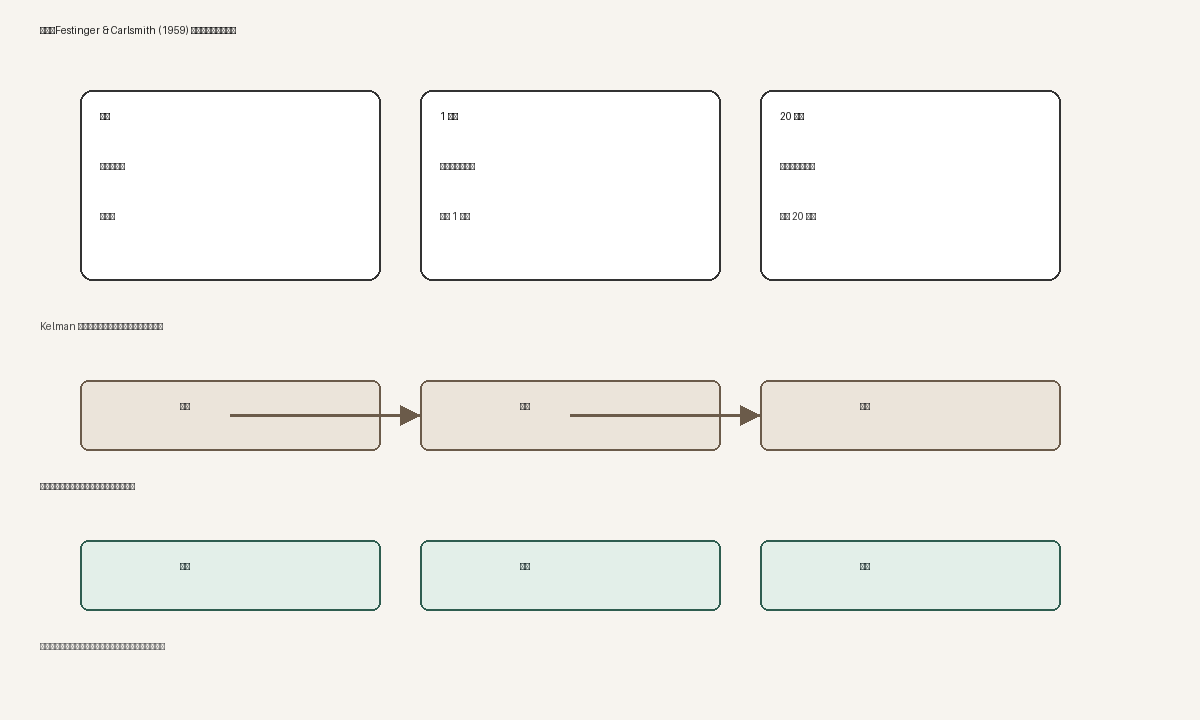
Figure: Schematic of the three roles and relative Kelman-style vs dissonance prediction orderings (no numeric values).
Result order and an alternative check
Table 1 means for task enjoyableness were −0.45 (control), +1.35 ($1), and −0.05 ($20).[1] With control as baseline, the $1 group was significantly above control and above $20; $20 did not differ significantly from control.[1] That order fits dissonance—small justification lifts ratings; large justification stays near the no-lie baseline—not “larger reward, larger change.”[1] To check whether the $1 group simply sold the lie harder and thus persuaded themselves, two blind raters scored the recordings; the data did not support a greater-$1-effort path.[1] Ethically, the paper records deception, covert recording, and a debrief that explained the true purpose and recovered the payment—historical facts, not a recommended template for new work.[1]
From payment size to choice paradigms
Vaidis et al. (2024) note that early induced-compliance work used reward size for sufficient versus insufficient justification, while later studies more often manipulated choice (high vs low) with a counterattitudinal essay.[2] Their preregistered multilab constructive replication, based on Croyle and Cooper (1983, Experiment 1), spanned 39 labs, 19 countries, 14 languages, and N = 4,898 across high-choice counterattitudinal, low-choice counterattitudinal, and high-choice neutral essay conditions.[2] Primary analyses did not support the core hypothesis: no significant attitude difference after high- versus low-choice counterattitudinal essays, though counterattitudinal versus neutral essays differed.[2] Self-perception accounts (Bem, 1965, 1967) are noted as once widely discussed; interpersonal-simulation details are not expanded here.[2] Critically, that project tested a choice paradigm—it is not a replication of Festinger and Carlsmith’s $1/$20 payment design.[2]
When you set an induced-compliance factor, decide whether you are manipulating justification sufficiency or choice. Festinger and Carlsmith’s small payment, large payment, and no-lie control were built so two predictions would rank conditions differently while nearly everyone complied. How robust later choice paradigms are should be judged from preregistered multilab evidence—not by exporting the 1959 payment order unchanged.
References
-
Festinger, L., & Carlsmith, J. M. (1959). Cognitive consequences of forced compliance. Journal of Abnormal and Social Psychology, 58(2), 203–210. https://doi.org/10.1037/h0041593
-
Vaidis, D. C., et al. (2024). A multilab replication of the induced-compliance paradigm of cognitive dissonance. Advances in Methods and Practices in Psychological Science, 7(1). https://doi.org/10.1177/25152459231213375