A report that says “double-blind” can still leave readers unsure who was masked. A survey cited in the CONSORT 2010 explanation found 18 different combinations of blinded roles among 200 trials labelled double-blind; about one in five blinded none of participants, healthcare providers, or data collectors.[1] The same labels also shift by field—“third blind” may mean analysts, endpoint committees, or sponsors, and “single-blind” sometimes masks only participants, sometimes only assessors.[2] The explanation therefore tells authors and editors to abandon single/double/triple-blind wording and name who was unaware of assignment.[1] Below: role–bias mapping—who is masked, what is blocked—and what to prioritise when full blinding is impossible.
Five roles: what masking blocks
The CONSORT 2010 Item 11a explanation text walks through how five groups can introduce bias when they know assignment—participants, healthcare providers, data collectors, outcome adjudicators, and data analysts—while Box 4 mainly clears terminology, defines those roles, and reports how “double-blind” usage scatters; it is not the place that “lists all five role biases” by itself.[1] Aware participants may change responses—reporting more favourably when they believe they received the new treatment—and may shift adherence, co-interventions, and dropout; when participants self-report subjective outcomes, their knowledge also sits on the outcome-assessment path.[1] Unblinded providers can bring similar performance bias and co-intervention differences. Unblinded data collectors may change measurement frequency or timing, remeasure abnormal findings, or give uneven encouragement—mechanisms that belong with outcome measurement.[1] Outcome adjudicators are most exposed on subjective outcomes. Analysts may bias by choosing time points and outcomes or removing cases; that risk is judged by mechanism, not defaulted into “measurement of the outcome.”[1][3] A checklist of who was unaware supports chasing risk by mechanism—not scoring how many people were masked, and not arguing whether a trial “counts” as double-blind.[1]
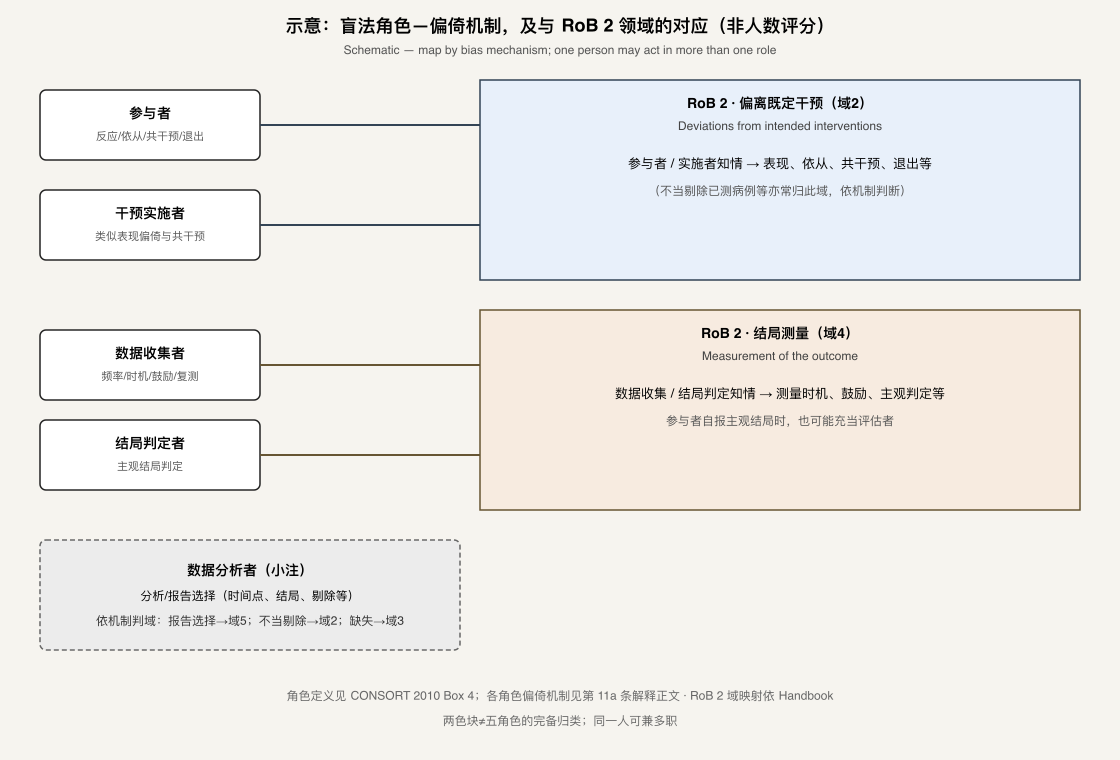
Figure: Schematic role–bias mechanisms; collectors and adjudicators map to measurement, analysts noted separately by mechanism. Drawn for this article, CONSORT 2010 explanation[1]
Alignment with allocation concealment and RoB 2
Blinding protects after assignment—against performance and ascertainment bias. Allocation concealment protects before assignment—against selection bias—and can always be implemented in principle.[1] Neither substitutes for the other. In Cochrane RoB 2, knowledge among participants and providers mainly feeds “deviations from intended interventions”; knowledge among data collectors and outcome adjudicators mainly feeds “measurement of the outcome.”[3] Analysis/reporting choices (Handbook 8.7) sit in “selection of the reported result”; improper exclusion of already-measured cases is often discussed with domain 2 (8.4.4), and missing outcomes with the missing-data domain—do not force the analyst row into the measurement block.[3] The same person may hold more than one role; reports should still name duties separately. Item numbers follow CONSORT 2010 11a/11b. Even when objective outcomes make adjudicator knowledge less consequential, unblinded participants or providers can still distort comparisons through differential attrition.[1]
When full blinding is impossible
Blinding is not always feasible: the explanation’s example comparing ear versus thumb blood sampling for pain shows participants can hardly miss which site was used.[1] Authors should still state who was blinded. Subjective outcomes are more sensitive to assessor knowledge; objective outcomes needing little judgement, such as death from any cause, are usually less affected by assessor knowledge—yet unblinded participants or providers can still cause differential attrition.[1] Surgery often cannot blind operators and participants, but before/after photographs can be scored by external adjudicators; fields such as acupuncture sometimes use sham procedures to dampen expectancy.[1][2] Asking participants to guess assignment can assess blinding, but guess rates are nudged by efficacy clues and side effects and are not alone proof that blinding “worked.”[2] Substantial shares of cystic-fibrosis, rheumatoid-arthritis, and dermatology trial reports still omit whether blinding was used at all—omission itself leaves bias risk unjudgeable.[1] When full blinding fails, prioritising people on the outcome path and stating limits plainly is more useful than an empty “double-blind” label.
In methods text, replace single/double/triple-blind with a five-line list of who was unaware—participants, providers, collectors, adjudicators, analysts—naming which bias each line can block and how masking was done.[1] RoB 2 judges remaining risk by mechanism: deviations and outcome measurement are two common trunks, but analysis/reporting selection is not exhausted by those two colour blocks, and “how many people were masked” is not a substitute for mechanism.[1][3] Whether allocation concealment succeeded still needs its own statement.[1]
References
-
Moher, D., et al. (2010). CONSORT 2010 explanation and elaboration. BMJ, 340, c869. https://doi.org/10.1136/bmj.c869
-
Wikipedia contributors. Blinded experiment. https://en.wikipedia.org/wiki/Blinded_experiment
-
Higgins, J. P. T., et al. Cochrane Handbook Chapter 8 (RoB 2). https://www.cochrane.org/authors/handbooks-and-manuals/handbook/current/chapter-08