In spring 1954, more than 1.8 million U.S. first- through third-grade children entered the field trial of Salk’s inactivated poliomyelitis vaccine. Thomas Francis Jr. of the University of Michigan led the evaluation under two designs at once: in 11 states vaccine and placebo were randomly assigned and cases were judged without knowledge of vaccination status; in 33 states only second graders were vaccinated, with first and third graders as observed controls. Both sets of results pointed the same way, but only the former could keep volunteer effects and diagnostic bias out of the comparison.
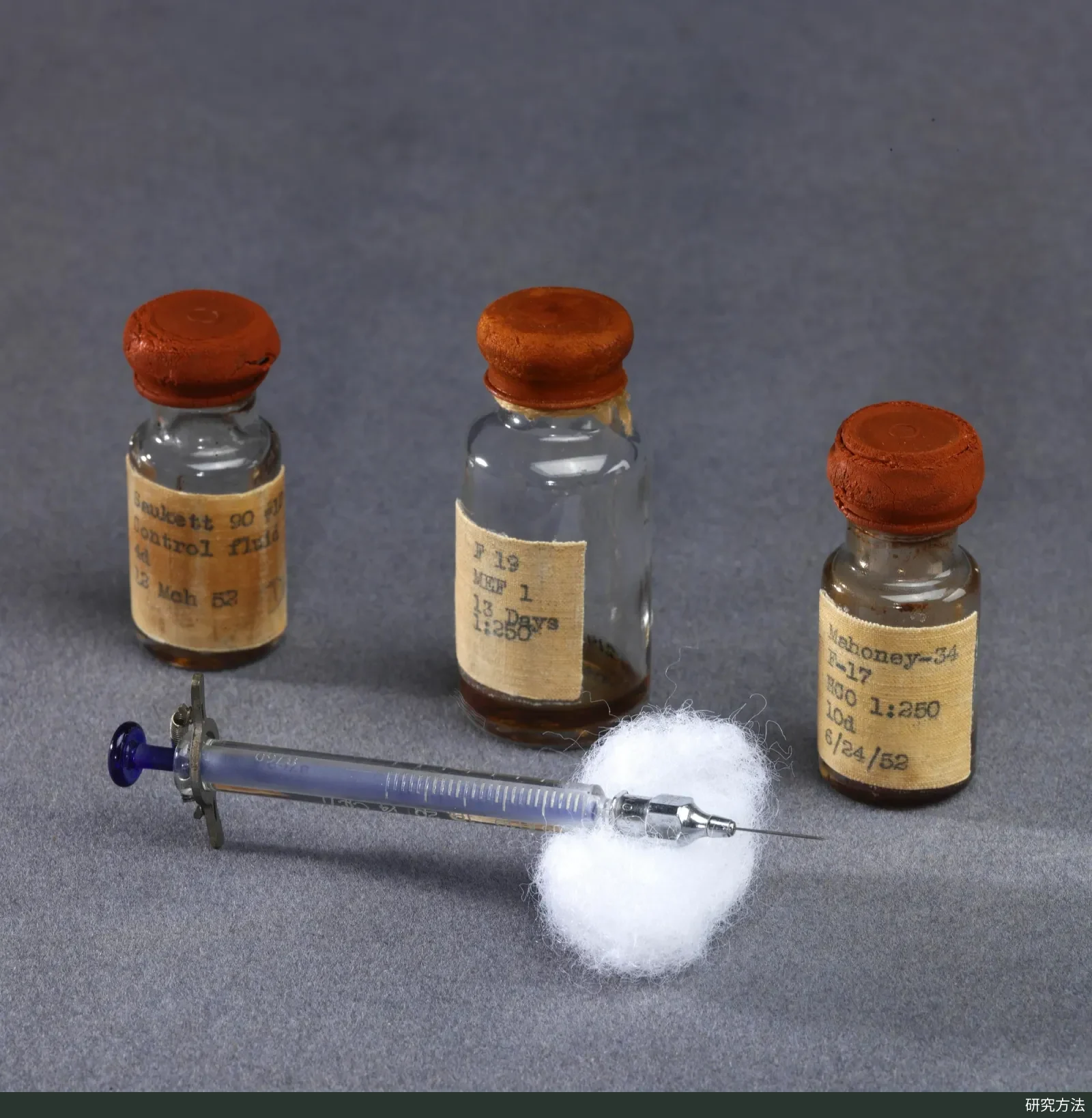
Vaccine vial used in Salk’s first human trials near Pittsburgh in July 1952, labeled Type 1 Mahoney strain and donated by the National Foundation for Infantile Paralysis; it predates the 1954 field trial. Image: Smithsonian National Museum of American History (object nmah_874829), license: CC0 1.0.
Observed controls versus placebo controls
Jonas Salk at the University of Pittsburgh developed a formalin-inactivated poliomyelitis vaccine. An advisory committee of the National Foundation for Infantile Paralysis (NFIP) judged that existing small-scale inoculations showed it was safe and could raise high antibody levels in children, but field evidence that it could prevent disease in natural epidemics was still missing. The Foundation funded the field trial and asked Thomas Francis Jr. of the University of Michigan to lead an independent evaluation. The evaluation center sat in the School of Public Health and unified forms, case investigations, and laboratory diagnostic procedures across sites.
The Foundation’s first published plan was: second graders whose parents applied could be vaccinated; all first and third graders would serve as controls—observed only, no injection. That design was easy to run: controls and vaccinees shared schools and seasons, and an epidemic wave hitting second grade would also hit adjacent grades. Francis listed its flaws in the report: the vaccinated group came entirely from families who actively applied, while controls mixed willing and unwilling participants; ages did not match exactly, only “bracketing” second grade with first and third; and physicians could easily know whether a child had been vaccinated, which might affect later diagnosis.
Some state health departments said they would join only a rigorously designed trial. So a second design was added: among first through third graders whose parents applied, half received vaccine and half an identical-looking placebo; bottles carried only code numbers, with the key held by the evaluation center. In the end, 84 trial areas in 11 states used randomized, blinded placebo control, and 127 areas in 33 states kept observed controls. The full study population was 1,829,916 children; inoculations ran from late April through mid-June 1954.
Randomization, blinding, and sample size
Random assignment in placebo areas took place only among children who had already consented—the key to the whole design. Whether parents consented related to education, economic status, and even a child’s chance of virus exposure; but the draw came after consent, so vaccine and placebo arms were composed of the same kind of families. Francis reported that the two groups matched in every respect. Children who did not apply were followed with the same procedures but were defined as a separate population and not counted as controls—a rule fixed before results were pooled.
Measurement was likewise built to reduce subjective judgment. Mild polio is hard to separate from other febrile, fatiguing illnesses, and the line between “slight paralysis” and “weakness” varies by physician. The trial took paralytic cases as the main comparison and set uniform standards for diagnosis, paralysis grading, and laboratory interpretation: cases were first reported by local physicians and investigated epidemiologically, then physical therapists assessed muscle strength twice—at 10–20 and 50–70 days after onset—while virus isolation and antibody titers were obtained. Every case was classified without knowledge of vaccination status; the blind was broken only after all adjudications were finished.
Sample sizes had to reach the millions because the disease was rare and varied sharply by year and region. Meier offered an estimate: at about 50 cases per 100,000 and 50% vaccine efficacy, 40,000 per arm would expect only 20 versus 10 cases—a difference easy to call chance; at 100,000 per arm, 50 versus 25 cases is more persuasive. Allowing that trial areas might have few cases that year, and that only about half of confirmed cases were paralytic, the scale had to far exceed that figure. The study period began two weeks after each area’s third dose and ran through 31 December 1954, covering one epidemic season.
Results under the two controls
Placebo-area results were the cleanest. Among 200,745 vaccine-arm children who completed three doses there were 33 paralytic cases (16 per 100,000); among 201,229 placebo-arm children there were 115 (57 per 100,000)—about 3.5 times as many. All four deaths were in the placebo arm. Nonparalytic cases did not differ significantly between arms. Efficacy estimated from all paralytic cases was about 72%; narrowing to laboratory-confirmed paralytic cases raised placebo-area estimates to 80%–90%.
Observed-control areas pointed the same way with a smaller gap. Among 221,998 vaccinated second graders there were 38 paralytic cases (17 per 100,000); among 725,173 first- and third-grade controls there were 330 (46 per 100,000). Efficacy from all paralytic cases was about 62%, and 60%–80% from laboratory-confirmed cases. Francis judged the placebo-control data more trustworthy; the observed-area results would have been harder to interpret had they not lined up with the placebo trend.
Both designs included a group of nonparticipants who made volunteer effects visible. In placebo areas, unvaccinated children’s paralytic incidence was 36 per 100,000—below the placebo arm’s 57; in observed areas, unvaccinated second graders were at 35, also below the first- and third-grade controls’ 46. The University of Michigan Survey Research Center found clear socioeconomic differences between participating and nonparticipating families; Francis thought non-applicants might be more resistant themselves, while Meier invoked then-current understanding: in poorer sanitary settings infants more often met the virus under maternal antibody and acquired immunity. Using nonvaccinees as controls would understate efficacy; observed-area controls mixed two kinds of families and, with diagnostic awareness, the net bias direction was hard to know in advance.
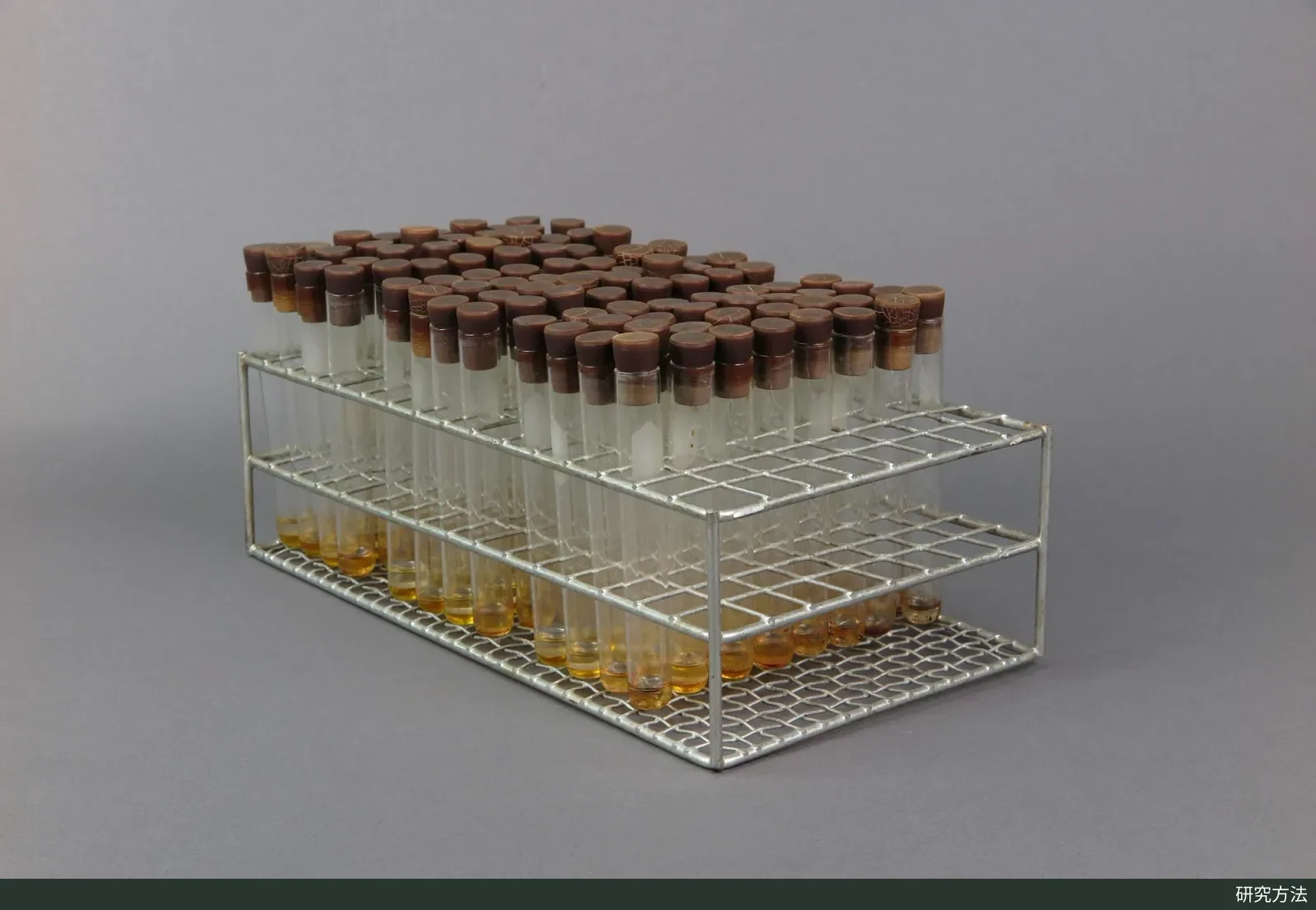
Wire rack for Salk’s poliomyelitis antibody “color test,” made in the early 1950s and donated by the National Foundation for Infantile Paralysis. During the field trial the evaluation center drew pre- and post-vaccination sera from more than 40,000 children for antibody assays. Image: Smithsonian National Museum of American History (object nmah_722924), license: CC0 1.0.
Scope of the conclusions
The question the trial answered was tightly framed: among consenting first- through third-grade children (about ages 6–9) in the selected trial areas, could the 1954 vaccine lots reduce paralytic poliomyelitis during that year’s epidemic season. Francis stressed that results apply to the specific conditions of the 1954 study. Randomization guaranteed comparability between vaccine and placebo arms, not that participants represented all U.S. children: participants came from particular trial areas and mainly from families who actively applied.
The report also flagged limits to extrapolation. Among virus-isolated cases, placebo-area efficacy against Type 1 was estimated at 68%, and above 90% against Types 2 and 3; Francis linked this to measurements showing weaker Type 1 antigenicity in some lots. In the placebo-area age-6 group, paralytic incidence did not differ significantly between vaccine and control; the report said that question was still under study. Case follow-up ran only through year-end, so duration of protection rested on five-month post-vaccination antibody follow-up, which then showed only moderate decline.
The trial also could not replace later quality control. Meier records that soon after the vaccine was released for general use in 1955, a few lots themselves caused severe poliomyelitis cases and distribution was briefly suspended. The field trial assessed efficacy of the preparations used in the trial; safety of production lots needed a separate assay system. Methodologically, what travels to other research is the design itself: randomize after consent, blind diagnosticians, predefine who counts as a control, and measure everyone by the same standards.
References
-
Francis T Jr, Korns RF, Voight RB, Boisen M, Hemphill FM, Napier JA, Tolchinsky E. An evaluation of the 1954 poliomyelitis vaccine trials: summary report. American Journal of Public Health and the Nation's Health. 1955;45(5 Pt 2):1–63. doi:10.2105/ajph.45.5_pt_2.1
-
Francis T Jr. Evaluation of the 1954 poliomyelitis vaccine field trial: further studies of results determining the effectiveness of poliomyelitis vaccine (Salk) in preventing paralytic poliomyelitis. JAMA. 1955;158(14):1266–1270. doi:10.1001/jama.1955.02960140028004
-
Meier P. The biggest public health experiment ever: the 1954 field trial of the Salk poliomyelitis vaccine. In: Tanur JM, et al., eds. Statistics: A Guide to the Unknown. San Francisco: Holden-Day; 1972:2–13. Course-page reprint
-
Meldrum M. "A calculated risk": the Salk polio vaccine field trials of 1954. BMJ. 1998;317(7167):1233–1236. doi:10.1136/bmj.317.7167.1233
-
University of Michigan School of Public Health. 1955 Polio Vaccine Trial Announcement (including the 12 April 1955 press release). sph.umich.edu/polio
-
Information compiled and published by the Scholay academic platform; please report infringements for takedown.
-
Also published on EnterScholar, a scholar community for the intelligent era.