Multilevel regression and poststratification (MRP, also called Mister P) is a method for projecting a sample to a target population. It first uses a multilevel model to predict responses in demographic-by-geography cells, then weights those cells by their population counts—often for small-area estimation from national surveys. It can dampen small-sample noise, but it does not automatically remove selection bias and does not provide causal identification.
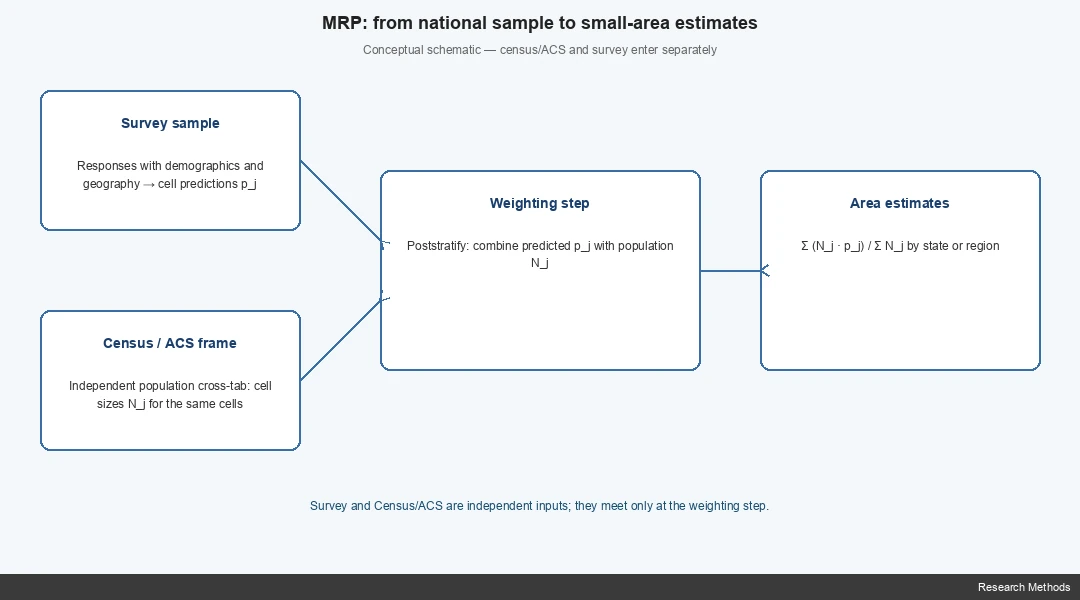
Small-area estimation and direct poststratification
MRP is a model-based approach to population inference, often used for small-area estimation and sample-composition adjustment. Once a national survey is split by state and further crossed by age, education, and similar factors, some cells have few respondents or none. Direct poststratification weights cell sample means by population counts; sparse cells are unstable and empty cells have no mean. MRP instead predicts cell responses with a model and stabilizes estimates through partial pooling.[1]
Multilevel prediction and population weighting
Step one predicts cell responses with a multilevel model that includes demographic and geographic effects. Binary outcomes can use multilevel logistic regression. Partial pooling lets groups share information: sparsely observed groups are pulled more toward the common distribution; richly observed groups keep more of their own signal. Similarity is expressed by the model and group-level predictors—not by geographic adjacency alone.[1][3]
Step two weights the predicted probabilities p̂ⱼ by cell population counts Nⱼ in the target region: estimate = ΣNⱼp̂ⱼ / ΣNⱼ. Censuses or the ACS can supply population structure, but age bins, education coding, geographic boundaries, and population definitions must align with the survey.[3]
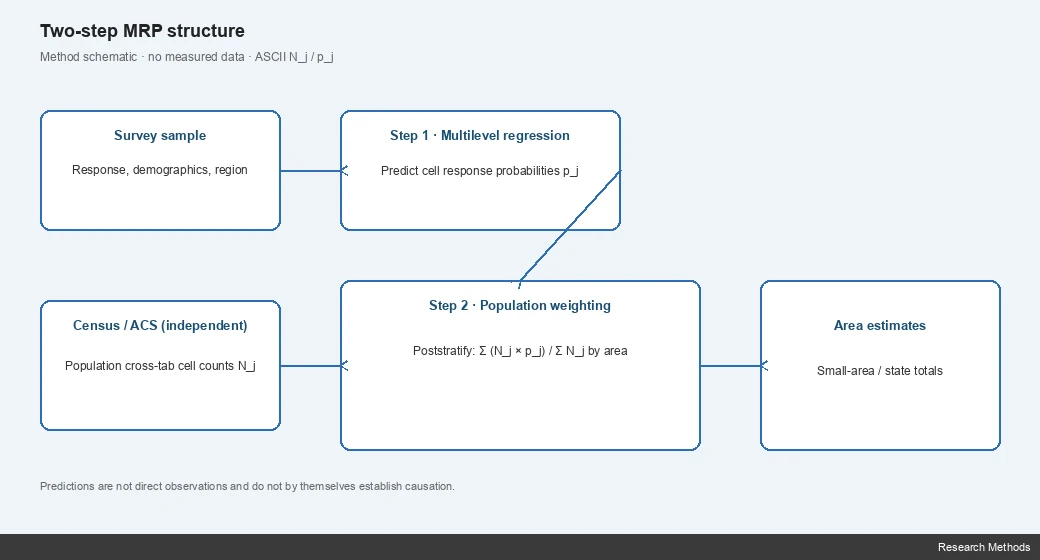
A conceptual state-support example
Conceptually: use a national poll to estimate each state's support for a policy. Direct means in sparse states swing with a few answers; MRP first predicts support probabilities in that state's demographic cells, then aggregates with the state's population table. This example has no real data and reports no accuracy gain.
Park, Gelman, and Bafumi (2004) used 1988 and 1992 pre-election polls against state election results and reported that multilevel models outperformed the methods they compared. That result is limited to their setting and does not guarantee higher accuracy on every issue; applications should validate against independent large samples or matching benchmarks.[2]
Assumptions and common misuses
Use requires that the model reasonably predicts cell responses in the target population and adequately handles selection or nonresponse differences related to the outcome. If respondents within a cell still systematically differ from nonrespondents, bias can remain after adjustment; omitted key variables or outdated population tables also limit inference.[1][3]
Common misuses include treating adjusted group differences as causal effects; cutting cells ever finer as if that alone raises accuracy while empty cells lean on model extrapolation; and substituting separate marginal age and education proportions for true joint cross-classification counts. Marginals do not uniquely determine the joint distribution; any reconstruction must state extra assumptions.
Report the target population, coverage, population-table source and definitions, model specification, external validation, and uncertainty, and check sensitivity to the model and joint-distribution assumptions. Model intervals do not automatically cover unmodeled selection bias.
References
-
[1] Gelman, A., & Little, T. C. (1997). Poststratification Into Many Categories Using Hierarchical Logistic Regression. Survey Methodology, 23, 127–135. Author manuscript dated 1997-09-30; Statistics Canada catalogue records formal publication 1997-12-15.
-
[2] Park, D. K., Gelman, A., & Bafumi, J. (2004). Bayesian Multilevel Estimation with Poststratification: State-Level Estimates from National Polls. Political Analysis, 12, 375–385. DOI. Publication year verified; exact month and day not verified.
-
[3] Chapter 1 Introduction to MRP. Multilevel Regression and Poststratification Case Studies. Publication date unclear; accessed 2026-10-27.
-
Research Methods · Ritual can be imitated; understanding cannot be faked.
-
Compiled and published by Scholay, the one-stop academic platform. If anything here infringes your rights, please let us know and we will take it down.
-
Also published on EnterScholar, a community for scholars in the age of AI.