General-purpose probabilistic programming systems have lowered the barrier to Bayesian modeling, but in high-dimensional settings with tens of thousands to more than a hundred thousand parameters, recomputing the full log posterior and gradient for every proposal is very costly. The R package hobbs, released as version 0.4.5 in October 2026, uses parameter-local blocks and deterministic incremental caches to sharply reduce the per-step cost of Metropolis-within-Gibbs under sparse or structured dependence. This article explains its mechanism, its evidence and the limits of where it applies.
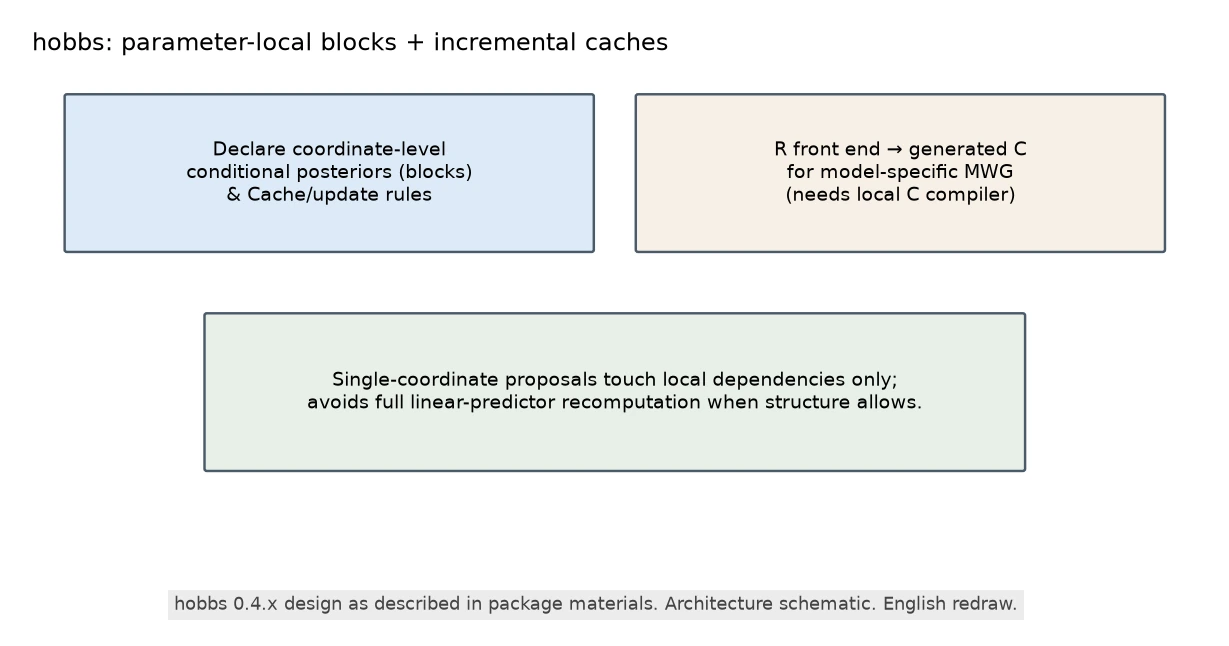
hobbs confines high-dimensional parameter updates to local dependency blocks and maintains the linear predictor terms through incremental caches (AI-generated illustration)
The High-Dimensional Bottleneck and Decoupling the Computation: Local Sampling Blocks and Deterministic Incremental Caches
In Bayesian statistical modeling, probabilistic programming systems (PPSs) such as Stan and JAGS let researchers declare a joint generative model in a form close to mathematical formulas, while the underlying engine carries out Markov chain Monte Carlo (MCMC) inference automatically. However, when the model grows from hundreds of parameters to tens of thousands or even more than parameters, architectures that treat the joint log posterior as a single black-box function run into a clear computational bottleneck. Whether it is computing a reverse-mode automatic differentiation gradient over the whole parameter vector or recomputing the full log likelihood on a single-coordinate update, as long as every proposal must traverse all the data and all the predictors, the cost per iteration grows multiplicatively with dimension. Yet in common statistical structures such as generalized linear mixed models (GLMMs) or high-dimensional sparse variable selection, a change in a single fixed-effect coefficient, random effect or discrete inclusion indicator often touches only a local likelihood term, or produces only a local incremental correction to a shared linear predictor vector.
To address this structural redundancy, the R package hobbs (High dimensiOnal Bayesian omniBus Sampler), developed by Mike Kleinsasser (version 0.4.5 released on CRAN on 5 October 2026, with the companion paper and software description released on Zenodo on 8 October), takes a different system-design route: it does not rely on a compiler to infer a sparse computational graph automatically, but lets the modeler declare the "model-specific computational structure" explicitly in a probabilistic program written in a C-like syntax. Its core consists of two primitives: the first is a parameter-local sampling block (block), used to specify which prior and likelihood contributions a scalar or indexed parameter truly depends on in a Metropolis-within-Gibbs (MwG) sweep; the second is a deterministic cache with an incremental update rule (cache and update). Take a regression structure with observations and predictors as an example: the linear predictor vector of length can be initialized with cache mu(n); when the -th regression coefficient makes a proposal, update mu(n) uses only the difference between the proposed value proposal(beta(j)) and the current value current(beta(j)) to update column-wise , reducing the full-matrix recomputation that would have cost to (and it can shrink further when sparse non-zero indices are used). If that Metropolis-Hastings proposal is rejected, the runtime engine automatically rolls back and restores the cache vector to its state before the update.
// Sketch of a hobbs model structure: a local sampling block and an incremental cache of the linear predictor
param beta(p) save=mean;

cache mu(n) {
    for (i = 1:n) {
        for (k = 1:p) {
            mu(i) += beta(k) * x(i, k);
        }
    }
}

block beta(j) {
    beta(j) ~ dnorm(0, 10);
    y_lpdf();
}

update mu(n) {
    for (i = 1:n) {
        mu(i) += (proposal(beta(j)) - current(beta(j))) * x(i, j);
    }
}
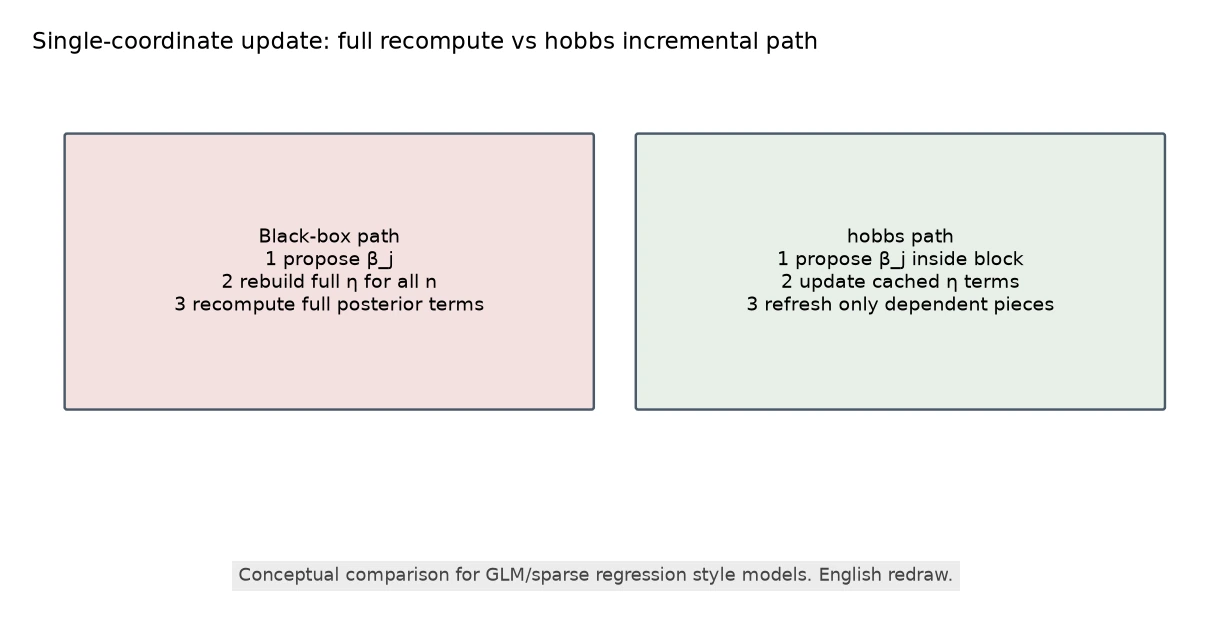
Full posterior recomputation compared with hobbs's parameter-local blocks and deterministic incremental cache update mechanism (AI-generated illustration)
A Two-Layer Compilation Toolchain and Validation on Cases with a Hundred Thousand Dimensions
In its engineering implementation, hobbs uses a two-layer compilation architecture: an "R front end that generates C code plus a reusable Rust sampling runtime". When the user calls hobbs() in R, the front end first translates the model script into compiled C code specific to that model's likelihood and cache structure, and then hands it to the underlying Rust engine, which carries out the Markov chain sweeps, step-size adaptation and binary chain output. When declaring a parameter with param, the modeler can choose the sampling kernel to suit the coordinate: continuous parameters use an adaptive scalar random-walk Metropolis by default (sampler=rwmh), and can also be switched to univariate slice sampling (sampler=slice) through a local modifier; bounded discrete parameters use an exact finite-state Gibbs update directly. To deal with the memory and disk exhaustion common in high-dimensional models, a save=mean modifier can be attached when declaring a parameter, instructing the sampler to accumulate only the online posterior mean after the burn-in period ends, without writing the full trace to disk; once sampling is done, researchers can use read_hobbs() to read the retained chain draws, or read_hobbs_mean() to extract the posterior means of high-dimensional nuisance parameters directly. In an everyday environment, it can be installed with install.packages("hobbs") and self-checked with hobbs_check_sampler(); installing the package and running models requires a local C compiler, and the Rust and Cargo toolchain needs to be configured only when building from source or explicitly rebuilding the underlying sampler.
As for methodological evidence, the project documentation and the companion paper give empirical support along two dimensions: "correctness alignment" and "high-dimensional scalability". First, to verify that the compiled code and incremental caches do not drift from the target posterior distribution, the project website provides a distribution validation suite aligned with Stan and JAGS, which systematically checks the agreement of posterior means, quantiles and distribution shapes on standard conjugate and non-conjugate benchmark models. Second, among high-dimensional application cases, the official materials show two typical scenarios: the first is a generalized linear mixed model (GLMM) with large-scale clustered random intercepts and random slopes, with parameter counts ranging from tens of thousands to more than , using group-local blocks to avoid repeated evaluation across clusters; the second is a high-dimensional sparse Bayesian variable selection model with about candidate predictors, which combines finite-state Gibbs updates of the discrete inclusion indicators with an incremental linear predictor cache for the regression coefficients, so that coordinate-level sweeps that could not have borne a full-matrix recomputation can be completed on an ordinary workstation.
Limits of Applicability: The Risk of Silent Bias from Hand-Written Caches and the Trade-Off with Posterior Correlation
Although local blocks and incremental caches substantially reduce the per-step cost in high dimensions, hobbs is not an unconditional replacement for general black-box samplers, and its first boundary is that responsibility for correctness shifts from the compiler to the modeler. In Stan or JAGS, as long as the joint log density or the directed acyclic graph is written correctly, the system can guarantee that the sampling target is consistent with the declared model; in hobbs, the runtime fully trusts the user's hand-written block and update logic. If a researcher omits, in some parameter's block, a likelihood term or hierarchical prior term affected by it, or writes the incremental correction formula wrongly in update, the C compiler and the Rust engine usually raise no syntax or runtime error, and instead silently sample from the wrong stationary distribution, causing hidden posterior bias. So when using hobbs on a new model, a prudent practice is first to compare the posterior distributions strictly against the results of Stan or JAGS on small-sample, low-dimensional simulated data, and to scale up to data with a hundred thousand dimensions only after confirming that the incremental update logic is correct.
The second key boundary comes from sampling geometry and posterior correlation structure. The core engine of hobbs is based on coordinate-level or local-block Metropolis-within-Gibbs (adaptive scalar rwmh, univariate slice and discrete finite-state Gibbs) and does not use the gradient geometry of the joint parameters. When high-dimensional parameters have sparse dependence or conditional independence structure (such as random effects across groups), or contain discrete indicator variables that HMC cannot handle directly (such as spike-and-slab variable selection), coordinate-level sweeps with or incremental updates have a strong advantage; but if continuous parameters show strong collinearity or complex, narrow curvature in the posterior, single-coordinate random-walk or slice sampling can move only in small steps along the coordinate axes each time, the autocorrelation time grows sharply, and the efficiency per effective sample size (ESS) may be far below that of the Hamiltonian Monte Carlo and No-U-Turn samplers (HMC/NUTS) used by Stan (and interfaces such as CmdStanR). In short, HMC/NUTS excels at conquering strongly correlated continuous posteriors at the price of costly full-graph gradient computation, whereas hobbs focuses on providing a programmable incremental-computation channel for models that are "high-dimensional, contain discrete indicators or have structured sparse dependence".
References
-
Kleinsasser, M. (2026). hobbs: A Probabilistic Programming System for High-Dimensional Bayesian Data Analysis (Version 0.4.5, published 2026-10-08). Zenodo. https://doi.org/10.5281/zenodo.23239260
-
Kleinsasser, M. (2026). hobbs: High Dimensional Bayesian Omnibus Sampler (R package version 0.4.5, published 2026-10-05). Comprehensive R Archive Network (CRAN). https://cran.r-project.org/package=hobbs
-
Kleinsasser, M. (2026). hobbs CRAN README: Installation and Linear Regression Block Example. CRAN. https://cran.r-project.org/web/packages/hobbs/readme/README.html
-
hobbs Project Website & Validation Suite Overview. https://hobbs-dev.github.io/
-
hobbs Companion Paper Page. https://hobbs-dev.github.io/paper.html
-
hobbs Case Study: High-Dimensional Generalized Linear Mixed Models (GLMM). https://hobbs-dev.github.io/examples/glmm.html
-
hobbs Case Study: High-Dimensional Sparse Variable Selection. https://hobbs-dev.github.io/examples/variable-selection.html
-
hobbs Tutorial Documentation. https://hobbs-dev.github.io/tutorial/index.html
-
hobbs Source Repository on GitHub. https://github.com/hobbs-dev/hobbs
-
Research Methods · Rituals can be imitated; understanding cannot be faked
-
Compiled and published by the Scholay all-in-one academic platform; if any rights are infringed, please contact us and we will take the content down.
-
Also published at Enter Scholar, a scholar community for the age of intelligence