After a statistical agency or health-data steward releases two differentially private event counts, researchers may still want to compare event risk between the groups. Fluctuations in those counts come from two places: sampling error in the data themselves, and random noise added by the release mechanism. If standard errors are still computed with ordinary binomial formulas, the second part is missed.
Tomer Shoham and Katrina Ligett study this problem in a 2026 preprint: when both group sample sizes are known and public, and the two event counts are each perturbed with independent noise, how can one construct confidence intervals for the risk ratio (RR) and the odds ratio (OR). The authors split the log-scale variance into a sampling term and a privacy-noise term, then form the standard error from their sum. An analyst who only has the released counts can therefore estimate how much privacy noise widens the interval, without returning to the raw data.[1]
Starting from two noisy counts
Let the two event counts be X and Y, independent binomial draws with public group sizes nₓ and nᵧ. What is released is X̃ = X + Nₓ and Ỹ = Y + Nᵧ; the two noise terms are independent of each other and of the original data. The released event rates are X̃/nₓ and Ỹ/nᵧ; dividing the former by the latter yields the RR estimate from the released counts. The OR instead compares each group's event-to-non-event ratio.[1]
Noisy counts can fall outside the usable range. Before computing ratios, the paper clips each count into its own [1, n−1] interval so that both the event and non-event counts are positive. Clipping and the subsequent ratio calculations are post-processing of already released results.[1]
Combining both variances on the log scale
For Gaussian noise, the paper's squared standard error for log RR can be written directly as two parts. Write the two noise variances as σₓ² and σᵧ²:[1]
The first part is binomial sampling variability; the second brings in the effect of count noise after the ratio transform. Because the two sources are independent, the variances add under a first-order approximation; their standard deviations must not be added directly. In practice one takes the square root of the total variance, forms a normal interval around the log-RR point estimate, and exponentiates both endpoints to obtain a positive ratio interval. A 95% interval uses a normal critical value of about 1.96.[1]
The OR construction follows the same idea, but its logarithm involves both event and non-event counts. Thus when either group's event count nears zero, or its non-event count nears zero, privacy noise is amplified on the log-OR scale. The RR noise term includes the squared reciprocal of the event counts directly, so the group with the smaller event count contributes more to the noise variance.[1]
A fixed-count scale illustration
The figure below fixes both public sample sizes at 200 and constructs released event counts of 80 and 40. The corresponding RR is 2 and the OR is 8/3. Holding those two counts fixed, the known standard deviations of the independent Gaussian noise terms are set to 0, 2, 5, and 10 in turn, so one can compare how the first-order standard error and intervals change as the noise variance changes.
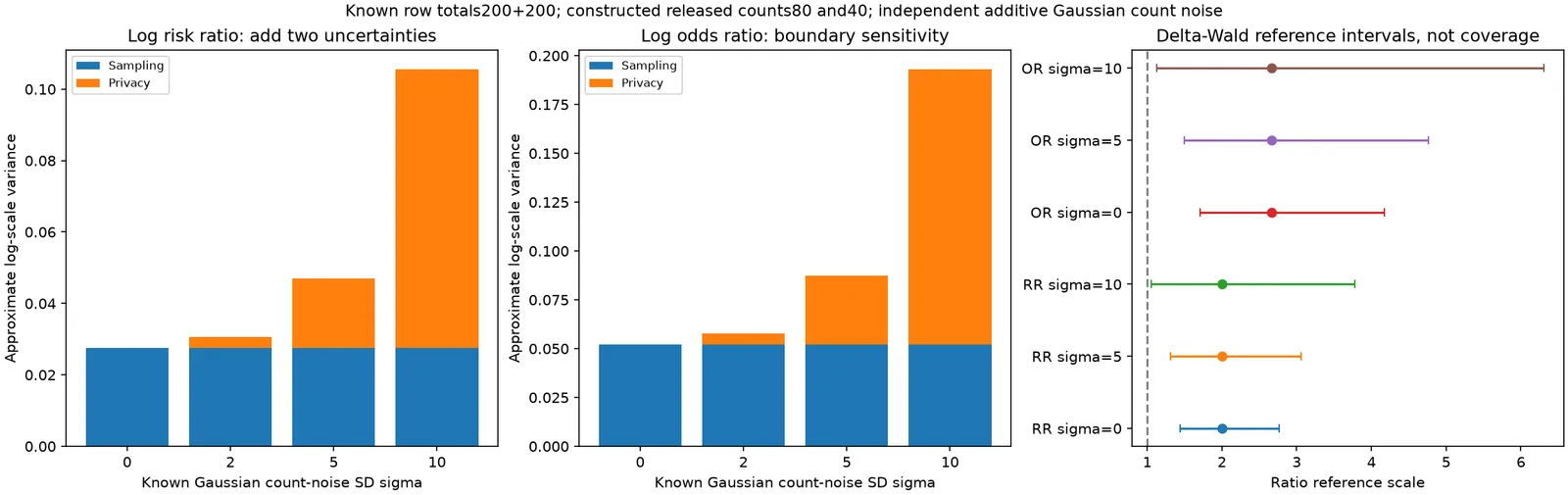
With public group sizes of 200 each and constructed released counts of 80 and 40, the known independent Gaussian noise variances yield a first-order variance decomposition and Wald-interval reference for log RR / log OR; this is not an empirical coverage study.
In this setting, the sampling variance of log RR is 0.0275 and the privacy-noise variance is 0.00078125σ². When the noise standard deviation is 5, the latter is about 0.0195; at a standard deviation of 10 it rises to 0.0781 and already exceeds the sampling term. Doubling the standard deviation multiplies the noise variance by four, so the reference intervals on the right widen markedly. The four noise levels are for scale; the point estimate is always computed from the same fixed pair of counts.
In the same illustration, the sampling variance of log OR is about 0.0521 and the privacy-noise variance about 0.00141059σ². The two ratios live on their own log scales; what matters in the figure is how much the privacy term grows relative to the sampling term within each measure. That comparison can be completed from the released counts and the mechanism's noise variances alone.
What the paper's results imply
The paper also compares how the two error sources shrink with sample size. With privacy parameters held fixed and both event proportions kept interior, the sampling standard error falls like the reciprocal square root of n, while the privacy-noise contribution falls like the reciprocal of n. As effective counts grow, the privacy term can become a smaller share of total uncertainty; when counts are sparse or noise is large, it should be computed separately.[1]
The authors also report analyses on simulated and real data tables that examine estimation bias, interval width, and coverage. In the simulation settings they present, some coverage rates are close to the nominal level. Those results give empirical support for the method and a reference for the variance decomposition: when privacy noise is large enough, intervals that include it reflect the extra uncertainty.[1]
The practical value of this advance is to turn post-release interval estimation into a computable diagnosis: obtain the two counts, public sample sizes, and noise variances from the releasing party, compute the sampling and noise terms separately, then build the interval on the log scale. Comparing the two terms shows how much the privacy mechanism affects inference at the current data size, and avoids treating the noisy point estimate as the whole answer.[1]
References
- [1] Shoham T, Ligett K. Differentially Private Confidence Intervals for Relative Risk and Odds Ratio. arXiv:2611.02951v1, 2026-11-02.