Mechanistic eco-evolutionary models can replay half a billion years of marine diversification, yet struggle to invert their own parameters: each forward run is costly, so Bayesian sampling stalls. INDITEK-2.0, published online on 22 October 2026 in Methods in Ecology and Evolution, compresses a forward run to about 30 seconds and attaches MCMC, recovering parameter posteriors from present global diversity patterns and retrieving true values on synthetic data.
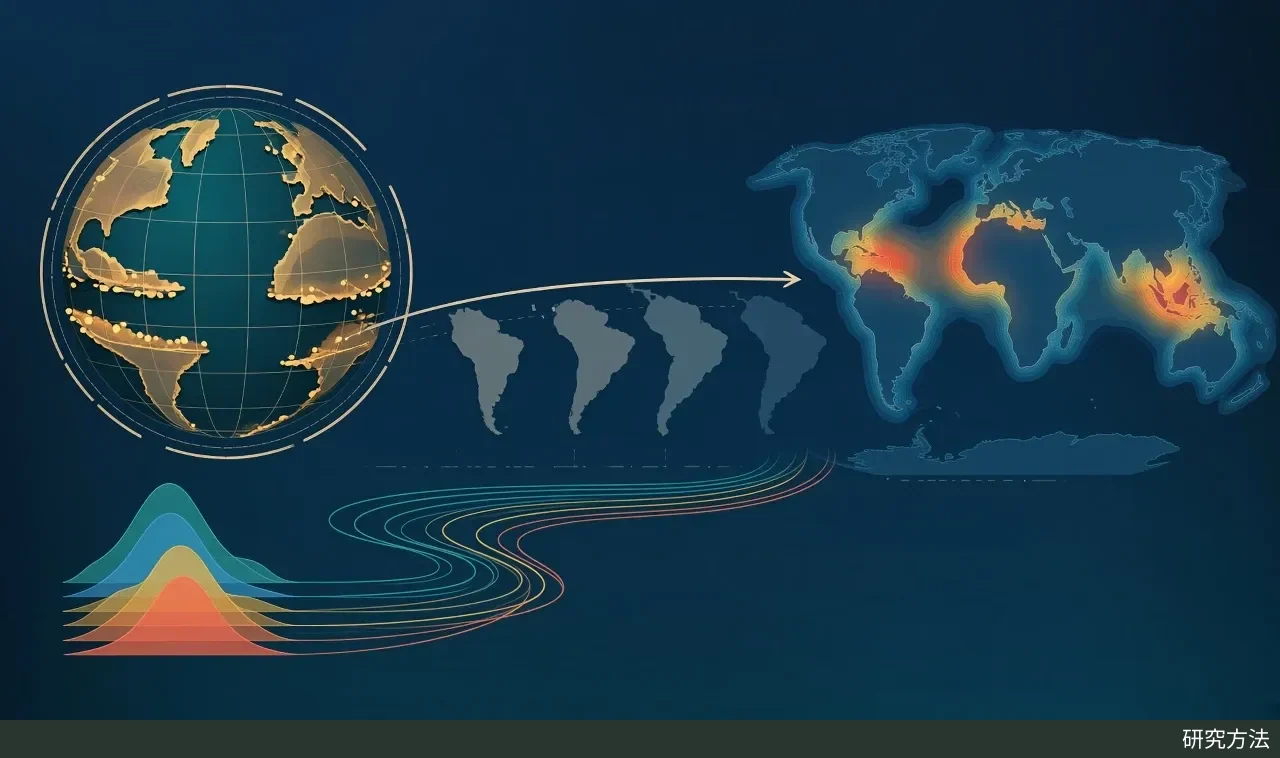
Conceptual figure of deep-time forward simulation and Bayesian inversion: shelf points on the left Earth drift with plates and land along a time arrow on the present diversity heat map at right; several sampling chains below flow back into a parameter posterior. AI-generated schematic; continents, hot spots, and curves are illustrative, not paper results.
From forward to inverse: narrowing the model for samplable speed
INDITEK is a spatially explicit diversification model. It treats seafloor sites from plate reconstructions as "particles" that drift with plates; each particle carries the temperature and food supply it experienced and accumulates genus-level diversity via a logistic equation: speciation rates range between set minima and maxima and rise or fall with sea-surface temperature (via a Q10 coefficient) and marine export productivity (via a Michaelis–Menten equation); carrying capacity K varies linearly with net primary productivity between Kmin and Kmax; background extinction is constant, while mass-extinction magnitude and timing are imposed from fossil diversity curves. Forward direction is "parameters → ~500 Myr of diversification → present diversity in each 0.5°×0.5° cell."
Inversion reverses that: given the present diversity map, which parameter combinations can generate it, and with what probability? MCMC typically needs thousands of forward runs; if each is slow, probabilistic inversion is infeasible—the gap the abstract names. INDITEK-2.0 speeds up by two narrowing choices: it does not track individuals or species, but treats diversity above the species level as the state variable; and it simulates only continental shelves, where most marine diversity concentrates. Per the code repository, a single simulation drops to about 30 seconds, making multi-chain, multi-thousand-iteration sampling feasible.
Metropolis–Hastings inversion loop and priors
The inversion skeleton is a parallel Metropolis–Hastings algorithm. Each step randomly perturbs current parameters to a candidate set; runs a full forward simulation with those candidates to produce a simulated present diversity map; then compares cell by cell with the observed map to form a residual sum of squares (RSS) normalized by observation-error variance. Lower RSS accepts the candidate; higher RSS accepts with a probability that avoids trapping in local optima. Several chains start from different points; after discarding burn-in, remaining parameter samples approximate the posterior. In the code, the main entry inditek_parallelMCMC.py loads data, sets priors, and assigns chains; inditek_MCMC.py handles each accept/reject step; inditek_main_2.py completes one forward run and hands off to inditek_model_proof.py for RSS.
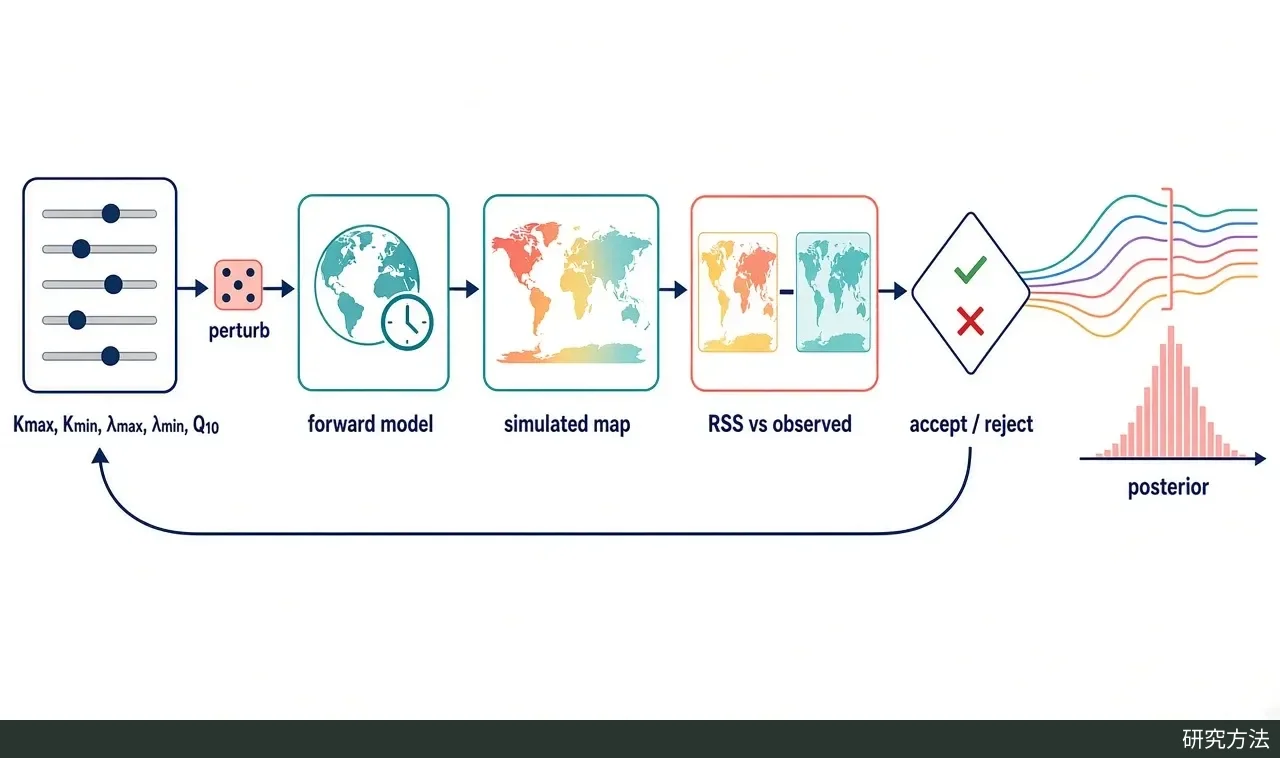
Schematic of the Metropolis–Hastings inversion loop: parameters (Kmax, Kmin, λmax, λmin, Q10) are randomly perturbed, one forward run produces a simulated map compared with observations via RSS, then the candidate is accepted or rejected and returns to parameters; parallel chains on the right form a posterior histogram. AI-generated schematic; map colors and histogram shapes do not represent paper data.
Five parameters are estimated: carrying-capacity bounds Kmax and Kmin, speciation-rate bounds λmax and λmin (spec_max and spec_min in code), and temperature sensitivity Q10. With little prior information, the first four use uniform priors; Q10 uses a Gaussian prior because literature values for marine invertebrates often fall between 1 and 3. Candidates outside allowed ranges are rejected outright. Output is not a single best-fit point but a probability distribution over parameter space and, from it, a set of diversity histories each carrying probability.
Synthetic recovery of truth and mechanism-sensitivity experiments
Validation is a "known-answer" synthetic experiment. Authors first generate present global shelf diversity from reference truths set after Cermeño et al. 2022, add Gaussian noise with a 2-genus standard deviation per cell to mimic observation error, then give only that noisy map to inversion. In the preprint's second version, six chains draw Latin-hypercube starts within ±20% of truth, each for 2000 iterations with the first 200 as burn-in. Kmax, Kmin, and λmax stabilize within 500–1000 iterations; Q10 and λmin converge more slowly, with some λmin chains needing nearly 1500; all five truths fall inside 65% posterior credible intervals, and diversity maps recomputed from posterior means show no clear regional bias versus the synthetic map. The journal abstract summarizes: target parameters were recovered at relatively low uncertainty.
The joint posterior also reveals parameter coupling: λmin correlates strongly positively with Q10; λmax correlates negatively with Kmax and positively with Kmin. The authors' reading is that a very high speciation ceiling must pair with a lower carrying-capacity ceiling so diversity does not overrun observations, while higher baseline diversity needs faster growth to explain the map. For users, inspecting a single parameter's marginal posterior understates how parameters can compensate for one another.
The journal version adds mechanism-sensitivity experiments; the repository lists five configurations: proof is the concept demonstration above; open widens the initial parameter window to test convergence far from truth; expo removes carrying-capacity constraints so diversity grows exponentially; temp removes temperature dependence of speciation; food removes marine export productivity's effect on speciation rate. Comparing posteriors and RSS across configurations shows whether the model can still fit the same present map after a mechanism is switched off: a clear fit deterioration means the present pattern carries that mechanism's signal and the corresponding parameters are identifiable from the data.
This evidence is a self-consistency check: data are generated by the same model that inverts them; the paper does not head-to-head compare other parameter estimators on the same data. The inferential target differs from existing practice. Birth–death models on dated molecular phylogenies have long estimated diversification rates and rate shifts probabilistically; INDITEK-2.0 attaches probabilistic inference to a spatially explicit mechanistic model whose parameters map directly onto temperature, food, and carrying capacity, and can trace diversity histories of a modern region (the Caribbean and Mediterranean in the paper) along plate trajectories.
Scope limits and reuse conditions
Validation so far stops at synthetic data. The preprint notes that recovered histories differ little from one another—mainly from the added noise—and should disperse more under real observations; observed_D.npz in the repository is also simulated concept-proof data. The tool is therefore not yet empirically calibrated for a taxon class, nor a claim to have reconstructed true Phanerozoic diversity history or to replace fossil-record sampling standardization. Conclusions also depend on forcing inputs: seafloor ages from plate/paleo-elevation models, temperature and food from the cGENIE Earth-system model, mass-extinction magnitude and timing from fossil diversity curves, and shelves from a land–shelf–ocean mask. Environmental inputs currently use only 30 time slices (each spanning 10–20 Myr) and a 36×36 equal-area grid, with constant background extinction; change those settings and posteriors change with them.
The error model is likewise an approximation. Per the preprint, RSS is the cell-wise residual sum of squares divided by noise variance—equivalent to assuming independent equal-variance errors across cells, not a full process likelihood—so posterior width hinges on that error setup. For reuse, the code is Python (developed under 3.9.18, tested under 3.8.12); data and code are also on Zenodo, version 1.0 released 24 August 2026, package about 190 MB; the paper is CC BY-NC, so reuse of figures and text requires attribution and non-commercial use. A safer use is to test which mechanism combinations can explain present patterns and to propagate parameter uncertainty into reconstructed diversity histories.
References
-
Herrero-Gascón, G., García-Comas, C., Bodin, T., Benton, M. J., Gurung, K., Mills, B., Pohl, A., & Cermeño, P. (2026). INDITEK-2.0: A Bayesian inverse modelling framework for mechanistic evolutionary processes. Methods in Ecology and Evolution. https://doi.org/10.1111/2041-210x.70422
-
University of Bristol Research Portal. INDITEK-2.0: A Bayesian inverse modelling framework for mechanistic evolutionary processes. https://research-information.bris.ac.uk/en/publications/inditek-20-a-bayesian-inverse-modelling-framework-for-mechanistic/
-
INDITEK-eco-evo-Model. INDITEK-2.0 (GitHub repository). https://github.com/INDITEK-eco-evo-Model/INDITEK-2.0
-
Herrero Gascón, G., García-Comas, C., & Cermeño, P. (2026). Data and code for: INDITEK-2.0: A Bayesian inverse modelling framework for mechanistic evolutionary processes (Version 1.0). Zenodo. https://doi.org/10.5281/zenodo.22079167
-
Cermeño, P., García-Comas, C., Herrero Gascón, G., Benton, M. J., Bodin, T., Gurung, K., Mills, B., & Pohl, A. (2025). INDITEK-2.0: A Bayesian inverse eco-evolutionary modelling framework for reconstructing Phanerozoic biodiversity. bioRxiv. https://doi.org/10.1101/2025.08.22.671786
-
Research Methods · Rituals can be copied; understanding cannot be faked
-
Information compiled and published by the Scholay academic one-stop platform; please report infringement for takedown.
-
Also published on Enter Scholar, a scholars' community for the intelligent era