Why do infant monkeys cling to their mothers: because the mother provides food, or because bodily contact itself brings comfort? Harlow separated the milk bottle from the soft surface and let infant monkeys choose between two surrogate mothers, then observed daily contact and reactions after a fright. The design turned entangled feeding and touch into comparable conditions and gave attachment behavior recordable measures.
Separating Feeding Location from Contact Surface
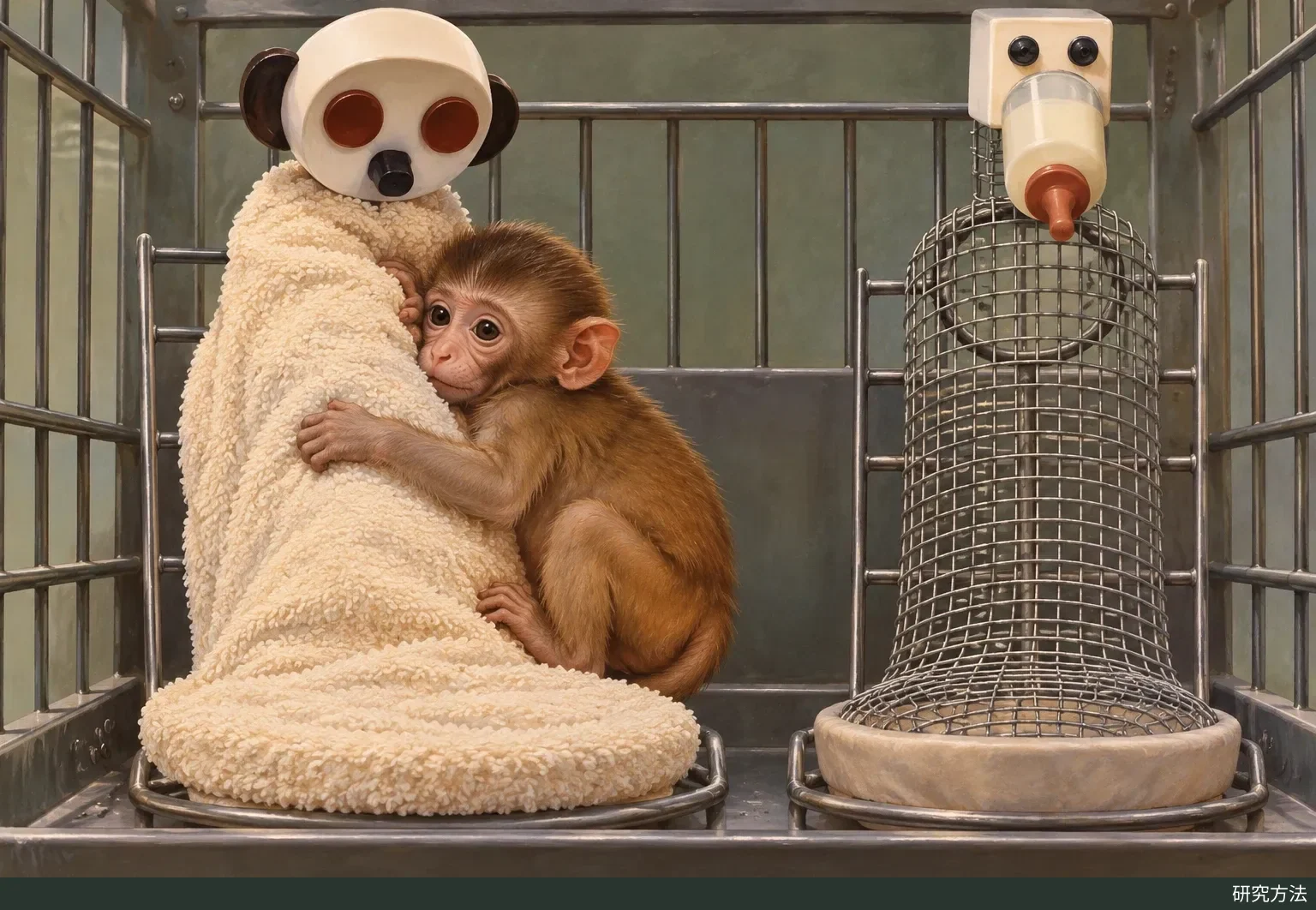
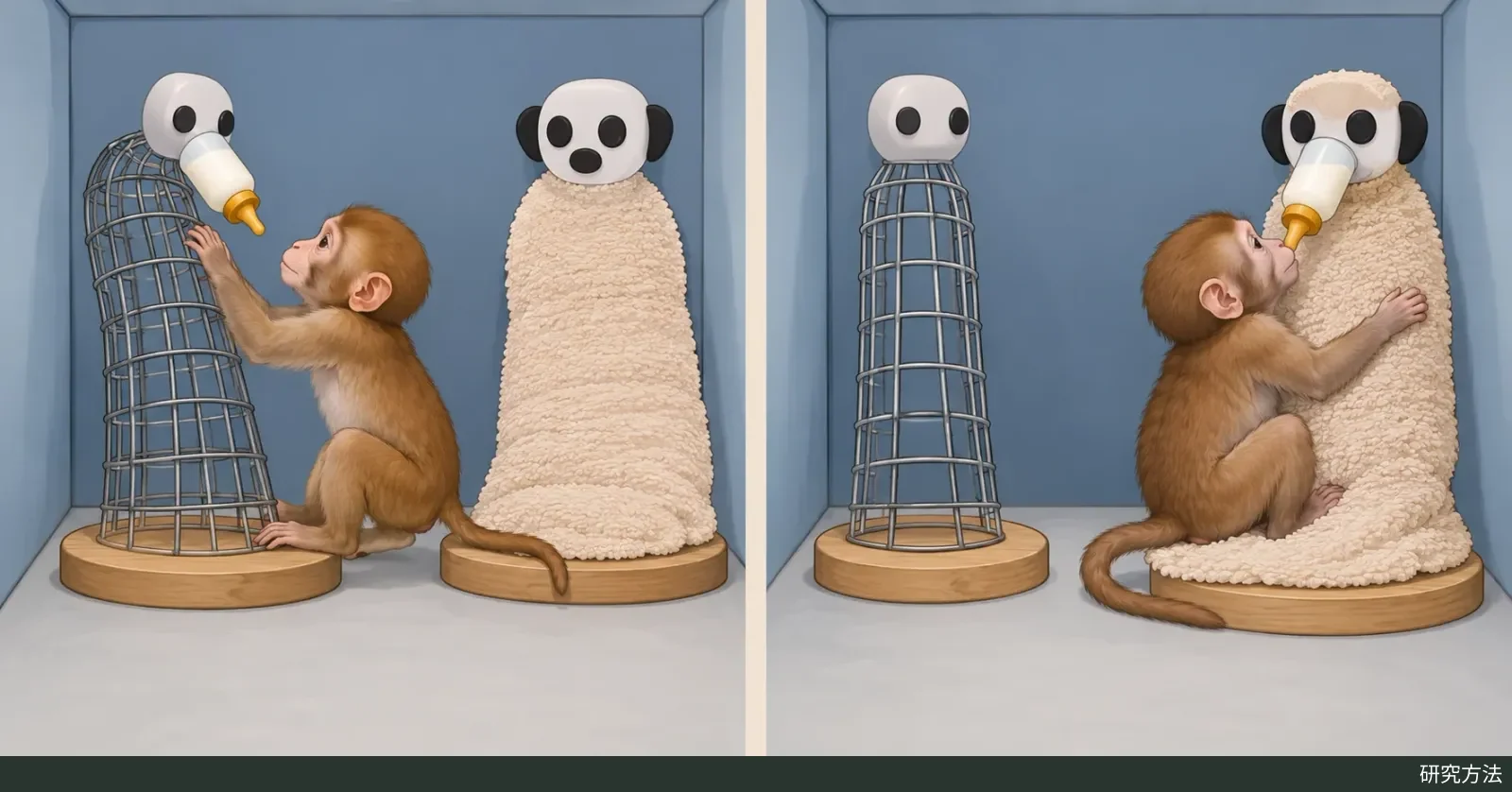
The 1958 report describes a two-surrogate condition: each infant rhesus monkey's living cage was connected to two small compartments, one holding a cloth surrogate and one a wire surrogate. The two were built as similarly as possible, differing mainly in the surface available for contact. Of eight newborn monkeys, four were fed milk from the cloth surrogate and the other four from the wire surrogate; every one had access to both. The bottle position was swapped between groups, while material preference was compared between the two options within each infant.
If infants simply followed whoever supplied milk, swapping the bottle position should change which surrogate they mainly stayed with; if soft contact itself mattered, the cloth surrogate should receive more contact even when it supplied no milk. The researchers recorded how much time each infant spent in contact with each surrogate per day and tracked it with age. Other groups lived with only a wire surrogate or only a cloth surrogate, providing single-surrogate comparisons, but those conditions gave no chance to choose between the two.
Contact Time and Choice After a Fright
Under both feeding configurations, infants spent more contact time on the cloth surrogate. When the bottle was on the wire side, infants went to the wire surrogate to feed but afterward still stayed mainly on the cloth side. The report's figure shows that for the early wire-fed group, mean contact time with cloth rose with age in days while contact time with wire stayed low. Feeding location affected where nursing happened, but it did not make the milk-supplying wire surrogate the main object of contact.
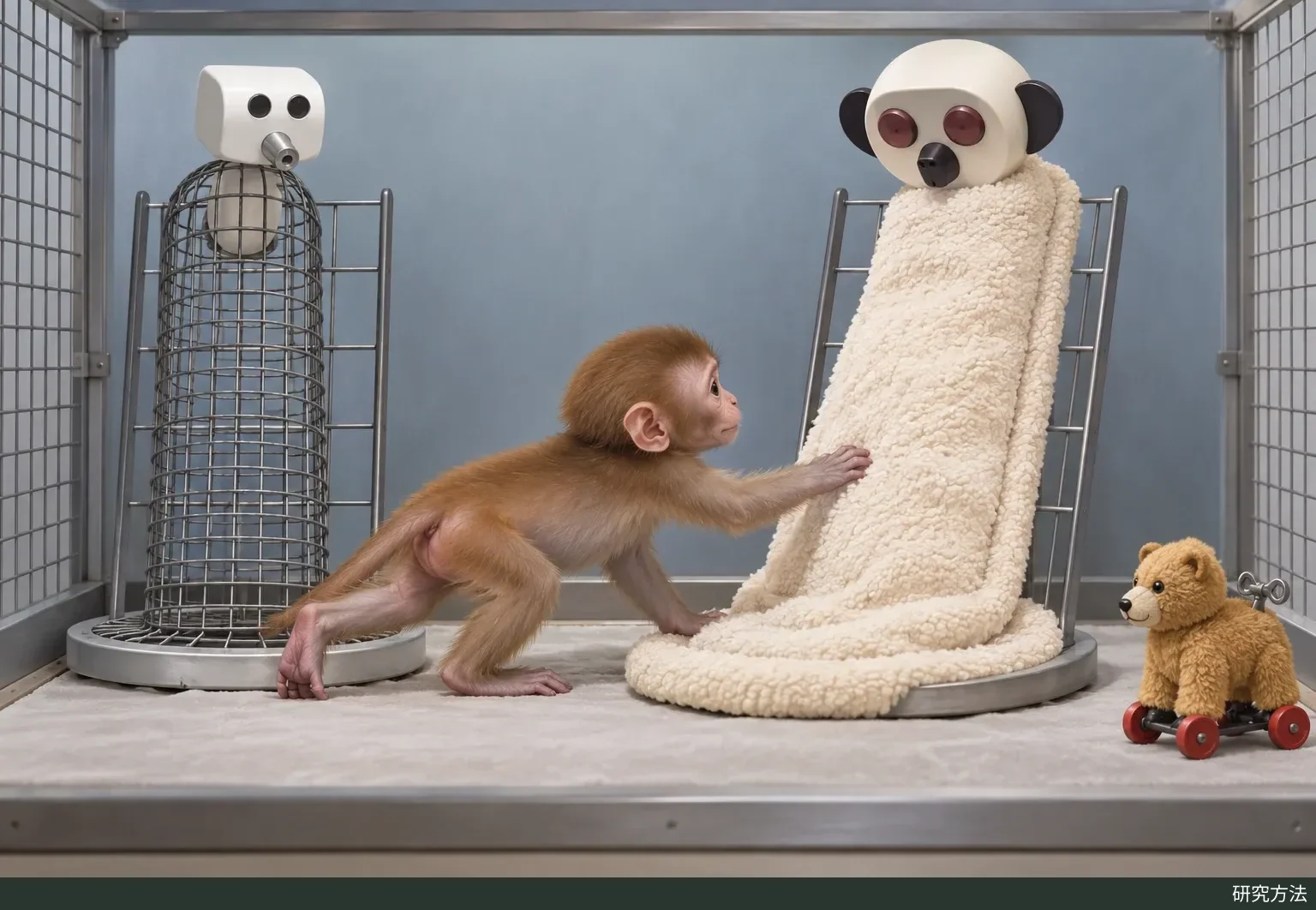
The researchers also presented fear-inducing stimuli in the cage, such as a moving toy bear, and watched which surrogate the infant ran to. The report states that frightened infants favored the cloth surrogate, under both feeding configurations. This is a different observation from everyday time spent: it shows where an infant seeks refuge when the environment suddenly becomes unsettling.
In another test in an unfamiliar environment, the researchers brought some infants into a room with novel objects and compared behavior with and without the cloth surrogate present. With the surrogate present, an infant could first touch it, then leave to explore and return to its vicinity; Harlow described this as using the surrogate as a base of activity. The exploration test and the in-cage two-surrogate fright choice are different procedures.
Conclusions, Extrapolation and Ethical Limits
The strength of the design is that it swaps the key conditions: soft surface and bottle position are no longer always bound together. Contact time and choice when frightened jointly support the view that, in this surrogate-rearing paradigm, soft contact is an important cue for attachment behavior, and that an account in which feeding alone forms attachment is inadequate. It does not directly measure human internal working models or neurotransmitters, cannot prove that touch determines all of development, and cannot deny the importance of nutrition and sensitive caregiver responsiveness.
The core two-surrogate sample was only eight animals, and the subjects were rhesus monkeys separated from their mothers and reared artificially; the results cannot be taken directly as effect sizes for human infants in families. Surrogate rearing and social isolation imposed serious welfare costs on the infants, and later isolation studies documented lasting behavioral damage. Contemporary animal research requires consideration of replacement, reduction and refinement, and designs that cause severe suffering must undergo strict ethical review and are hard to repeat as originally done.
References
-
Harlow, H. F. (1958). The nature of love. American Psychologist, 13(12), 673–685. Full text.
-
Harlow, H. F., & Zimmermann, R. R. (1959). Affectional responses in the infant monkey. Science, 130(3373), 421–432.
-
Research Methods · Rituals can be imitated; understanding cannot be faked
-
Compiled and published by the Scholay all-in-one academic platform. Please contact us to have it taken down in case of infringement.
-
Also published at Enter Scholar, a scholar community for the age of intelligence