Blood pressure, weight, or lab values in electronic records usually appear only when a patient contacts the health system. Return visits themselves may depend on current health: the measurements that appear in the data need not represent everyone's status. In a 2026 preprint, Iván Díaz places this informative missingness and time-varying treatment in one causal model to study how to estimate mean outcomes under treatment strategies.[1]
To estimate treatment effects, first handle who returns for measurement
Consider a longitudinal study that uses clinic records to compare treatment strategies. At each visit a clinician may record markers and adjust prescriptions; at times without a visit, contemporaneous markers are unseen. Even when two patients have similar past records, their then-unrecorded health may still affect whether they return. Analyzing only recorded outcomes folds the visit process into treatment-effect estimates.[1]
The paper's “self-censoring” model allows that dependence: whether a variable is observed can depend on the variable's own value at that time. Missing a visit does not mean health is absent; what is missing is measurement and recording. That differs from assuming recorded history alone explains missingness, so extra structure is needed to identify the target.[1]
Self-censoring is not new to this paper. Chen and coauthors studied causal inference when the outcome itself affects whether it is observed, and under conditions treated treatment as a “shadow variable.” Díaz extends related ideas to multi-time treatment strategies: treatment, health, and later visits interact over time and must be handled period by period.[1][2]
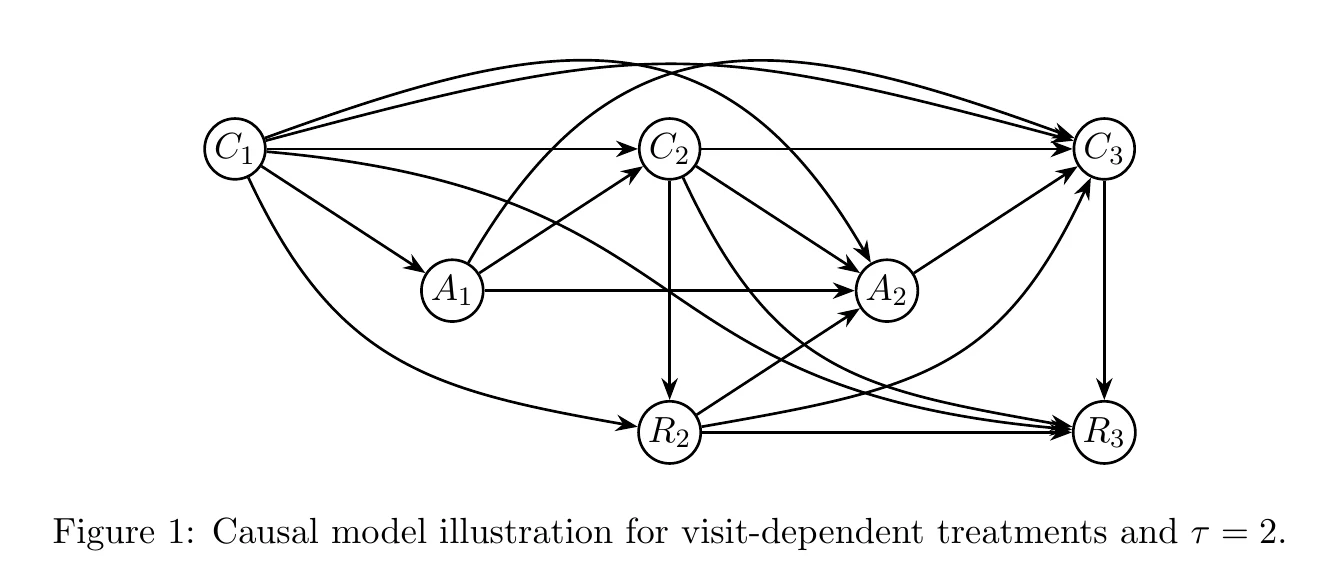
Figure 1|Causal sketch of visit-dependent treatment with two treatment times (τ=2): C denotes time-varying covariates, A treatment, and R whether a visit or measurement occurs. Arrows encode the paper's structural assumptions. Source: Díaz (2026), Figure 1, CC BY 4.0. License
Treatment can change; return visits are not forced on a fixed schedule
The paper focuses on “longitudinal modified treatment strategies”: follow a pre-specified rule that revises treatments that would otherwise have been received, then estimate the mean outcome at a chosen time under that strategy. For example, a rule may say: when the patient returns, start the drug if it has not yet been used; when there is no visit, treatment evolves under pre-defined continuation or expiry rules for the prior prescription.[1]
The intervention acts only on treatment; it does not require everyone to return on a fixed schedule. Under the strategy the visit process evolves naturally: changing medication may change health and may further change later visits. “Natural” therefore does not mean freezing each person's originally observed visit dates.[1]
Writing the strategy into data analysis requires distinguishing treatments that can change at a visit from status when there is no visit. Prescription dates, doses, days of supply, and renewals can define when a prior prescription remains active; the strategy must also be supported by treatment options that actually occur in the data.[1]
How treatment becomes a shadow variable for missing data
In one of the paper's settings, prior-period treatment is both the exposure in the causal problem and a shadow variable for next-period health. It supplies variation related to health; at the same time the model requires that, given previously observed history and next-period health, prior treatment is no longer associated with whether the next visit occurs.[1]
That is a substantive assumption about the visit mechanism. If a drug directly requires scheduled returns that are not fully represented by health and history in the model, treatment may affect visits through another path and the shadow-variable exclusion restriction fails. The model needs those paths stated; checking correlation between treatment and measured values alone is not enough.[1]
The paper uses a “bridge function” to link observed data to the missingness target. Write Hₜ for observed history before treatment at period t, Aₜ for treatment, Cₜ₊₁ for next-period health, and Rₜ₊₁ for whether next-period measurement occurs. Researchers seek a function βₜ satisfying E[Rₜ₊₁ × βₜ(Hₜ, Cₜ₊₁) | Aₜ, Hₜ] = 1.[1]
The identity uses observations under different treatment levels to constrain the missingness mechanism. When there is no measurement, Rₜ₊₁ is zero; when measurement occurs, Cₜ₊₁ and its bridge value enter the term. The model then uses the bridge to adjust observed outcomes and feeds the adjusted quantities into a longitudinal recursion—without first imputing a concrete marker value for every missed visit.[1]
More than one bridge may satisfy the identity. A key result is that, under the corresponding causal assumptions, support conditions, and range conditions on the adjoint operator for the target parameter, different bridge solutions still yield the same strategy mean outcome. Informative variation in treatment and health helps the construction, but correlation alone does not guarantee the range condition.[1]
Two histories, two sets of identifying conditions
In the first setting, observed history—including past visit patterns—is assumed sufficient to control confounding between treatment and later outcomes. Analysis can then build bridges and backward recursion around recorded treatment, history, and later measurements. Markers missed at a visit may still affect future health, but treatment-confounding control rests on that observed-history assumption.[1]
The second setting allows that fully controlling confounding needs the complete health history, including states unmeasured when visits were missed. The paper builds period-wise bridging and recursion for that case; it also requires stronger visit-process assumptions, including that complete history suffices to control confounding between the current visit–treatment pair and later variables.[1]
The second setting further limits how past visits affect later processes: visits may influence the future through treatment or care already included in the model, but the model does not allow an omitted independent visit pathway. For example, scheduled follow-ups, referrals, or pending tests that affect later visits must be represented in the treatment and care information the model uses.[1]
As time advances, people with complete history may become scarce. The paper also discusses building recursion from finite-horizon history: keep only the most recent periods and impose extra restrictions on earlier history given the retained state. That can enlarge the records usable for the relevant regressions while making history length part of the model specification.[1]
From identifying formulas to an entire outcome curve
For estimation, the paper first handles the strategy's treatment-distribution change and the bridge function, then estimates a sequence of conditional regressions from later times toward earlier ones, finally adding corrections for the recursion and bridge. Machine learning can fit the intermediate functions; the paper recommends cross-fitting so calculations on each validation fold use functions trained on the other folds.[1]
To estimate mean outcomes at several times, the paper also proposes pooling regression tasks that share the same position in the recursion and including time as a predictor so sparsely measured times can share information. Estimates are still reported separately for each outcome time rather than collapsing all times into one average.[1]
Under the paper's regularity conditions and product-rate conditions on intermediate-function errors, the estimators support asymptotic inference and simultaneous confidence bands covering multiple outcome times. The contribution is identification and estimation theory; broader finite-sample evaluation and sensitivity analysis when shadow-variable assumptions fail are listed as future work.[1]
References
-
Díaz, Iván. Longitudinal causal inference under informative missingness using the self-censoring model. 2026-10-06.
-
Chen, Jacob M., Daniel Malinsky, Rohit Bhattacharya. Causal inference with outcome-dependent missingness and self-censoring. 2023.
-
Research Methods · Rituals can be imitated; understanding cannot be faked
-
Compiled and published by the Scholay academic platform; report infringement for takedown requests.
-
Also published on Enter Scholar, a scholar community for the intelligent age