How can one observe an infant's attachment to a particular caregiver without merely tallying cries? Ainsworth and colleagues designed the Strange Situation: about one-year-old infants in a playroom experience a stranger entering, brief maternal departures and returns, then exploration, contact-seeking, and reunion behavior are compared. This fixed sequence turns a hard-to-watch relational organization into a recordable, codable behavior stream.
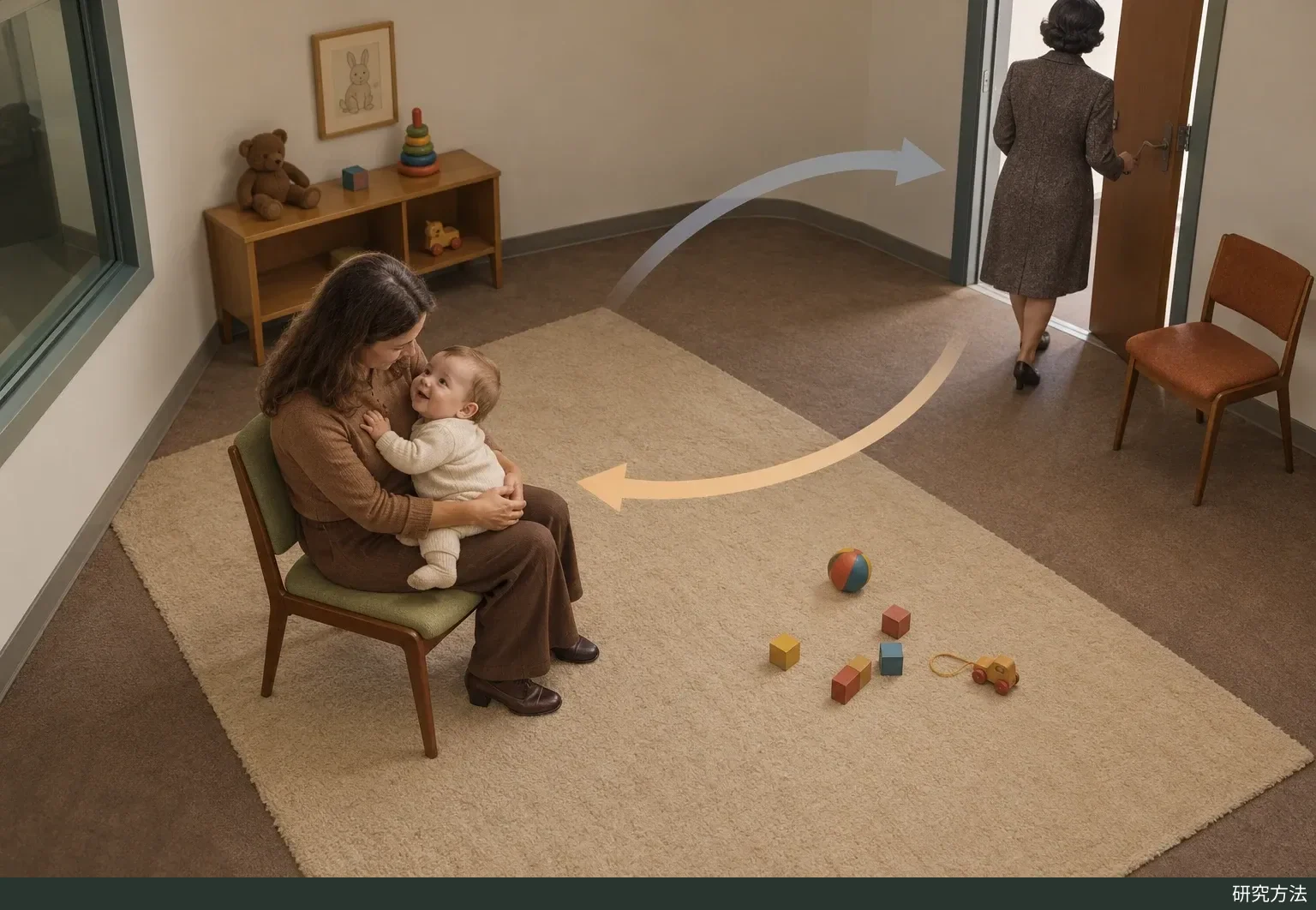
An eight-episode procedure in the playroom
In 1970, Mary Ainsworth and Silvia Bell reported observations of infants around one year of age. The room had toys, a chair for the mother, and a stranger's seat near the door; observers recorded behavior through a one-way window. Mother and stranger entered and left on a preset script while the infant could move freely. Researchers did not keep the child long separated from the mother; they briefly changed whether she was available in the same novel setting.
The eight episodes proceed in order:
- An observer accompanies mother and infant into the room, then leaves.
- The mother sits in the room while the infant may explore the toys.
- A stranger enters, sits quietly first, then talks with the mother and gradually approaches the infant.
- The mother leaves; the stranger stays with or comforts the infant as needed.
- The mother returns, pauses briefly at the door, and the stranger leaves; mother and infant reunite.
- The mother leaves again, leaving the infant alone.
- The stranger returns and responds to the infant as needed.
- The mother returns again, the stranger leaves, and the second reunion is observed.
Most standard episodes last about three minutes; the length of the first reunion depends on whether the infant resettles and returns to play. If distress during separation is excessive or inconsolable, the episode ends early. Termination rules are part of the procedure.
Observational conditions and behavior coding
The sequence arranges three observational conditions at once. The new room and toys offer exploration and may also activate dependence on the caregiver; the stranger appears before and after maternal absence so reactions to familiar and unfamiliar adults can be compared; two departures and returns provide two reunions. Conditions are stacked in a fixed order rather than randomly assigned as independent factors, so the procedure alone cannot estimate each factor's separate causal effect.
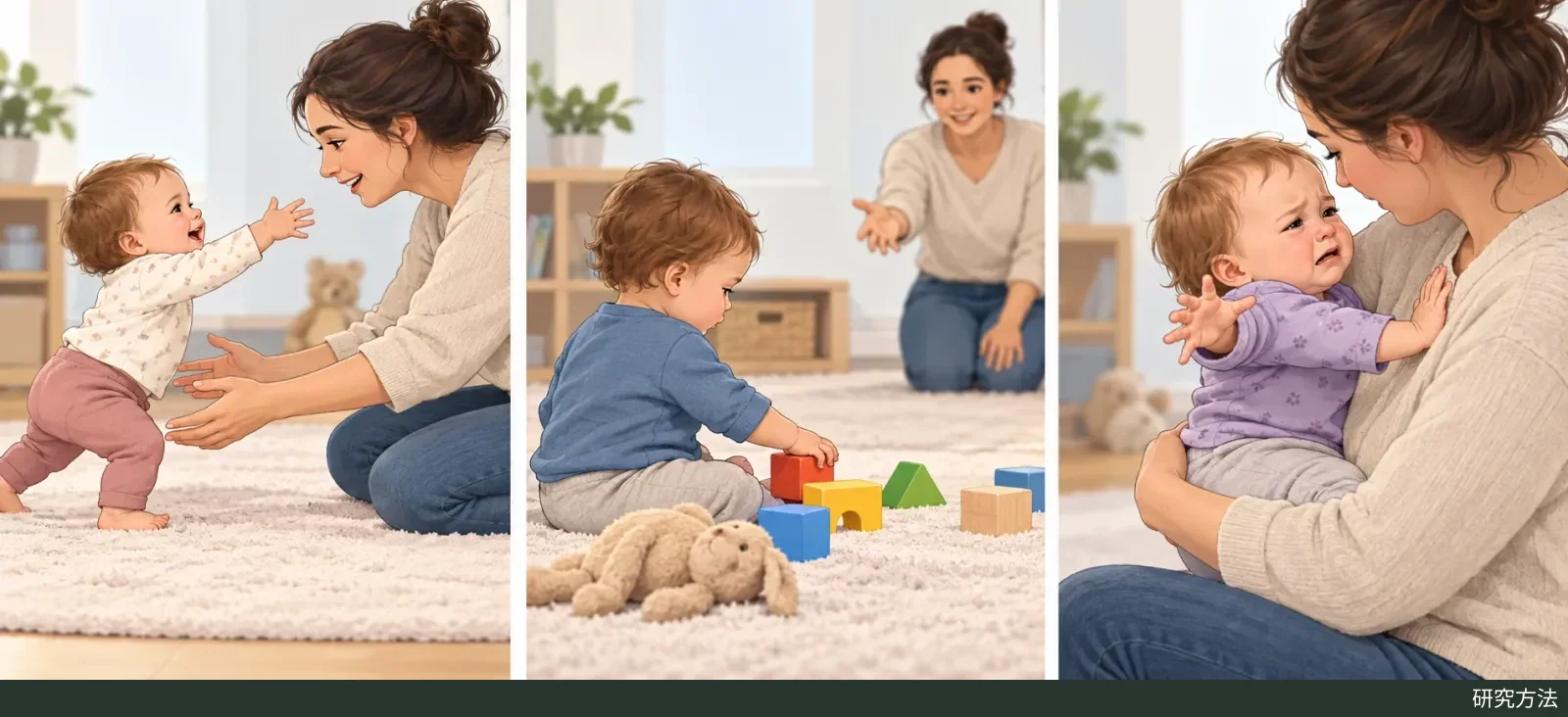
Observers record exploration and crying and also code by behavioral function: whether the infant approaches, reaches for, or crawls to the mother, and whether contact is maintained once gained; whether at return the infant looks away, turns, or walks off; whether during contact the infant pushes away or struggles. Classification concerns how these behaviors are organized across separation and reunion, not the loudness of a single cry. The original study coded from observational records; using the method requires trained coders and reliability checks.
Reunion patterns and interpretive limits
In the classic typology, secure type B usually seeks comfort from the mother at reunion and, once soothed, explores again; not every B infant seeks physical contact with equal intensity. Avoidant type A seeks or maintains contact relatively little, may turn the head or avoid the mother, and keep attending to toys. Resistant or ambivalent type C may seek or maintain contact while also resisting—struggling or pushing when picked up, for example—and settle less readily. Classification rests on multiple behavioral cues, not a single act.
These are organizations of behavior in a particular relationship and situation, not fixed personality labels or lifelong outcomes. Later work added type D, the disorganized/disoriented classification; how best to represent individual differences with categories versus continuous dimensions remains debated. The Strange Situation is not everyday home life: culture, caregiving arrangements, and daycare experience may change responses to separation and strangers, and cross-group comparisons need that context. Links between maternal sensitivity at home and laboratory performance can supply external evidence, but sensitivity is not manipulated inside this procedure; nor does the procedure directly measure neural representations of internal working models.
Brief separation itself stresses the infant. Contemporary use requires caregiver informed consent, ethics review, clear distress monitoring and early-stop plans, and comfort after reunion. Standardization aids comparison, but individual distress must not be ignored merely to fill episode length.
References
-
Ainsworth, M. D. S., & Bell, S. M. (1970). Attachment, exploration, and separation: Illustrated by the behavior of one-year-olds in a strange situation. Child Development, 41(1), 49–67. Original paper.
-
Ainsworth, M. D. S., Blehar, M. C., Waters, E., & Wall, S. (1978). Patterns of Attachment: A Psychological Study of the Strange Situation. Erlbaum. Publication information.
-
Duschinsky, R. Cornerstones of Attachment Research. Strange Situation classification table.
-
Madigan, S., et al. The First 20,000 Strange Situation Procedures: A Meta-Analytic Review.
-
The Open University. Attachment in the early years.
-
Research Methods · Rituals can be copied; understanding cannot be faked
-
Information compiled and published by the Scholay academic one-stop platform; please report infringement for takedown.
-
Also published on Enter Scholar, a scholars' community for the intelligent era