In two constructed rating records, two raters agree on 90 of 100 items in each set. The first set has Cohen's κ of 0.80; the second is about −0.053. The difference is that κ compares observed agreement with a chance-pairing baseline built from each rater's label distribution.
Two tables, the same 90% agreement
Imagine two raters judging whether images contain a guitar, 100 images per set. “Yes” means a guitar is present; “No” means it is not. Rows are rater A's judgments and columns are rater B's; cells on the main diagonal are the agreements.
Set 1: balanced labels
| A / B | Yes | No | A total |
|---|---|---|---|
| Yes | 45 | 5 | 50 |
| No | 5 | 45 | 50 |
| B total | 50 | 50 | 100 |
Set 2: few “Yes” labels
| A / B | Yes | No | A total |
|---|---|---|---|
| Yes | 0 | 5 | 5 |
| No | 5 | 90 | 95 |
| B total | 5 | 95 | 100 |
In Set 1, 45 images are jointly “Yes” and 45 jointly “No,” so observed agreement is (45+45)/100=90%. In Set 2, 0 are jointly “Yes” and 90 jointly “No,” so observed agreement is also (0+90)/100=90%. Each set has 10 images where the raters disagree.
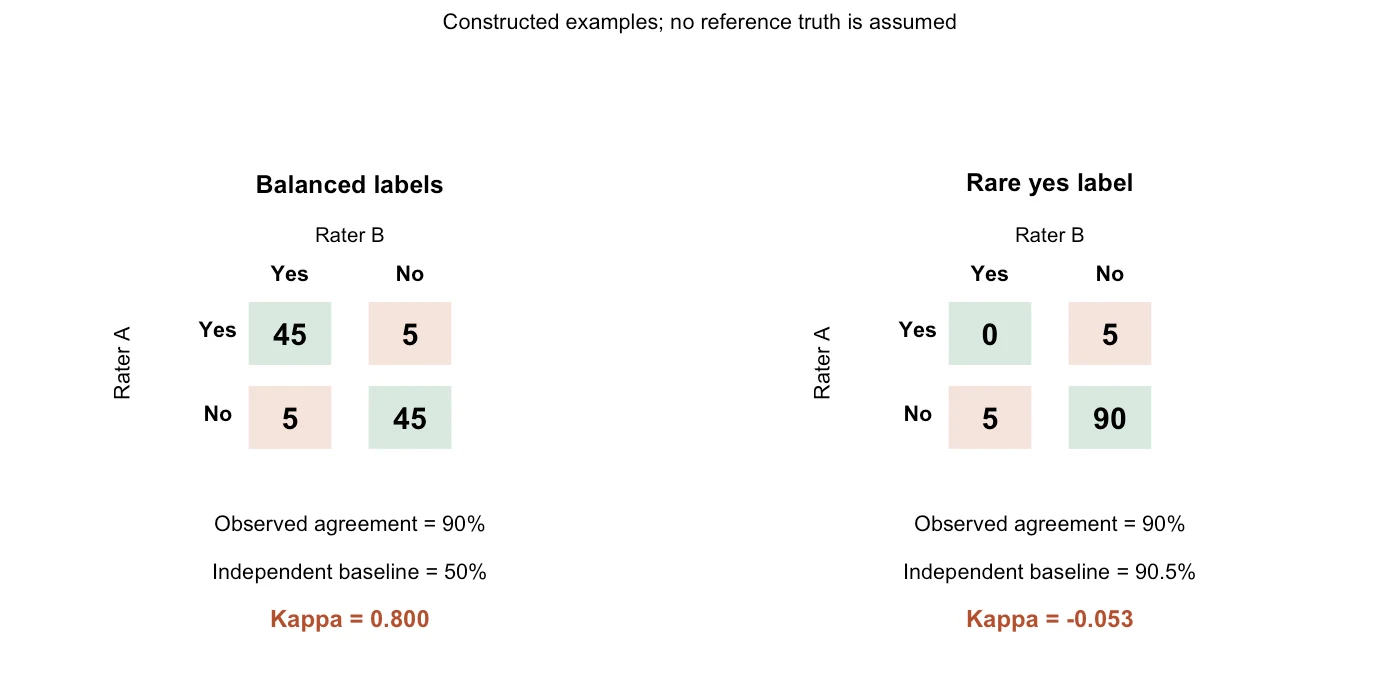
Figure 1|In two constructed binary rating tables, both pairs of raters have 90% observed agreement; chance baselines from their own margins are 50% and 90.5%, yielding Cohen's κ of 0.800 and about −0.053. The example sets no external ground truth.
What κ compares agreement against
When a label is used often, randomly re-pairing the two raters' labels can still produce many matches. Cohen's κ compares item-by-item observed agreement with a chance-pairing baseline computed from each rater's label proportions.[1]
That baseline keeps each person's category counts and imagines randomly re-pairing the two label lists. For each category, multiply A's and B's proportions for that category and sum across categories. The independence model is a comparison baseline; it does not claim the raters actually scored at random.[2]
Write observed agreement as Pₒ and the chance baseline as Pₑ. In this binary example:
Pₑ=(A's Yes rate)×(B's Yes rate)+(A's No rate)×(B's No rate)
κ=(Pₒ-Pₑ)/(1-Pₑ)
The numerator is the gap between observed agreement and the baseline; the denominator is the distance from the baseline to perfect agreement. κ therefore measures how much of that remaining agreement space the observations fill relative to the baseline.
In Set 1 each rater uses “Yes” half the time and “No” half the time, so Pₑ=0.50×0.50+0.50×0.50=0.50. With Pₒ=0.90, κ=(0.90-0.50)/(1-0.50)=0.80: the excess over the 50% baseline fills 80% of the distance from baseline to perfect agreement.
Where the negative value comes from
In Set 2 each rater uses “Yes” 5% of the time and “No” 95%. The same formula gives Pₑ=0.05×0.05+0.95×0.95=0.905, or 90.5%. Observed agreement is still 90%, so κ=(0.90-0.905)/(1-0.905)=−1/19, about −0.053.
The minus sign comes from the numerator: 90% is 0.5 percentage points below the 90.5% baseline. In terms of disagreements, Set 2 has 10 disagreements, while the chance baseline expects 9.5 per 100 on average. Negative κ means observed agreement is below the baseline in use—not that disagreements outnumber agreements.
Reading a negative κ: return to the cross-tabulation
Set 2's 90 agreements all come from joint “No.” Of A's 5 “Yes” images, B never also says “Yes”; of A's 95 “No” images, B also says “No” on 90. Each rater uses “Yes” five times, but never on the same image.
Category proportions and the composition of agreements both change across the tables: Set 1 has 45 joint “Yes” images; Set 2 has 0. Overall 90% agreement compresses those differences into one number; κ, through the changing chance baseline, pulls the two results apart.
When reporting or comparing κ, therefore, also give the cross-tabulation, each rater's label proportions, and observed agreement. To improve a labeling task, inspect “A Yes, B No” and “A No, B Yes” items separately and check whether category definitions or image information invite different readings.[2]
References
-
Jacob Cohen. A Coefficient of Agreement for Nominal Scales. 1960.
-
Michael Quinn, Jeremy Miles, Ka Wong. Measuring Validity and Reliability of Human Ratings. 2023-07-18.
-
Research Methods · Rituals can be imitated; understanding cannot be faked
-
Compiled and published by the Scholay academic platform; report infringement for takedown requests.
-
Also published on Enter Scholar, a scholar community for the intelligent age