A worker suddenly injures a hand on the job. Before the injury, was he performing a task he rarely does? To study questions like this, the case-crossover design does not first find an uninjured worker as a control; instead, it compares his exposure before the injury with his exposure in other comparable periods. Pooling this within-person comparison across many cases lets us estimate the association between a transient exposure and the timing of an acute event.[1]
The "control" here is time, not another person. Characteristics of the same person that stay unchanged across the comparison periods, such as genetic background, do not become confounders in the within-person comparison. The focus of the study thus shifts: is the exposure before the event different from this person's exposure in suitable reference periods?[1][2]
First define the event and the exposure window
The design starts from the time of the event. Researchers first determine what counts as an event and when it occurred, then, according to the time over which the exposure might act, define the hazard window before the event. For example, if the question is whether a non-routine task was performed in the hour before the injury, one must first list which tasks count as exposures, and use the same rule to judge whether they occurred in that hour.[2]
Suppose a worker is injured at 10:30 on a Wednesday, and the researchers take 9:30 to 10:30 that day as the hazard window. The reference window is also one hour, taking 10:30 on other suitable days as the reference time point and checking whether the same defined tasks were performed in the preceding hour. What is compared is not simply "injured today, not injured on another day", but the exposure in the two windows.
How to choose reference periods
One time-stratification method first divides dates by year, month and day of the week, then selects reference days within the same stratum. For example, if the 15th of a month is a Wednesday, the other Wednesdays are the 1st, 8th, 22nd and 29th; where they meet the study conditions, these four days can serve as references for the 15th. Environmental epidemiology studies often use this same-year, same-month, same-weekday selection, which focuses the comparison on similar seasons and also aligns weekly cycles.[1][3]
Having the same weekday is not enough: for an occupational injury question, a reference period should be a time when this person was also at work and had the opportunity for the studied injury to occur. If he was on leave one of those days, or his post and tasks changed after returning to work following the injury, one cannot declare it comparable merely because "it was also a Wednesday". The study protocol needs to specify in advance how absence and post-event changes in work are handled.[2]
The rule for reference days affects the results. If an exposure keeps rising over calendar time and reference periods are taken only from before the event, the reference values may be generally lower simply because they are earlier, creating a difference even when exposure and event are unrelated. Taking references at fixed intervals both before and after the event can change this problem, but selecting references can still introduce bias; time stratification first delineates non-overlapping strata of dates and then compares within each stratum.[1]
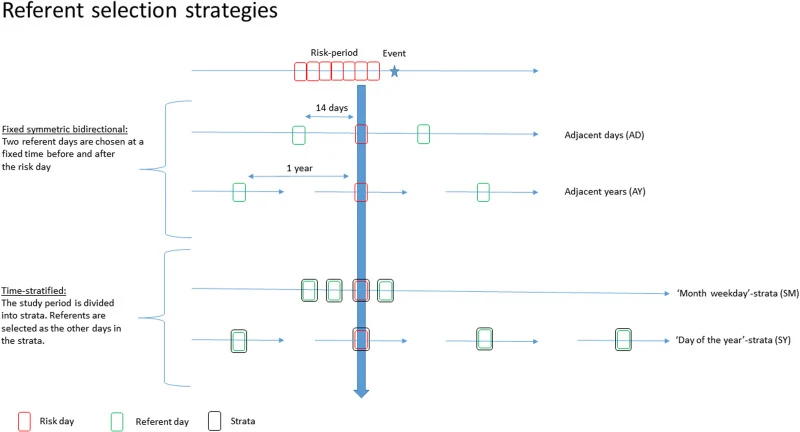
Figure: Different ways of choosing reference days. Red boxes are hazard days, green boxes are reference days, black boxes indicate time strata, and the asterisk marks the event. Source: T. Braeye, N. Hens, 2020, Fig. 2[1]; CC BY 4.0.
What the matched periods give us
Start with the simplest case: each case has only one reference window, and exposure is simply "yes" or "no". The table below constructs 20 matched sets; the two windows in each set belong to the same worker.
| Non-routine task in hazard window | Non-routine task in reference window | Number of pairs |
|---|---|---|
| Yes | Yes | 4 |
| Yes | No | 6 |
| No | Yes | 2 |
| No | No | 8 |
In this example with a single exposure and one reference window per case, pairs in which the two windows have the same exposure provide no information on the exposure difference; the calculation relies on the two kinds of discordant pairs: 6 sets with exposure in the hazard window but not the reference window, and 2 in the opposite direction. The crude matched odds ratio is 6÷2=3, meaning there are three times as many discordant pairs of the first kind as of the second.[4]
This 3 is an odds ratio obtained from matched data; it is not an absolute probability of injury, and by itself it cannot establish that non-routine tasks caused the injury. A formal study must also report the uncertainty of the estimate, and interpret the result in light of the choice of references, exposure measurement and confounders.
With multiple reference windows, or when other time-varying variables need to be included at the same time, conditional logistic regression is commonly used. The data form one matched set for each event and its reference periods, recording exposures and relevant variables in each period; the model compares the event time with the reference times within each set, then combines information across sets to estimate the association between exposure and the timing of the event.[1][3]
The same person also changes over time
The same person does not mean that all periods are identical apart from the exposure of interest. Workload, task assignments and fatigue can all change: for example, rushing to meet a deadline may affect both task assignment and the chance of injury. Researchers need to record such potential confounders in a comparable way in the hazard and reference windows, and handle them in the analysis according to the research question.[2]
The time precision of exposure records is equally important. If an interview after the injury can recall the tasks before the injury in detail but only roughly recall other days, the exposure in the two windows may be recorded differently. Shift, task or equipment records can help reconstruct what happened in each period; which records to use and whether the times are precise enough should be decided at the design stage.[2]
Braeye and Hens built a simulation using Belgian Legionnaires' disease and meteorological data to compare different reference-day strategies. They let the simulated event probability be influenced simultaneously by a given exposure effect, seasonality and a long-term trend; the results showed that even with time stratification, residual time variation within matched sets can still cause confounding bias. In the scenarios the authors set up, adding the corresponding seasonal terms or long-term trend removed the estimation bias, but reduced the statistical power to detect the effect.[1]
Therefore, when reporting a case-crossover study, one needs to state the event definition, the length of the hazard window, the rule for choosing reference periods, how exposure was recorded, which time-varying factors entered the model, and the estimates and confidence intervals. Comparing the results under different reasonable windows or reference schemes can also show how sensitive the conclusion is to the time choices.[1][2]
References
-
T. Braeye, N. Hens. Optimising the case-crossover design for use in shared exposure settings. 2020-05-04.
-
G. S. Sorock, D. A. Lombardi, C. L. Gabel, G. S. Smith, M. A. Mittleman. Case-crossover studies of occupational trauma: methodological caveats. 2001-09-01.
-
A. Tobias, Y. Kim, L. Madaniyazi. Time-stratified case-crossover studies for aggregated data in environmental epidemiology: a tutorial. 2024.
-
R. C. Dicker. Analyzing and Interpreting Data. 2025-01-06.
-
Research Methods · Rituals can be imitated; understanding cannot be faked
-
Compiled and published by the Scholay all-in-one academic platform. If any content infringes your rights, please let us know and it will be taken down.
-
Also published at Enter Scholar, the scholar community for the age of intelligence