On October 26, 2026, Nawaf Bou-Rabee of Rutgers University posted the preprint "Persistence Pays" on arXiv, proving that for smooth, strongly log-concave targets a Metropolis-adjusted kinetic Langevin sampler needs a number of gradient evaluations that grows with the condition number κ only as √κ. The key change is not in the integrator but in having the uniform random number used for accept/reject be updated "persistently" across steps.
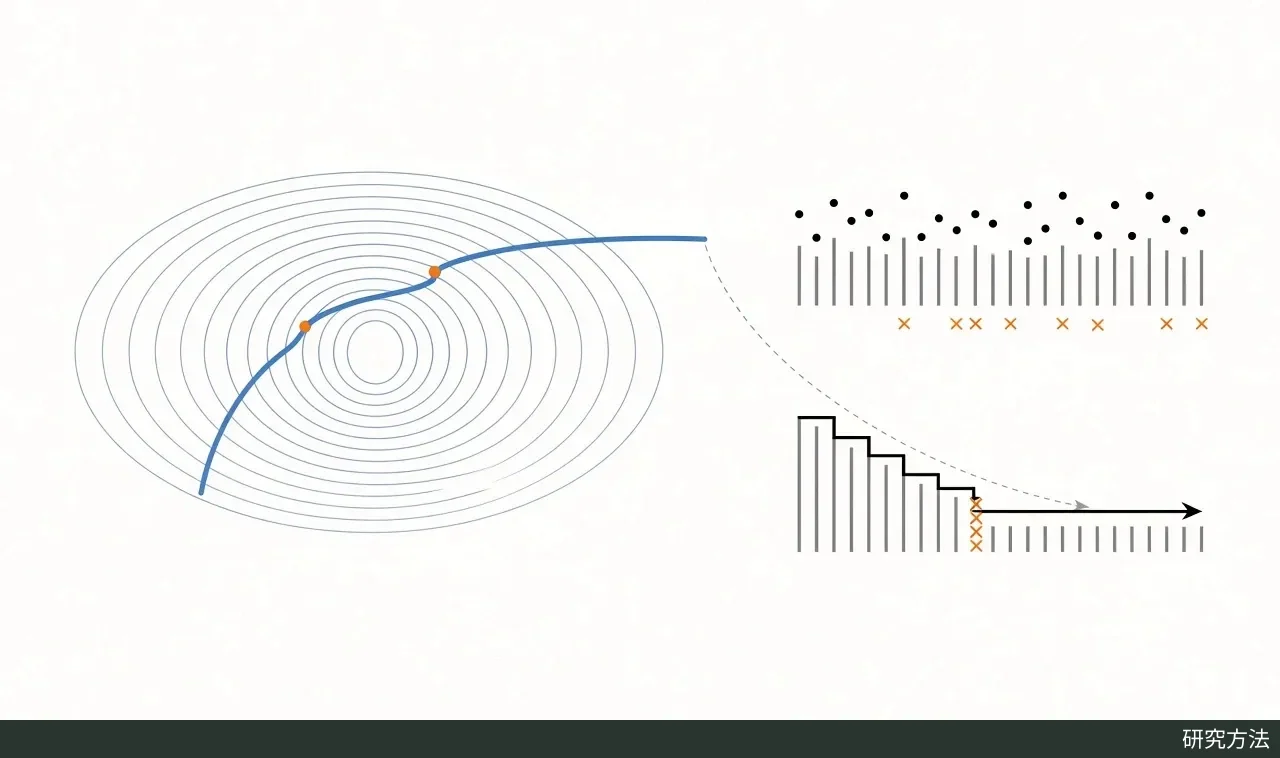
AI-generated schematic: a conceptual comparison of a kinetic Langevin trajectory and two kinds of acceptance threshold; it does not correspond to data in the paper.
1
The condition number κ=L/m describes the span of curvature of the target distribution: m and L are the lower and upper bounds on the Hessian of the potential U (the negative log density). The larger κ is, the further apart the steepest and flattest directions are: the step size is limited by the steepest direction, yet the chain has to travel far enough along the flattest one. For overdamped adjusted samplers such as MALA, the known mixing bounds over the whole strongly log-concave class grow linearly in κ.
Continuous-time kinetic Langevin dynamics offers a better point of reference. With friction γ=2√m it converges at a rate of order √m, independent of L. The explicit Verlet discretization requires a step size of about L^(−1/2), so if a discrete scheme can inherit this rate, reaching accuracy ε takes about √κ·log(1/ε) gradient evaluations, whereas overdamped samplers take about κ·log(1/ε). The author calls this gap "acceleration," by analogy with Nesterov's method in optimization; existing query lower bounds on Gaussian targets also indicate that √κ is essentially the best order one can hope for.
The difficulty is that three things have to hold at once: the scheme can actually be implemented, it carries a Metropolis adjustment, and the conclusion covers the whole smooth, strongly log-concave class. Previous whole-class results for adjusted samplers were all linear in κ or worse: the bound for MALA depends linearly on κ, and the coupling bound of Bou-Rabee and Oberdörster for adjusted OABAO carries a factor of κ^(3/2); Apers et al. obtained √κ·d^(1/4) on Gaussian targets, but the proof relies on Gaussian structure. Another preprint by the author earlier in 2026 also proved that standard Strang splittings such as OBABO and BAOAB, if the step size and friction are fixed using only the curvature bounds and the dimension, are not accelerated when started cold.
2
OBABO splits one step into five stages: a half step of the Ornstein–Uhlenbeck process to refresh the velocity (O), a half step of force impulse (B), a full step of free flight (A), then another half step of impulse (B) and a half step of noise (O). The middle three stages are exactly the velocity Verlet integrator. The adjusted version applies a Metropolis test to the Verlet proposal and reverses the velocity on rejection.
Writing the uniform random number as u=exp(−ℓ), the test amounts to comparing the threshold ℓ with the energy error ΔH of the proposal: accept if ℓ>ΔH. The standard practice redraws ℓ at every step. The non-reversible update proposed by Neal in 2020 keeps ℓ in the state of the chain: on acceptance ℓ←ℓ−ΔH, and on rejection it is unchanged. The version analyzed in this paper runs in epochs, each containing E steps, and redraws ℓ only once at the start. Using the auxiliary-variable involution framework of GIST, the author proves that every step leaves the extended target invariant, so every epoch preserves the target distribution.
The reason a persistent threshold helps comes from an exact identity for the energy error of velocity Verlet: ΔH=G(x₁)−G(x)+τ, where G=(h²/8)|∇U|² and τ is the trapezoidal-rule error along the flight stage. The OU half steps do not change the position, so when summing along a path the G terms telescope, leaving only the first and last terms and the sum of the τ over the steps. Under a persistent threshold, an epoch is accepted in full if and only if the initial ℓ exceeds the largest partial sum of the accumulated energy errors; the rejection probability is controlled by the maximum energy along the path and is no longer multiplied by the number of steps E. With redrawing at every step, the corresponding upper bound is the sum of E positive parts, positive and negative errors cannot cancel, and the longer the epoch, the more likely a rejection becomes.
The animation on the author's page gives an intuitive picture: with the same starting point and the same noise, the two chains reject the same proportion, but the persistent threshold concentrates the rejections so that they appear in clusters when the "allowance" is nearly used up, with long stretches of rejection-free motion in between. Every rejection reverses the velocity, and a long rejection-free stretch means the chain moves ballistically along the flat directions of the target, which is precisely where kinetic samplers beat a random walk.
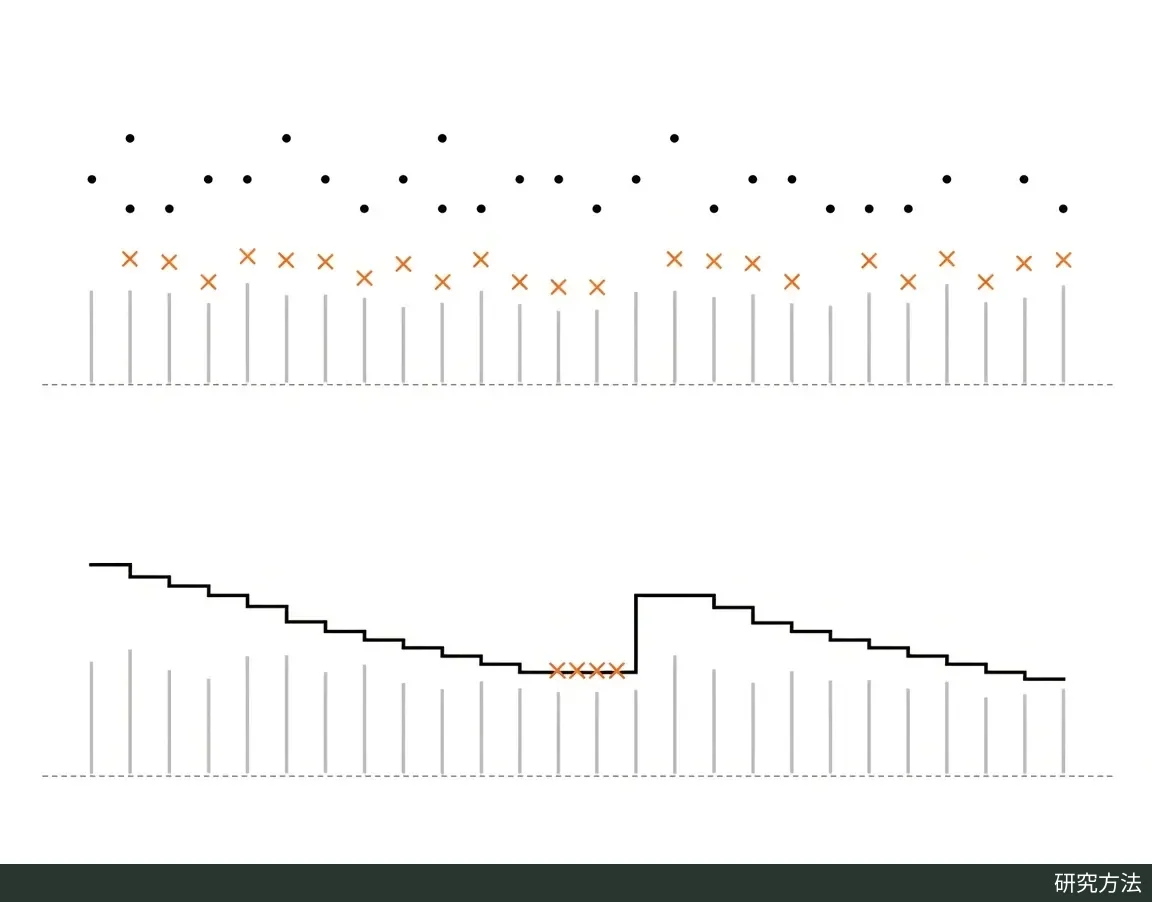
AI-generated schematic: a conceptual comparison of two acceptance rules, the threshold redrawn at every step (top) and Neal's persistently updated threshold (bottom), drawn along the lines of Figure 1 in the paper; it contains no real data.
3
The main theorem requires mI⪯∇²U⪯LI with an L_H-Lipschitz Hessian, and an initial distribution whose L² density ratio relative to the target is finite. The way of starting given in the paper is to first spend O(√κ·log(…)) gradients using Nesterov's accelerated gradient method to find an approximate minimizer, and then start from a Gaussian distribution near it. The number of gradients needed to reach total variation accuracy ε is then Õ(√(κd)+√L_H·(d/m)^(3/4)), dominated by the first term roughly when L_H/m^(3/2) ≤ κ/√d. The author also proves that √κ cannot be dispensed with for this algorithm: on anisotropic Gaussian targets, whether with redrawing at every step or with the persistent update, and however the friction and the step size within the stability range are chosen, the total variation distance is greater than 1/4 whenever the number of steps is less than (√2/8)·√κ·d^(1/6).
The pillar of the proof is another theorem: the relative entropy of unadjusted OBABO decays at a rate of order √m, independent of κ, plus a discretization bias. This is a discrete version of Lu's continuous-time hypoelliptic entropy estimate; for it the author proves an entropy inequality for free transport, filling the gap introduced by the force impulse. A coupling over the whole epoch is then used to combine the contraction of the unadjusted chain with the probability that the adjusted chain has "no rejection over the entire stretch." The paper states that the two main theorems and the related propositions have been formalized in Lean 4 with Mathlib and have passed checking.
The empirical part uses two Bayesian logistic regression posteriors with Gaussian priors: the breast cancer data (569 observations, parameter dimension 31) and the Sonar data (208 observations, dimension 61), with the condition number tuned through the prior scale. With a conservative step size chosen from the global upper bound on curvature, κ ranges from 11 to 1.9×10⁴, the rejection rates of both rules are below 0.2%, the integrated autocorrelation time (IAT, measured in physical time) does not grow with κ, and there is almost no difference between the two chains.
When the step size is instead chosen from the maximum curvature at the mode, L̂, as h=1/√L̂ (which is already outside the parameter range of the theorem), both chains reject about 7%–13% of proposals, and the condition number at the mode, κ̂, spans about four orders of magnitude. The IAT of the persistent chain stays at about 4 to 8 time units, while that of the chain redrawn at every step rises from about 5 to 64 (breast cancer) and 74 (Sonar). A least-squares fit of the gradient cost per effective sample against log κ̂ gives slopes of 0.54±0.01 (breast cancer) and 0.50±0.02 (Sonar) for the persistent chain, and 0.76 on both datasets (±0.02 and ±0.05) for the redrawn chain: the former grows roughly as √κ̂, the latter roughly as κ̂ to the power 3/4.
4
What the theorem covers is smooth, strongly log-concave targets, with a Hessian that must be bounded above and below and Lipschitz continuous, and a warm start; multimodal or non-log-concave posteriors are out of scope. If the initial distribution is very poor, for example with a log density ratio of order κd, the first term degrades to κ√d; a point-mass initialization has no density ratio, so the theorem does not apply directly and a stretch of optimization is needed first, with those gradients counted separately.
The L_H condition has a real effect on the conclusion. On the paper's logistic family, L_H grows as κ^(3/2), so the second term of the theorem dominates and all that can be guaranteed is κ^(3/4). The square-root growth measured in the experiments goes beyond what the theorem has proved, and both the step size and the metric used in the experiments (stationary IAT rather than total variation) differ from those of the theorem.
As for dependence on dimension, on Gaussian targets the upper bound is √κ·d^(1/2) and the lower bound is √κ·d^(1/6). Proximal-type samplers (such as the proximal bouncy particle sampler) already achieve √κ·d^(1/4) over the whole class with a warm start, and they do not need a Hessian-Lipschitz condition; the contribution of this paper is confined to the class of Metropolis-adjusted discretizations of kinetic Langevin. The open questions listed by the author include whether the chain itself really needs a Lipschitz Hessian, whether acceleration from an arbitrary point is possible without an optimization phase, and whether the same holds for other splittings such as OABAO combined with a persistent uniform.
This is still a 37-page single-author preprint, and the experiments compare only adjusted OBABO under the two acceptance rules, with no comparison against adaptive samplers such as NUTS. For users of the method, its most direct lesson is that in adjusted HMC or Langevin sampling, how the accept/reject random number is handled is itself a design choice that changes the dependence on the condition number. The scripts for reproducing the logistic experiments are included in the ancillary files of the arXiv version.
References
-
Bou-Rabee, N. (2026). Persistence Pays: Square-root condition-number dependence for Metropolis-adjusted kinetic Langevin Monte Carlo with a non-reversibly updated accept/reject uniform. arXiv:2610.35781, v1 submitted 2026-10-26.
-
Bou-Rabee, N. (2026-10-27). Persistence Pays. Explanatory article on the author's personal website.
-
Neal, R. M. (2020). Non-reversibly updating a uniform [0,1] value for Metropolis accept/reject decisions. arXiv:2001.11950.
-
Research Methods · Rituals can be imitated; understanding cannot be faked.
-
Compiled and published by the Scholay one-stop academic platform. If anything here infringes your rights, please report it and it will be taken down.
-
Also published on Enter Scholar, a community for scholars in the age of AI.