Whether artificial deadlines curb procrastination and raise completion quality is a common design question. The classic paradigm is Ariely and Wertenbroch’s (2002) proofreading tasks: the same three texts over a three-week horizon, comparing evenly spaced deadlines, self-set deadlines, and a single last-day deadline.[1][3] That article was retracted in September 2026; Data Colada’s reanalyses flag multiple anomalies in the original data, and Hyndman and Bisin’s preregistered replication reports negligible effects of deadline structure on performance.[1][2][3][4] Below is a checkable controlled-experiment plan—question and arms; variables, controls, and measures; how to read results—while separating the original report (only as the object of anomalies), the reanalyses, and the replication. Citations use the 2025-04-09 replication PDF; this is a proposed new controlled-experiment plan.
Question and three-arm design
Three tasks and three deadline schedules are randomly assigned at the person level; a class- or session-level randomisation would need design and analysis at that unit.[1][3] Materials are three proofreading texts with about 100 spelling/grammar errors each; the horizon is 21 days. Evenly spaced: one submission due on days 7, 14, and 21. Self-set: choose deadlines within allowed earliest/latest bounds (intermediate deadlines optional), locked at the start. Last-day only: all three due on day 21.[1][3] Original Study 2 reported 60 people (20 per arm); the replication PDF randomizes individually and, after ANOVA/pairwise power calculations, targets about 40 starters per arm (124 recruits in the 2025-04-09 PDF), expecting out-of-lab attrition.[1][3] Shared tasks and pay rules across arms leave deadline structure as the contrast of interest—and keep it distinct from within-self-set selection comparisons. A new plan should also preregister the earliest/latest bounds for self-set deadlines and whether bundling all three on the last day is allowed. The three-arm contrast asks whether evenly spaced external deadlines outperform self-set or last-day schedules, not whether “any deadline” exists.
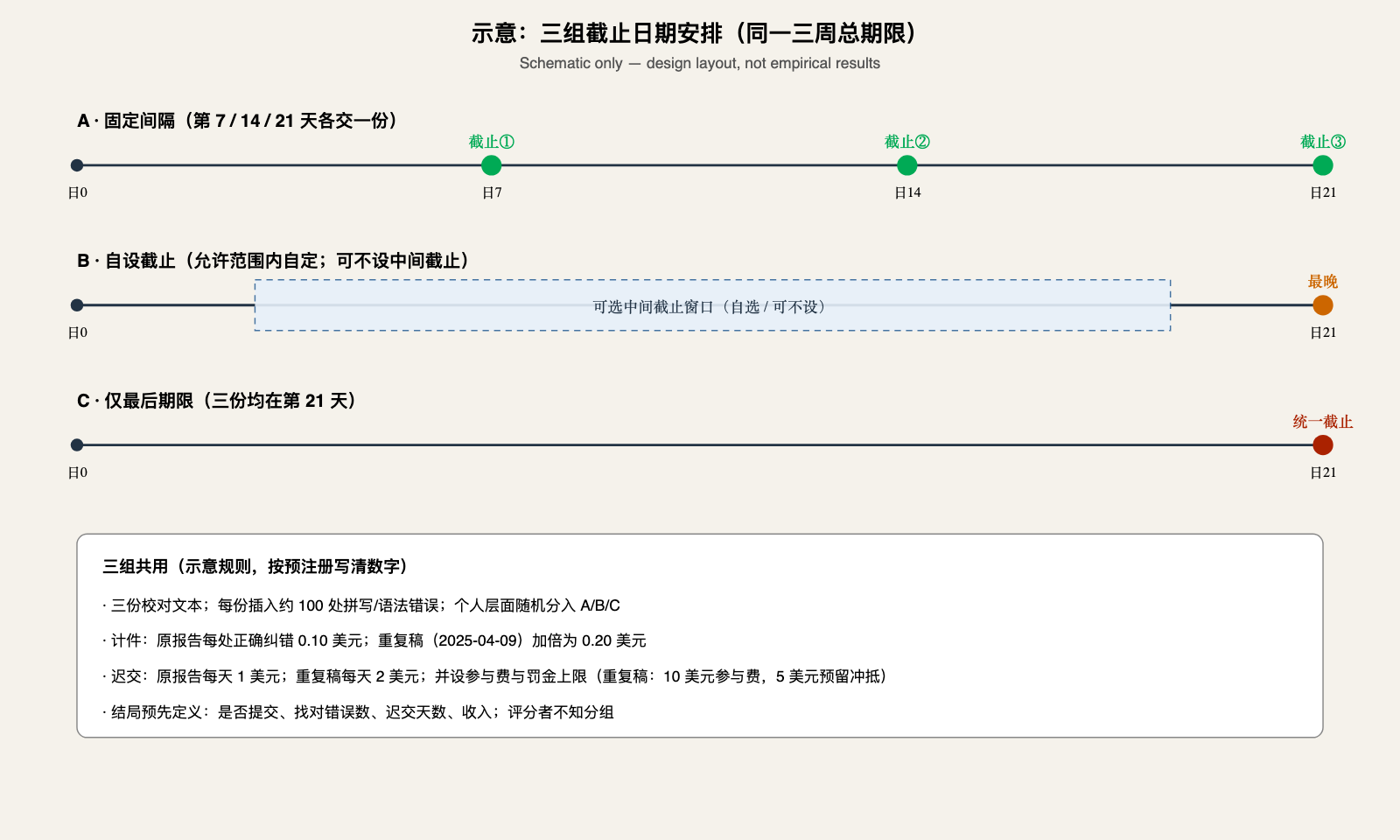
Figure: Three 21-day deadline-arm timelines. This journal, Data Colada[1]
Variables, controls, and measures
Predefine outcomes: whether submitted, errors correctly found, days late, earnings, plus task ratings and self-reported time; keep per-task raw records and publish how scores compose so others can recompute.[3] Piece rates and late penalties are common to all arms: the original report used $0.10 per correct error and $1 per day late; the Hyndman–Bisin 2025-04-09 PDF doubles these to $0.20 and $2, with a $10 participation fee ($5 upfront, $5 reserved against penalties; no further liability beyond the reserve).[3] Graders unaware of assignment score by a fixed rule; the replication also describes anti-cheating presentation/submission measures that a new plan should preregister.[3] Power and recruitment belong in the preregistration; out-of-lab tasks should expect attrition—the PDF reports about 52% overall submission (about 46% with at least one correct error) in the evenly spaced arm, without significant between-arm submission differences, so analysis plans should spell out intent-to-treat and completer paths and how non-submission is coded.[3] In the self-set arm, record each locked triple of deadlines to describe choice distributions without treating within-arm associations as between-arm causal effects.
How to read results—and the original study’s boundary
Between-arm contrasts under random assignment can support causal claims; within the self-set arm, comparing “spread” versus “bunched” choosers is selection, not a deadline effect.[2] Data Colada’s Study 1 recomputation shows the two course sections were not clean individual randomisation; published Finding #3 (spreaders do better within self-set) depended on altered grades, vanishes when grades are recomputed, and was absent from an earlier working paper.[2] For Study 2, the reanalysis flags oversized effects (e.g., a between-condition corrections gap with Cohen’s d ≈ 2.5—cited only as an anomaly, not as evidence), “twin” identical per-task correction counts for 18 of 20 last-day participants, missing correlations that are strong in the replication, and barely rounded self-reported times.[1] Attribution follows those posts and Retraction Watch only: severe tampering or fabrication; Wertenbroch requested retraction; the journal retracted in September 2026; Ariely stated publicly that the data cannot be trusted.[1][2][4] Original effect sizes are therefore not evidence. The replication (cite the 2025-04-09 PDF) finds little performance effect of deadline structure, while people still willingly self-impose deadlines—separating willingness to precommit from a large boost from evenly spaced external deadlines.[3]
A checkable plan puts randomisation unit, arm definitions, pay/late rules, outcomes and blinded scoring, power, and expected attrition into the preregistration, and releases recomputable raw records.[3] The retracted study is a timeline and anomaly object only; new claims should come from preregistered between-arm contrasts, not within-self-set selection or retracted numbers.[3][4] ANOVA and effect-size details belong in a statistics column; this piece only locks the design boundary.
References
-
Data Colada [138] (2026). Artificial Deadlines (Part 1). https://datacolada.org/138
-
Data Colada [139] (2026). Artificial Deadlines (Part 2). https://datacolada.org/139
-
Hyndman, K., & Bisin, A. (2025-04-09 PDF). Replication of “Procrastination, Deadlines, and Performance…”. https://bpb-us-e1.wpmucdn.com/wp.nyu.edu/dist/c/16384/files/2025/04/ssrn-5053636.pdf
-
Retraction Watch (2026-09-03). Procrastination study by Duke’s Dan Ariely retracted…. https://retractionwatch.com/2026/09/03/procrastination-study-duke-dan-ariely-psychological-science-data-colada-tampering-retraction/