A set has n card types; each draw independently hits one of them with equal probability. Collecting most of the set seems quick, yet the last few types are slow to arrive—repeats keep yielding what you already have. The coupon collector's problem breaks the wait into successive geometric stages, yielding expected collection time nHₙ and revealing fluctuation around that average.
Waiting time by stages
Let there be n coupon types; draws are independent and each type appears with probability 1/n; types already seen may appear again. Let T be the total number of draws until every type has appeared at least once. Segment the process by discovery of new types: Tᵢ is the number of draws needed, after i−1 types are held, until the i-th new type appears, counting the successful draw. Then T = T₁ + ⋯ + Tₙ.
At that stage n−i+1 types are still missing, so the probability of a new type on one draw is pᵢ = (n−i+1)/n. Thus Tᵢ follows a geometric distribution starting at 1, with expectation 1/pᵢ = n/(n−i+1). Adding stage expectations gives E[T] = n(1 + 1/2 + ⋯ + 1/n) = nHₙ, where Hₙ is the n-th harmonic number.
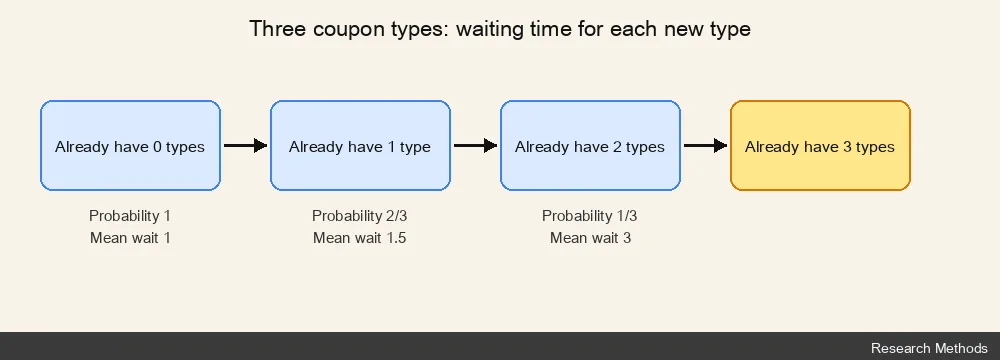
For two types, the first draw is always new; thereafter each draw has probability one-half of completing the other type, so the mean is 1 + 2 = 3 draws. For three types, the three stages average 1, 3/2, and 3 draws, totaling 5.5. That 5.5 is the average over many independent repetitions; a single run's draw count is an integer.
The last few types and logarithmic growth
If k types remain missing, the chance the next draw is new is only k/n, so the mean wait for the next new type is n/k. With one type left, that stage alone averages n draws; with two left, the next new type averages n/2 draws. As collection nears the end, remaining wait does not shrink in proportion to how few types are missing.
The end is slow, yet not every stage needs n draws: the waits form the harmonic series n, n/2, n/3, …. Because Hₙ = ln n + γ + 1/(2n) + O(1/n²), with γ ≈ 0.57721, the expected completion time is E[T] = n ln n + γn + 1/2 + O(1/n). The growth order is therefore n ln n: a logarithmic factor above linear growth, yet far below n².
Fluctuation and coverage
Expectation is not a guarantee for one experiment. Stage waits are independent, and a geometric variance is (1−p)/p², so Var(T) = ∑ᵢ(1−pᵢ)/pᵢ² = n²∑ₖ₌₁ⁿ1/k² − nHₙ. The wait for the last type alone has variance n²−n; the final stage both lengthens the mean and contributes much of the fluctuation. As n grows, the standard deviation is about πn/√6, so absolute fluctuation remains order n.
Erdős and Rényi studied the matching equal-probability independent balls-into-bins problem in 1961. When each type need appear only once and c is a fixed real, their result gives P(T ≤ n ln n + cn) → exp(−e^(−c)). That is a cumulative completion probability; at c=0 the limit is about 0.368. The scale n ln n centers the distribution; adding or subtracting multiples of n around it still changes completion probability substantially.
The same structure appears when random sampling must cover categories, or when testing must hit every input type: covering the last states often costs more time than gathering further repeats. The model's key assumptions are independence and equal probabilities; if some types are rarer or draws are dependent, nHₙ is not the direct answer. Compared with waiting only for the first repeat, requiring every type to appear yields a different scale.
References
-
Erdős, P., & Rényi, A. (1961). On a Classical Problem of Probability Theory. A Magyar Tudományos Akadémia Matematikai Kutató Intézetének Közleményei, 6(1–2), 215–220.
-
MIT CSAIL. Probability Review, §3: The Coupon Collector Problem. Course notes.
-
Research Methods · Rituals can be copied; understanding cannot be faked
-
Information compiled and published by the Scholay academic one-stop platform; please report infringement for takedown.
-
Also published on Enter Scholar, a scholars' community for the intelligent era