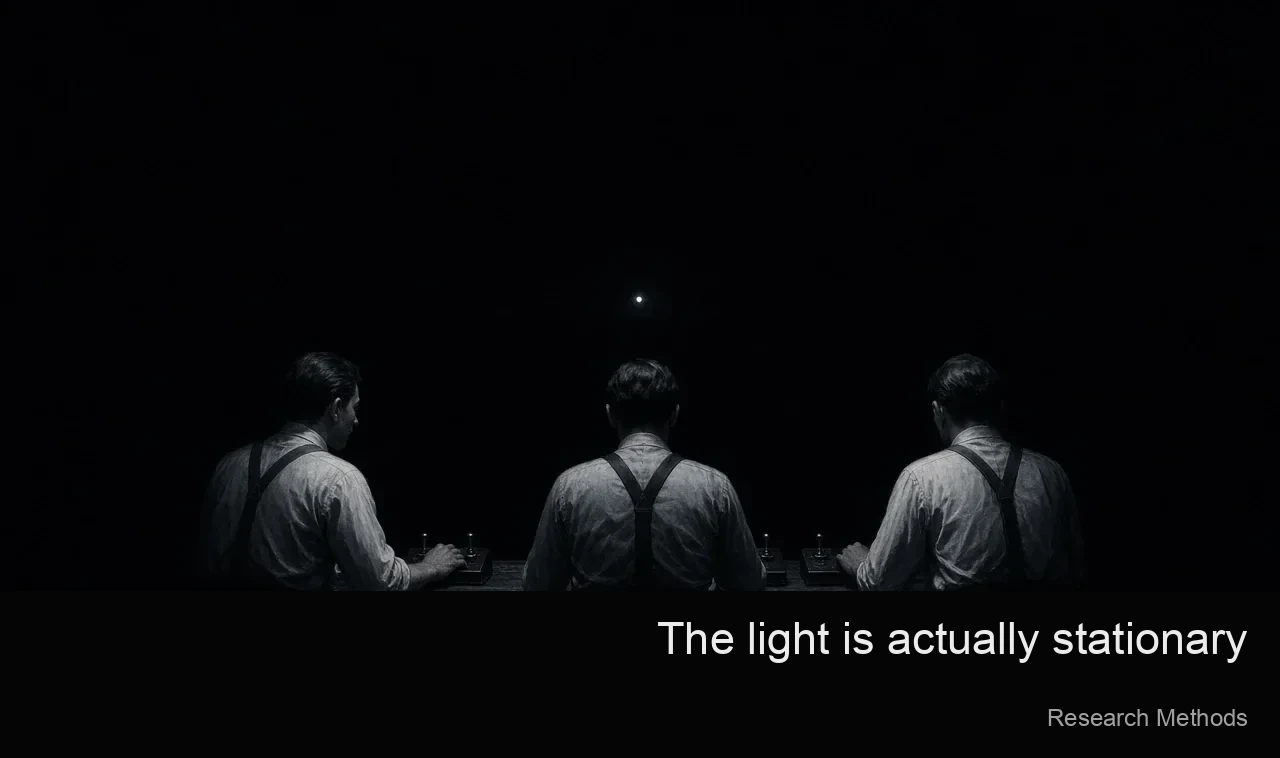
Schematic of the setting of Sherif's autokinetic experiment: in a completely dark room, participants sit 5 meters away and report aloud a number for the "distance moved" by a pinpoint of light that is in fact stationary. AI-generated schematic.
In 1935, at the Columbia University psychological laboratory, Muzafer Sherif had participants in a completely dark room estimate "how far" a point of light had moved. The light never moved, so the distance judgments had no physical answer at all. He compared two orders side by side, "alone first, then in a group" and "in a group first, then alone," and the results showed that a group forms its own norm of judgment from scratch, and that members continue to use this norm when they leave the group and judge alone.
The design question and the choice of stimulus
The question Sherif wanted to answer was not "will people yield to the majority" but a step that comes earlier: when every external reference point has been taken away, how does a person calibrate a series of judgments? When several people face the same unstable stimulus together, will each say something different, or will they create a standard that belongs only to this group? In his report he gave an operational criterion: if judgments under such conditions still show stable, consistent results, this can be taken as an indicator of a "subjectively produced frame of reference"; and if a group forms a standard peculiar to itself, one has obtained the rudiments of a group forming a norm.
Meeting this criterion requires a stimulus that "objectively provides no answer, yet subjectively always gives something to report." The autokinetic effect fits exactly: in complete darkness, a small stationary point of light appears to drift, because there is nothing to serve as a reference for locating it, and the direction is not fixed either. From long records made in the darkroom, Sherif summed up several adjustable conditions: the smaller and dimmer the light, and the less clear the observer is about the distance to it, the more readily the illusion appears; adding just one more point of light, or making a few objects visible, destroys the illusion. So "stimulus ambiguity" is itself the first design knob of this experiment, and every later manipulation is there to protect it.
This also sets it apart from Asch's line experiment. Asch's task has a clear correct answer, and the participant faces a majority arranged in advance to give the same wrong answer; what he studied was whether people conform or resist in the face of an existing standard. In Sherif's group experiments there were no confederates, all members were naive participants, and the task itself had no right or wrong. What he observed was how a standard is created from scratch, not how a minority is overborne by a majority.
The darkroom paradigm and the order comparison
The apparatus was simple. The experiment took place in a soundproof, light-tight room: the light source was housed in a metal box and showed a point of light only through a hole 1 millimeter in diameter, placed on a table 85 centimeters above the floor; the participant sat at the other end of the room, 5 meters from the light. While the room was lit, a four-panel folding screen always stood between the participant and the light source, and it was removed only after the room was completely dark, so the participant never saw the arrangement around the light source from beginning to end. Using a fairly long distance of 5 meters and an aperture as small as 1 millimeter both served to deprive the sense of distance and position of any basis as far as possible.
The procedure for a single trial was as follows: the experimenter gave a "ready" signal and opened the shutter to expose the light; the instructions told the participant that "after a little while the light will start to move," and to press the key on seeing movement; after the key press, the timer gave a soft click at 2 seconds and the experimenter then closed the shutter; the participant then reported aloud how many inches the light had moved. If there was no key press within 30 seconds, it was recorded as 0. Each participant made 100 judgments per session, and the experimenter wrote each number on a separate small sheet of paper.
The individual series had two parts. The first part had 19 participants, each completing one session of 100 judgments alone, to answer the question "without an external yardstick, will a person settle on a range and a center of their own?" The second part had 4 participants, each doing 3 sessions on different days within one week, 300 judgments per person in all, to test whether the range and median a person had settled on would be retained across sessions.
The group series is the core of the whole design. There were 40 participants in all, forming 8 groups of two and 8 groups of three. For each group size, half the groups followed the "alone first, then group" order and the other half the "group first, then alone" order, with each session on a different day:
| Order condition | Session I | Session II | Session III | Session IV |
|---|---|---|---|---|
| Alone first, then group (4 groups of two, 4 groups of three) | Each alone | Group | Group | Group |
| Group first, then alone (4 groups of two, 4 groups of three) | Group | Group | Group | Each alone |
This order comparison pulls apart two kinds of "anchor." Participants in the alone-first condition already had their own individual anchor before entering the group, so one can observe how far the group can pull them together; participants in the group-first condition met the stimulus for the first time within the group, with no individual anchor, so one can observe how much remains when the group anchor, once formed, is carried back into the solo session. With only one order, it would be impossible to tell "going along with what others say on the spot" from "a standard that has been formed and retained."
In the group sessions, social information had only one channel, namely the estimates the members said aloud to each other. Participants could report in any order and were asked to change the order from time to time, so that no one person always spoke first. In complete darkness the experimenter had to tell who was speaking, so each person was given a button to press while reporting; the buttons were connected to dim yellow, red, and green lights behind the screen that only the experimenter could see, and each person's numbers were recorded on a pad of the corresponding color. The post-experiment questionnaire also deliberately dropped the question "how did the light move," because once participants compared the directions each had seen, they could easily discover that it was only an illusion.
The outcome measures were also defined in terms of "norms": for each person's 100 judgments in each session, the range, mode, median, quartile deviation Q, and probable error of the median were computed. The median represents the "norm" of the individual or the group, and the range and Q represent how wide or narrow the acceptable range is. For comparison, Sherif computed the critical ratio for the difference D between the medians of every two members of a group; for the group-first participants, he also compared the difference between the same person's medians in Session III (the last group session) and Session IV (alone), denoted Self-D.
How the norm forms and persists
The first conclusion is that individuals do "make a yardstick" of their own. Each of the 19 participants tested alone formed a range and a center, but the differences from person to person were large: the smallest median was 0.36 inches and the largest 9.62 inches; the narrowest range was 1¼ inches and the widest 13 inches. In the questionnaires the participants wrote "there was no basis for judging distance in the dark" and "there was no fixed point to compare with," and at the same time wrote "compared with the previous one" and "took the first estimate as the standard." The 4 participants with three consecutive sessions, for their part, retained their own centers; for example, one of them had medians of 1.66, 1.9, and 1.61 inches across the three sessions.
In the alone-first order, the originally scattered individual medians gradually drew together over the group sessions, which Sherif called "funnel-shaped": the mouth of the funnel is the solo session, and it narrows as the sessions go on. Taking the second group of two as an example, the difference between the two medians fell from 6.81 inches when alone to 1.50, 0.41, and 0.34 inches in the three group sessions; in the first group of three, the difference between participants 1 and 2 fell from 6.84 inches to 1.89, 1.67, and 0.08 inches. However, convergence under this condition was not complete, and many pairwise differences remained statistically reliable.
In the group-first order, convergence took place from the very start. The differences between the medians in the four groups of two in the first group session were only 0.04, 0.05, 0.02, and 0.07 inches respectively, and they stayed close in the later group sessions; the group medians of the groups of three could rise or fall as a whole from session to session, but the members rose together and fell together. More crucial is Session IV: after the members were separated and tested alone, the Self-D of most of them was small and statistically unreliable. Sherif's conclusion was that people who first face this situation in a group, and who respond according to the group norm, tend to keep using the same norm after leaving the group; by comparison, for people who had first established an individual anchor, the influence of the group after they entered it was not as strong.
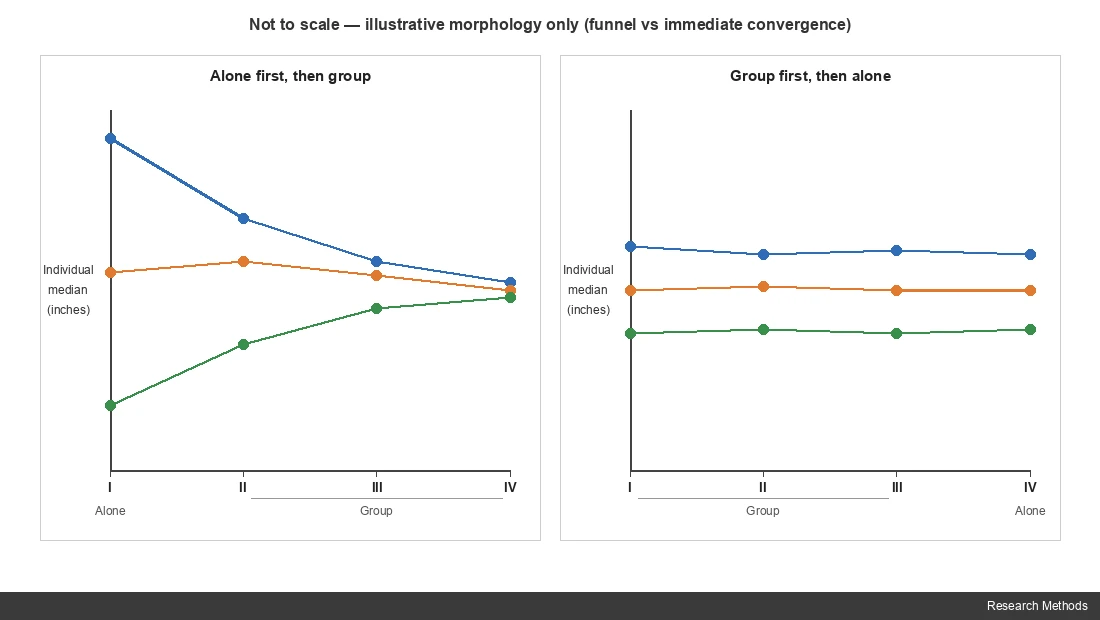
Schematic after Sherif (1935): left panel session I alone, sessions II–IV group (funnel convergence); right panel sessions I–III group, session IV alone (immediate convergence that persists when alone). Each line is one member's median; positions are not to scale and are not specific data points. AI-generated schematic.
Two supplementary observations are also worth entering in the design record. First, when participants were asked at the end of the experiment "were you influenced by the judgments of the others," only about 25% answered yes; convergence does not depend on participants being aware that they have been influenced. Second, after checking the data trial by trial, Sherif concluded that the influence mainly accumulated gradually over trials rather than being produced in an instant by any single report.
Scope of measurement, later tests, and ethics
First, one has to be clear about what this design measured. It records how distance estimates stated in public converge, and whether the convergence is retained in one later solo session; it did not use scales to measure whether participants were persuaded or felt pressure, nor did it measure mechanisms at the perceptual level. Sherif interpreted the results as "the formation of social norms in the absence of a frame of reference," which is his theoretical framework; "the group norm is carried back into the solo session" is the part directly supported by the data, whereas "the participants' inner beliefs changed" needs separate evidence.
Second, the effect depends on the ambiguity of the stimulus, and the original report itself records a counterexample. One group-first group of three gave a large number of 0s in the first session, and the mode for all three was 0; afterward one participant asked "is the light really moving," and it turned out that he had held a finger up in front of his eyes and found that the light did not pass beyond the finger. Before the second session, the experimenter asked everyone to keep their bodies still, and the mode for all three promptly rose to 4 and stayed there through each one's solo session. Sherif also mentioned that this participant was a fraternity president and football team manager, and he treated the case as a clue to the influence of "prestige." Evidently, as soon as a participant finds a reference point, the ambiguity is broken; and the status of a particular member of the group may also sway where the norm settles.
Later research has neither turned it into an iron law nor overturned it. Alexander, Zucker, and Brody (1970) told participants explicitly in advance that the light was stationary and that the movement seen might differ each time, and as a result neither the solo condition nor the groups of two showed convergence; they argued that convergence comes from participants' expectation that "there should be a consistent answer." Pollis and colleagues (1976) pointed out that these instructions themselves created an expectation that "there should not be agreement," so they added a condition in which participants were told only that "this is an illusion," and again saw more convergence in groups of two than in the solo condition. Jacobs and Campbell (1961) used confederates to plant an arbitrary norm of 15.5 inches and replaced one member every 30 trials; remnants of the norm persisted for four to five "generations" and then fell back to the natural level. MacNeil and Sherif (1976), in turn, found that arbitrary norms not so far from the natural norm were adopted more and maintained longer.
Finally, the sample and ethics. The participants in the autokinetic experiments were all male undergraduate and graduate students, aged 19 to 30, who came from the student employment offices of Columbia University, Teachers College, and New York University, and they were restricted to those who did not wear glasses and were not psychology majors. The instructions stated explicitly that "the light will start to move," and the questionnaire deliberately avoided questions that might let participants see through the illusion; this amounts to misleading information. Under the requirements of present-day ethical review, a design of this kind needs to justify the necessity of the deception and to arrange a debriefing.
To borrow this design for studying other ambiguous judgments, four elements can be extracted: first, choose a task that has no objectively correct answer but for which a numerical value must be given; second, restrict social information to a single recordable channel, such as reporting numbers in public; third, arrange both the "alone first, then group" and "group first, then alone" orders, to separate the individual anchor from the group anchor; fourth, record dispersion as well as the central value, and measure once more after participants leave the group. Reporting only whether the within-group averages are close would lose the two most informative points of this study: the order effect and the persistence of the norm.
References
-
Sherif, M. (1935). A study of some social factors in perception. Archives of Psychology, 27(187), 1–60. Chapter 2 (apparatus and participants): full text online at the Mead Project; Chapter 3 (results of the individual and group experiments): full text online at the Mead Project
-
Sherif, M. (1936). The Psychology of Social Norms. New York: Harper & Brothers. Google Books listing
-
Abrams, D., & Levine, J. M. (2012). Norm formation: Revisiting Sherif's autokinetic illusion study. In J. R. Smith & S. A. Haslam (Eds.), Social Psychology: Revisiting the Classic Studies. London: SAGE. Author manuscript; University of Kent repository
-
Research Methods · Rituals can be imitated; understanding cannot be faked.
-
Compiled and published by the Scholay one-stop academic platform. If anything here infringes your rights, please report it and it will be taken down.
-
Also published on Enter Scholar, a community for scholars in the age of AI.