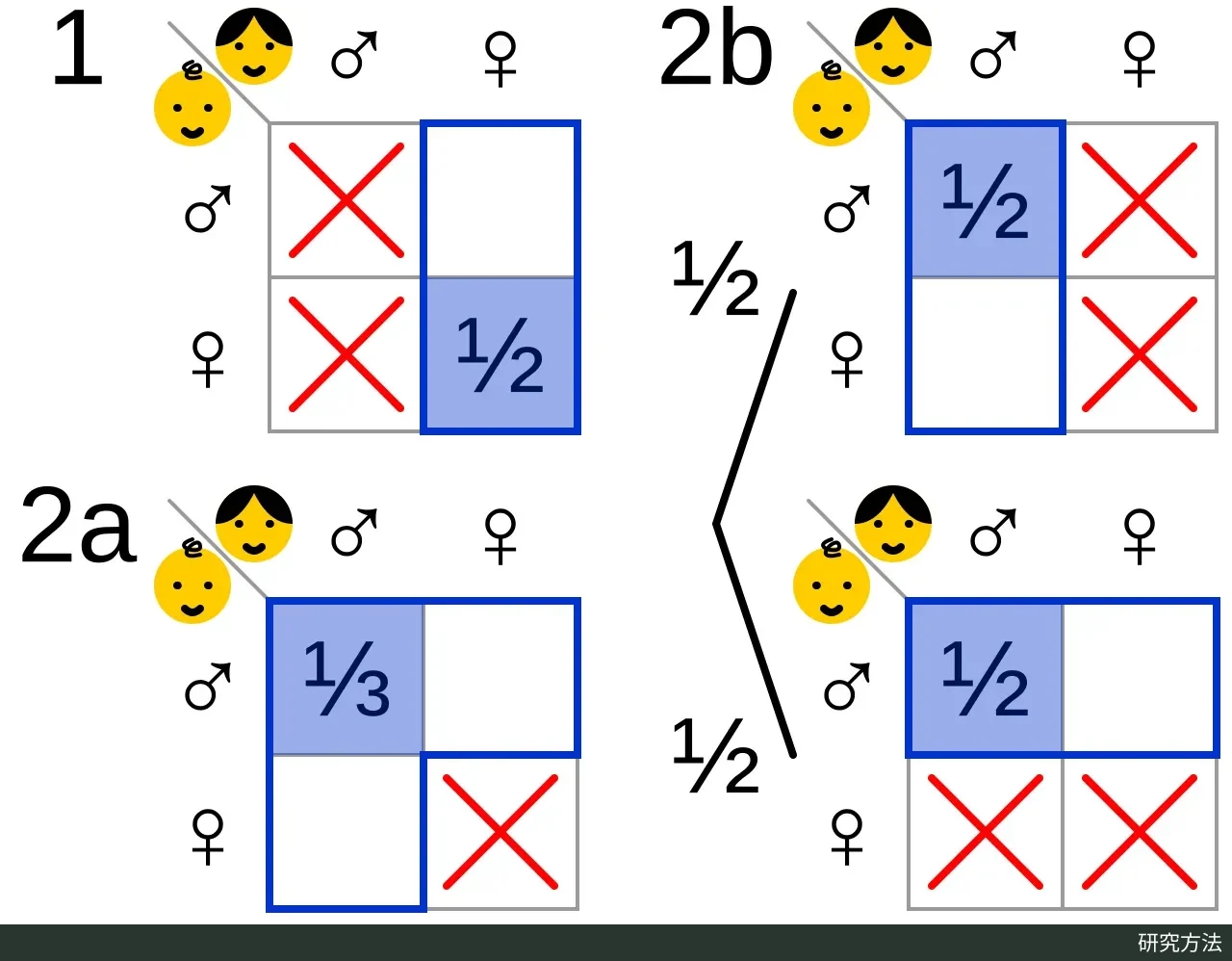
Diagram of the two-child problem: each cell represents one equally likely combination of sexes for two children; 2a and 2b in the figure correspond to the two readings of "at least one boy," and the probability sought is the proportion of outlined cells that are shaded. Image: Cmglee / Wikimedia Commons, CC BY-SA 4.0.
The Tuesday boy paradox is a variant of the two-child conditional probability puzzle. Given that a two-child family has "at least one boy," the probability under the standard model that both are boys is 1/3; add the sentence "this boy was born on a Tuesday," and the answer becomes 13/27, already close to 1/2. The seemingly irrelevant day of the week changes the answer because the subset this sentence filters out of all families has changed; and the procedure by which the sentence came to be said determines the answer as well.
The classic two-child problem and the four-cell sample space
The origin of this puzzle can be traced to a question Martin Gardner posed in the May 1959 issue of the "Mathematical Games" column in Scientific American: Mr. Smith has two children, at least one of whom is a boy; what is the probability that both are boys? According to a 2010 retrospective in Science News, the answer Gardner gave at the time was 1/3. Most people answer 1/2 the first time they hear it: since there is already one boy, the other child is equally likely to be a boy or a girl.
The standard model has three assumptions: each child is a boy or a girl with probability 1/2 each; the sexes of the two children are independent; and the two children are distinguished by birth order. Two-child families then have only four equally likely combinations: boy–boy, boy–girl, girl–boy, and girl–girl, each with probability 1/4. "At least one boy" rules out only girl–girl, and the remaining three cells are still equally likely; only the boy–boy cell has two boys, so the probability that both are boys is 1/3. Conversely, the probability that "the other child is a girl" (that is, exactly one boy and one girl) is 2/3. The intuition that answers 1/2 assumes we already know which child is the boy. If the problem said "the elder child is a boy," only the two cells boy–boy and boy–girl would remain, and only then would the answer be 1/2.
The Tuesday refinement and counting to 13/27
In March 2010, the puzzle designer Gary Foshee posed a problem of only three sentences at the Gathering 4 Gardner (a gathering of mathematics, magic, and puzzle enthusiasts in honor of Gardner): "I have two children. One is a boy born on a Tuesday. What is the probability I have two boys?" On the BBC programme More or Less he said that the first reaction is to ask what Tuesday has to do with it, but in fact it matters a great deal, and the answer is 13/27.
The calculation is the same as in the previous section, except that each child's label is refined from "boy/girl" to "sex × day of the week of birth." Assume each child is equally likely to be either sex, the day of birth is uniformly distributed over the seven days of the week, and the two children are independent; then each child has 14 equally likely labels, and two children have 14 × 14 = 196 combinations in all. Of these, 27 contain at least one "boy born on a Tuesday," and they can be counted in four blocks:
| Elder child | Younger child | Number of combinations | Both boys |
|---|---|---|---|
| Boy born on a Tuesday | Girl (born on any day) | 7 | No |
| Boy born on a Tuesday | Boy (born on any day) | 7 | Yes |
| Girl (born on any day) | Boy born on a Tuesday | 7 | No |
| Boy (born on a day other than Tuesday) | Boy born on a Tuesday | 6 | Yes |
| Total | 27 | 13 |
The last row has only 6, because "both are boys born on a Tuesday" has already been counted in the second row and cannot be counted again. Of the 27 combinations, 13 have two boys, so the probability that both are boys is 13/27, about 0.481; the probability that the other child is a girl is correspondingly 14/27, about 0.519. This result agrees with the item-by-item enumeration by the mathematician Keith Devlin in the Science News report and with the 196-cell diagram in The Actuary's 2020 article. Compared with the 1/3 and 2/3 of the previous section, both answers move noticeably toward 1/2.
The rarity of the label and the weight of two-boy families
Why can a seemingly irrelevant day of the week change the answer? Take a different angle: instead of counting cells, ask how much chance each type of family has "of satisfying this sentence." A family with two boys has two chances of hitting Tuesday: the probability that at least one boy was born on a Tuesday is 1 − (6/7)² = 13/49. In a family with one boy and one girl, only that one boy could have been born on a Tuesday, with probability 1/7, that is, 7/49. The three types of family, boy–boy, boy–girl, and girl–boy, originally have probability 1/4 each; after multiplying by each one's chance of satisfying the condition, the weights are in the ratio 13 : 7 : 7, and two boys therefore account for 13/27. Without Tuesday, all three types of family satisfy "at least one boy" with chance 1, the weights are in the ratio 1 : 1 : 1, and the answer returns to 1/3.
Replace "born on a Tuesday" with any characteristic that occurs with probability p, and the same derivation gives: conditional on "at least one boy with that characteristic," the probability that both are boys is (2 − p)/(4 − p). When p = 1 the characteristic brings no additional information and the answer falls back to 1/3; when p = 1/7 it is 13/27; The Actuary's article takes "born on Christmas Day" as an example and, with a uniform distribution over the 365 days of the year, obtains 729/1459; as p approaches 0, the answer approaches 1/2. The pattern is that a two-boy family's chance of hitting the characteristic is about 2p, twice that of a one-boy-one-girl family, which exactly offsets the double share that one-boy-one-girl families have in the prior (the two cells boy–girl and girl–boy). The rarer the characteristic, the more negligible the overlap in which both boys have it, and the more the sentence resembles pointing out one particular child; and pointing out a particular child is exactly the case in which the answer is 1/2.
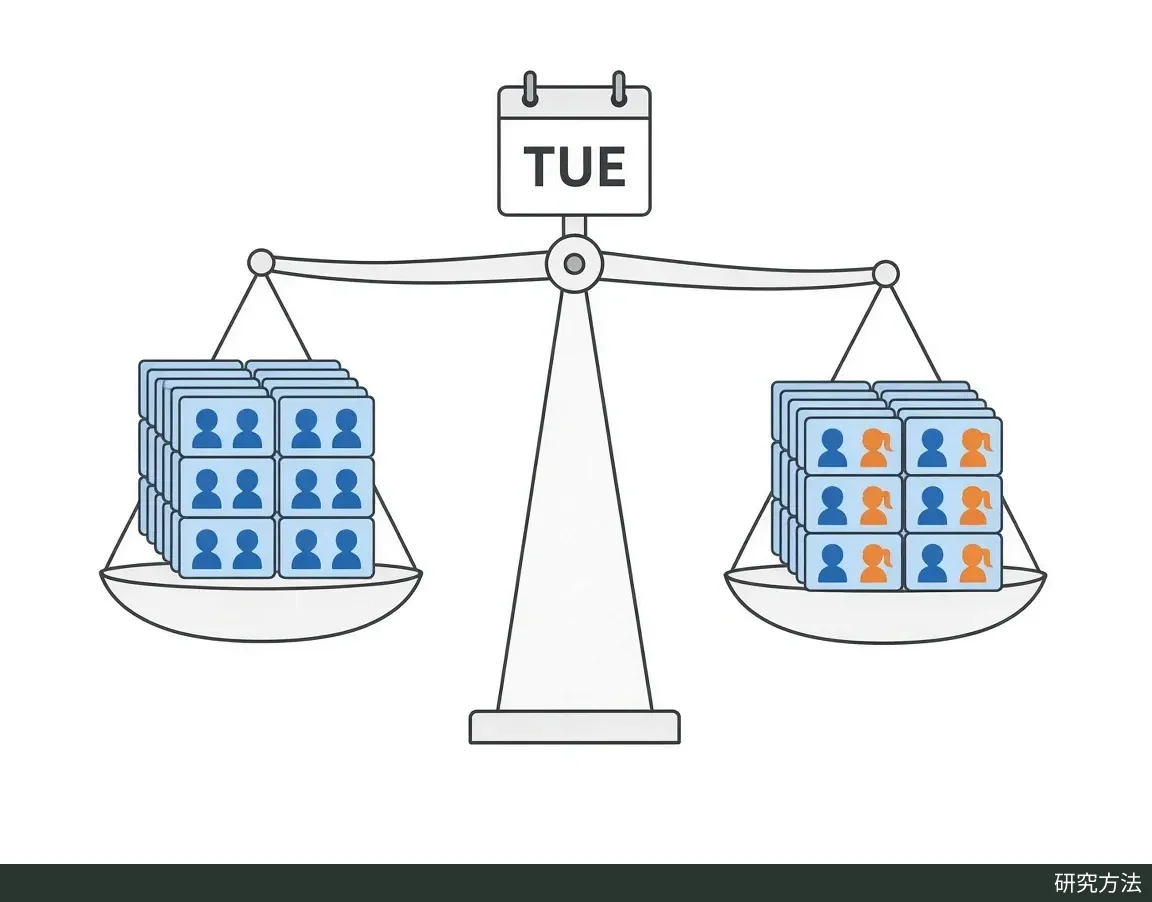
AI-generated schematic: the left pan represents families with two boys and the right pan families with one boy and one girl; after filtering by "at least one boy born on a Tuesday," the weights on the two sides are 13 to 14, almost level. The number of blocks in the figure is for illustration only and is not to scale.
The information-generating procedure, model assumptions, and related paradoxes
The answer also depends on how the information was produced. In his October 1959 column, Gardner acknowledged that the May problem was ambiguous: many readers pointed out that the answer depends on the procedure by which the information "at least one boy" was obtained. If a family is picked at random from all two-child families with at least one boy, the answer is 1/3; if a two-child family is first picked at random, and someone in the know then says "at least one is a ..." (saying boy if both are boys, girl if both are girls, and choosing one child at random to describe if there is one of each), then the probability that the two children are of the same sex is 1/2. He attributed the root of this kind of problem to the failure to specify the randomizing procedure.
The Tuesday version inherits the same ambiguity. Science News cites the view of the probabilist Yuval Peres: 13/27 holds only if the speaker mentions the child precisely because that child is a boy born on a Tuesday, and would have said nothing if neither child fit; if the speaker picks one child at random and then reports that child's sex and day of the week of birth, the probability that the other child is a boy is still 1/2. Letters from listeners received by the BBC programme described a third procedure: first ask parents of two children with at least one boy to stand up, then call on one of them at random to say the day of the week on which a son was born; in this case the day of the week brings no new information, and the answer is still 1/3. Foshee himself replied on the programme that his 13/27 comes from the arithmetic of sets, that is, taking the subset "has a boy born on a Tuesday" from all two-child families; if one considers how the child was selected, the answer may be different.
These numbers are all model probabilities, not population statistics. The standard model assumes that boys and girls are equally likely, that the sexes of the two children are independent, and that the day of birth is uniformly distributed over the week; the Science News report specifically notes that this analysis ignores differences such as slightly more births on weekdays than on weekends. This article discusses only two-child conditional probability, and how refining information such as "Tuesday" changes the answer; it does not estimate the distribution of birth days of the week in real populations, nor does it treat 13/27 as a proportion calculated from birth registration data.
This paradox is often lumped together with several related problems, but the mechanisms differ. The key to the Monty Hall problem lies in the host's strategy of opening doors according to rules; the birthday problem is about the probability of a shared birthday as the number of people grows; the inspection paradox is about individuals with long durations being more likely to be sampled. The Tuesday boy paradox is concerned with only one thing: which subset of all two-child families the same sentence "at least one ..." corresponds to, and by what procedure the sentence is said. In a blog post of October 27, 2026, John Mount of Win-Vector recast the problem as two coins, each paired with a random day of the week, to stress that this is a problem of probability rather than biology, and argued that it is thornier than the Monty Hall problem.
References
-
Gardner, M. (1959, May). Mathematical Games: Another collection of "brain-teasers". Scientific American, 200(5), 164. doi:10.1038/scientificamerican0559-164. scientificamerican.com
-
Gardner, M. (1959, October). Mathematical Games: Problems involving questions of probability and ambiguity. Scientific American. scientificamerican.com
-
Rehmeyer, J. (2010, June 28). When intuition and math probably look wrong. Science News. sciencenews.org
-
Hawkins, O. (2010, June 11). Tuesday Boy. BBC News, More or Less. news.bbc.co.uk
-
Olding, K. (2020, December 2). Tuesday's child. The Actuary. theactuary.com
-
Mount, J. (2026, October 27). "Boy Born on Tuesday" A Thornier Problem Than The Monte Hall Problem? Win-Vector LLC. win-vector.com
-
Research Methods · Rituals can be imitated; understanding cannot be faked.
-
Compiled and published by the Scholay one-stop academic platform. If anything here infringes your rights, please report it and it will be taken down.
-
Also published on Enter Scholar, a community for scholars in the age of AI.