When a camera is used to record the colour of corals, what questions the data can answer is decided before the shutter is pressed. In a perspective article in Methods in Ecology and Evolution, Akkaynak and Brown propose the 3P protocol for underwater colour measurement: preserve RAW, place a colour chart, and plan the imaging distance. It keeps the information needed for calibration at the capture stage, making it possible for colour comparisons across times, places, and cameras to hold up.
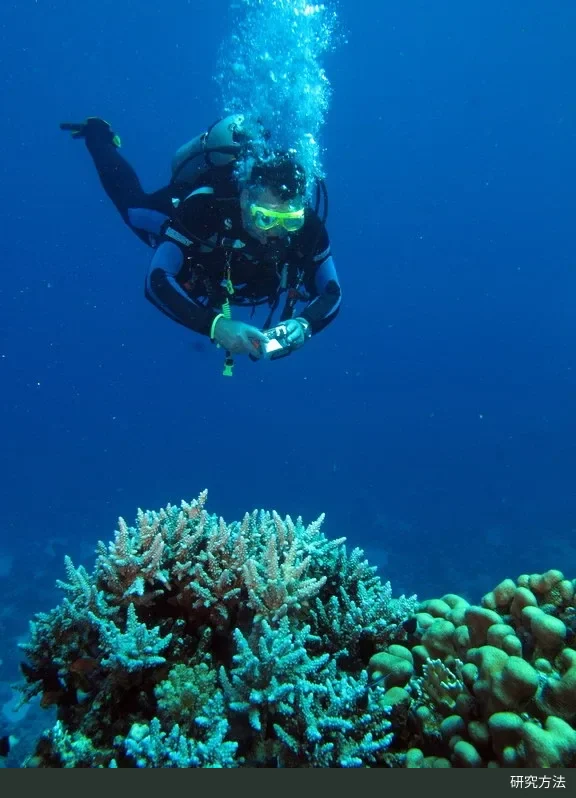
From photographs to measurement data
A camera can record whether a species is present, and it can also be used to measure the degree of coral bleaching or the body colour of animals. The latter kind of question requires comparing the colour information in the pixels, not just recognizing what is in the frame. The paper points out that a sensor responds approximately linearly to exposure within its usable, unsaturated range; RAW preserves this relationship, yet calibration is still needed to convert values that depend on the device and the illumination into colours that can be compared.
Typical in-camera JPEGs, by contrast, have gone through white balance, tone mapping, denoising, sharpening, colour rendering, and other processing. They are well suited to direct viewing and sharing, but they hand many decisions over to the camera. The crux of the problem is not the JPEG file name itself but the in-camera processing that has usually already taken place before compression and is hard to reverse; an inverse gamma transform or a colour chart in the frame cannot, on its own, uniquely recover the original sensor readings. RAW files are larger, and storage, transfer, and subsequent calibration consume more resources, but the researcher keeps the option of reprocessing.
Underwater distance and the 3P protocol
The additional difficulty underwater is that light is absorbed and scattered as it travels, with effects that vary with wavelength and path length. A nearby coral and a distant patch of sand are seen through different amounts of water, and the image is further overlaid with light scattered toward the camera by particles in the water. A single global white balance may improve the overall look, but it usually cannot remove the deviations at every distance at once; nor is a colour chart itself a model for distance correction.
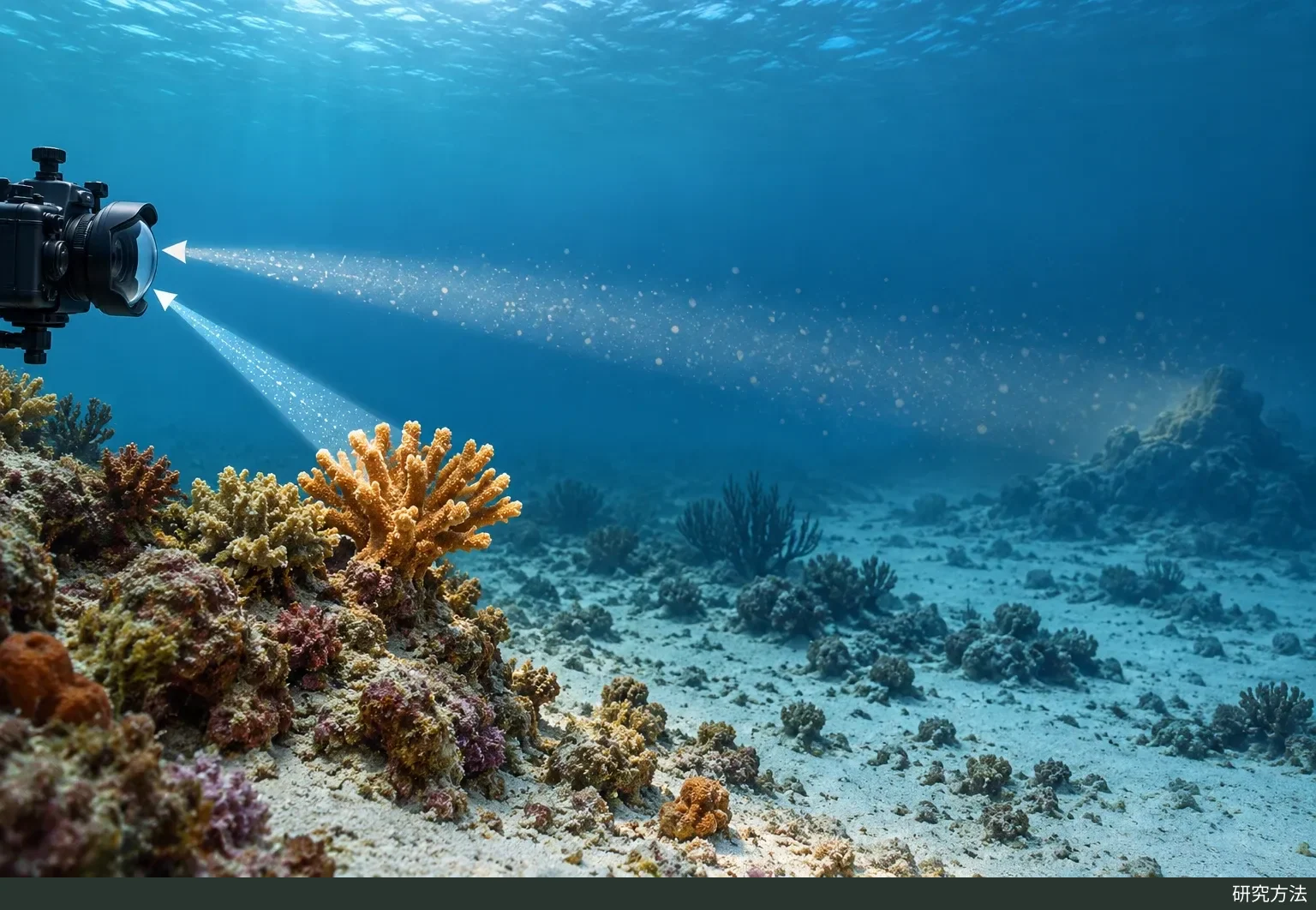
3P moves this measurement problem upstream to capture: Preserve, keeping RAW or minimally processed sensor data; Place, putting a reference object of known colours in the scene; Plan, controlling or estimating the distance from the camera to the scene. Distance can be obtained through reconstruction from multiple overlapping photographs, multiple cameras, or ranging devices. Once the effect of the water has been dealt with, the colour chart helps standardize the illumination, after which the camera-dependent RGB is converted to a standard colour space.
Physical reconstruction and scope of application
The authors show the responses of colour charts at different distances and use a Sea-thru reconstruction to illustrate the idea of physical correction: combine distance information with an underwater image formation model, estimate attenuation and backscatter, and then recover usable scene colours. The author's blog post shows the same seabed scene before and after correction; this kind of reconstruction depends on the imaging model and the input data, and is not the same as applying a global filter to a photograph to make it look good. What this perspective article offers is a framework for capture and calibration, not a new controlled trial proving that 3P achieves a given accuracy in all waters.
In the blog post, Akkaynak compares this choice to specimen preservation: formaldehyde helps preserve morphology but may damage the DNA that later research needs; in the same way, the original measurement information discarded by in-camera processing cannot be expected to be conjured back by future algorithms. For work that only needs to determine whether a species is present or to identify objects, processed images may still be sufficient; when colour itself is the object of measurement, or when colours may need to be compared in the future, the value of 3P lies in holding on to data that can be calibrated.
References
-
Akkaynak, D., & Brown, M. S. (2026). Underwater imaging without colour distortions requires RAW capture. Methods in Ecology and Evolution.
-
Akkaynak, D. (2026-09-30). The photograph you didn’t take: why underwater colour science starts before the shutter. Methods Blog.
-
Akkaynak, D., & Brown, M. S. (2026). Underwater imaging without color distortions requires RAW capture, arXiv:2603.20823v2, 2026-10-03.
-
Research Methods · Rituals can be imitated; understanding cannot be faked.
-
Compiled and published by the Scholay one-stop academic platform. If anything here infringes your rights, please report it and it will be taken down.
-
Also published on Enter Scholar, a community for scholars in the age of AI.