The OVIVA trial set out to answer a specific question: in eligible patients with bone and joint infection, can oral antibiotics in the early phase of treatment avoid being worse than intravenous treatment, in one-year treatment failure, by a clinically unacceptable amount? The study first set this "unacceptable gap" at 5 percentage points and later changed it to 7.5 percentage points. The change began with a planned interim analysis: the failure rate observed with the two groups pooled was about 12.5%, higher than the originally anticipated 5%.[1][2]
What was randomized was the treatment strategy
The trial enrolled 1,054 adults at 26 hospitals in the United Kingdom and randomized them one to one to an oral or an intravenous antibiotic strategy, 527 per group. The allocated strategy applied to the first six weeks of treatment: patients started the allocated strategy within seven days of definitive surgery; for those who did not need surgery, the clock started when antibiotics for planned curative treatment began.[1][2]
The study did not give everyone the same drug. Infection specialists chose the antibiotics within the allocated route of administration, taking into account the pathogen, the properties of the drugs and the patient's circumstances. Participants had to have suitable options for both oral and intravenous treatment; the trial excluded patients with recent Staphylococcus aureus bacteremia, bacterial endocarditis, and some patients clinically requiring continued intravenous antibiotics.[1]
The primary outcome was whether "definite treatment failure" occurred within one year after randomization. The study used prespecified microbiological, histological and clinical criteria, such as a qualifying bacterial result from a deep sample, or renewed pus in bone or near a prosthesis. Patients and clinicians knew the route of administration, but an independent endpoint review committee reviewed medical records stripped of cues about the route to judge potential failure events in a blinded manner.[1][2]
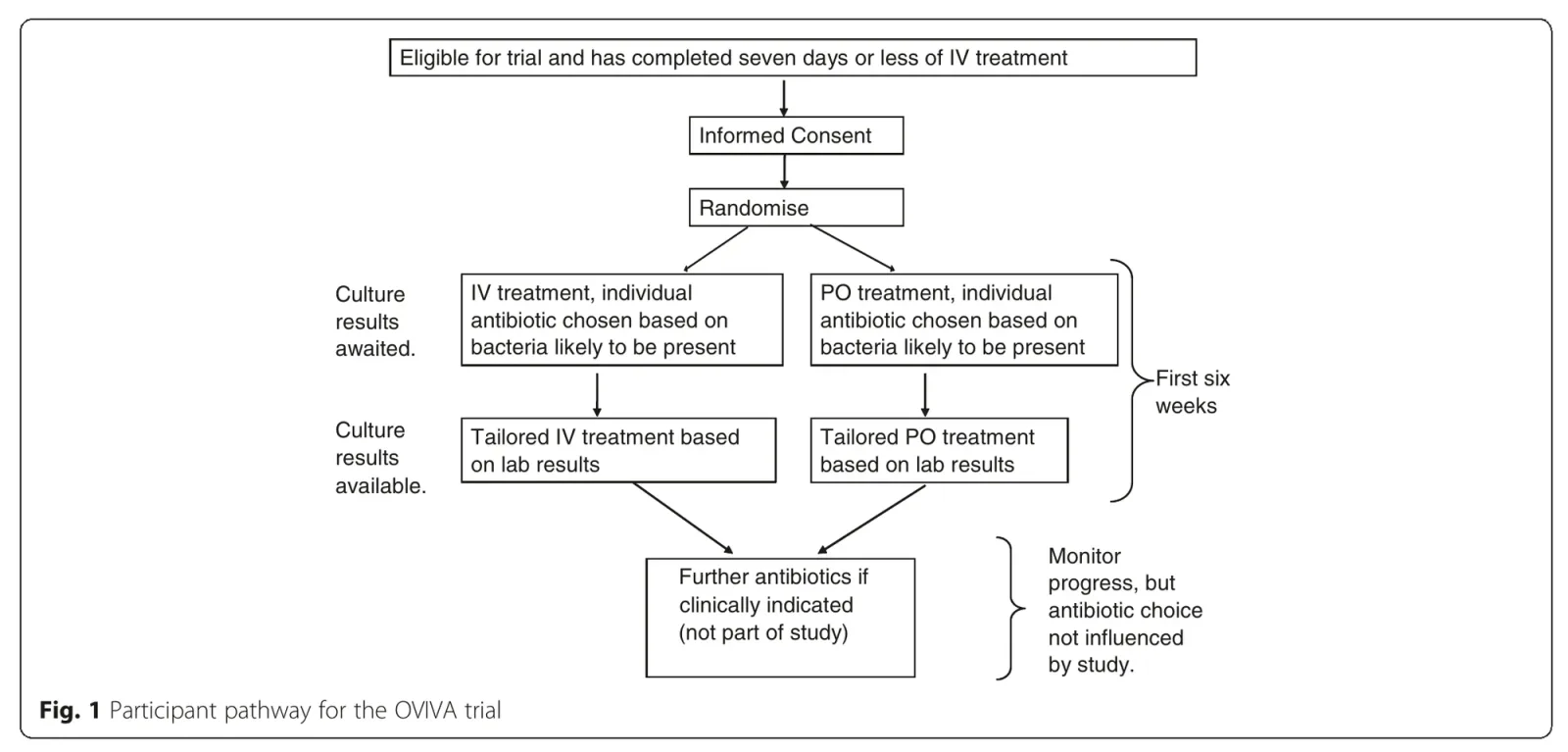
Figure 1 | Participant pathway in the OVIVA trial protocol: eligible participants who had received no more than seven days of initial intravenous treatment were randomly assigned after consent to an intravenous (IV) or oral (PO) strategy, with antibiotics in the first six weeks chosen and adjusted according to culture results and clinical circumstances. Source: Li et al., 2015, Figure 1, CC BY 4.0; cropped from page 6 of the paper PDF and rasterized. License
From 5 percentage points to 7.5 percentage points
The study originally expected a failure rate of about 5%, based on short-term follow-up in a single-center pilot study. The original non-inferiority margin was also 5 percentage points: if 5% is taken as the assumed failure rate in the intravenous group, an oral-group rate of 10% would sit exactly on that line. With a one-sided significance level of 0.05, 90% power and an expected loss to follow-up of about 10%, the researchers planned to recruit 1,050 people.[1][3]
In 2015, the second planned interim analysis showed that the primary outcome rate with the two groups pooled was about 12.5%, markedly higher than originally expected. The study team therefore concluded that the original 5-percentage-point margin was too strict, and after consensus discussion, with the approval of the trial steering committee, the data monitoring committee and the ethics committee, changed the margin to 7.5 percentage points. The study continued recruiting to its original target, and the control group's final failure rate was still unknown at that time.[1][2]
A higher failure rate changes the precision of the estimated risk difference at the same sample size. As an illustrative calculation: suppose the two groups are equal in size and have the same true failure rate; when this common failure rate goes from 5% to 12.5%, the approximate standard error of the difference between the two failure rates is multiplied by √[(0.125×0.875)/(0.05×0.95)], which is about 1.52 times the original. The interval may become wider as a result, and with the sample size unchanged, ruling out the original 5-percentage-point margin becomes harder.[1][3]
Absolute and relative differences also offer different views. Using a hypothetical baseline of 5%, an increase of 5 percentage points amounts to a 100% increase; using 12.5% as an illustrative baseline, an increase of 7.5 percentage points amounts to a 60% increase. But if both are compared against the same 12.5% baseline, 5 and 7.5 percentage points amount to increases of 40% and 60%, respectively: on the absolute risk-difference scale, the new margin is still the looser one. The interim 12.5% is pooled data and is not the known failure rate of the intravenous group.[1][2]
The event rate and sample size explain why the study team needed to reconsider the design, but they cannot by themselves decide how large a gap in failure rate is clinically acceptable. OVIVA's margin involves weighing the potential convenience and risks of oral treatment; changing from 5 to 7.5 percentage points also changed the smallest unacceptable gap the trial needed to rule out. It is therefore a protocol change that requires an explained rationale and timing, not a number fixed from the start of the study.[1][2]
Putting the two margins back into the results
In the end, 1,015 people had primary outcome data: in the oral group, 67 of 509 people had definite treatment failure, or 13.2%; in the intravenous group, 74 of 506 failed, or 14.6%. Another 39 people were missing primary outcome data. The study's main intention-to-treat analysis included all 1,054 randomized participants and used multiple imputation for missing outcomes, so its risk difference is not simply the value obtained by subtracting the two percentages above.[2][3]
The study defined the risk difference as "the failure rate of the oral group minus the failure rate of the intravenous group," with a positive value meaning a higher failure rate in the oral group. The estimated difference in the primary analysis was −1.4 percentage points, with a two-sided 90% confidence interval of −4.9 to 2.2 percentage points. Under the protocol, an interval upper limit below 7.5 percentage points meets the non-inferiority criterion; the actual upper limit of 2.2 is also below the original 5-percentage-point margin.[2]
The two-sided 90% interval used here corresponds to the one-sided 0.05 significance level set for the trial. The paper also reports a two-sided 95% interval, ranging from −5.6 to 2.9 percentage points, whose upper limit is likewise below both margins. The interval includes zero, so this comparison supports non-inferiority as judged by the trial's margin; it does not prove that the oral regimen is superior, nor that the two groups have exactly the same risk.[2]
The margin change is more telling in another analysis. The researchers carried out a missing-data sensitivity analysis that was least favorable to the oral group: all missing outcomes in the oral group were treated as failures, and all missing outcomes in the intravenous group as non-failures. The risk difference was then +2.1 percentage points, with a two-sided 90% interval of −1.5 to 5.7 percentage points. The upper limit is below 7.5 but above 5; this sensitivity analysis therefore satisfies the revised margin but not the original one.[2]
The trade-off between routes of treatment also includes results beyond the primary outcome. In the trial, intravenous-catheter complications occurred in 49 of 523 people in the intravenous group, about 9.4%; the oral group likewise had 523 people included in this analysis, of whom 5 had complications, about 1.0%. These results offer additional information for comparing the two strategies, but they cannot replace judgment about the risk of treatment failure and the non-inferiority margin.[2]
The design lesson from this case is to state in advance the direction of comparison, the outcome, the margin and the reasons for choosing it; and if a change is needed during the trial, to explain the triggering information, the approval process, and what the old and new margins mean. When reading the results, checking the primary and sensitivity analyses separately shows more clearly which line the conclusion depends on than seeing only "non-inferiority was established."[1][2]
References
-
[1] Li HK, Scarborough M, Zambellas R, et al. Oral versus intravenous antibiotic treatment for bone and joint infections (OVIVA): study protocol for a randomised controlled trial. 2015-12-21.
-
[2] Li HK, Rombach I, Zambellas R, et al. Oral versus Intravenous Antibiotics for Bone and Joint Infection. 2019-01-31.
-
[3] Scarborough M, Li HK, Rombach I, et al. Oral versus intravenous antibiotics for bone and joint infections: the OVIVA non-inferiority RCT. 2019-08.
-
Research Methods · Rituals can be imitated; understanding cannot be faked.
-
Compiled and published by the Scholay All-in-One Academic Platform. If any infringement is found, please let us know and the item will be taken down.
-
Also published at EnterScholar, the scholar community for the age of intelligence.