Toss a needle at random onto equally spaced parallel lines, record whether it touches a line, and you can work back to π. Buffon's needle problem turns position and orientation into a geometric region: the probability of crossing is a ratio of areas. π comes from the needle's random orientation, and the fluctuation across a finite number of throws is a reminder that a random estimate does not come out the same every time.
The Geometry of Landing and Crossing
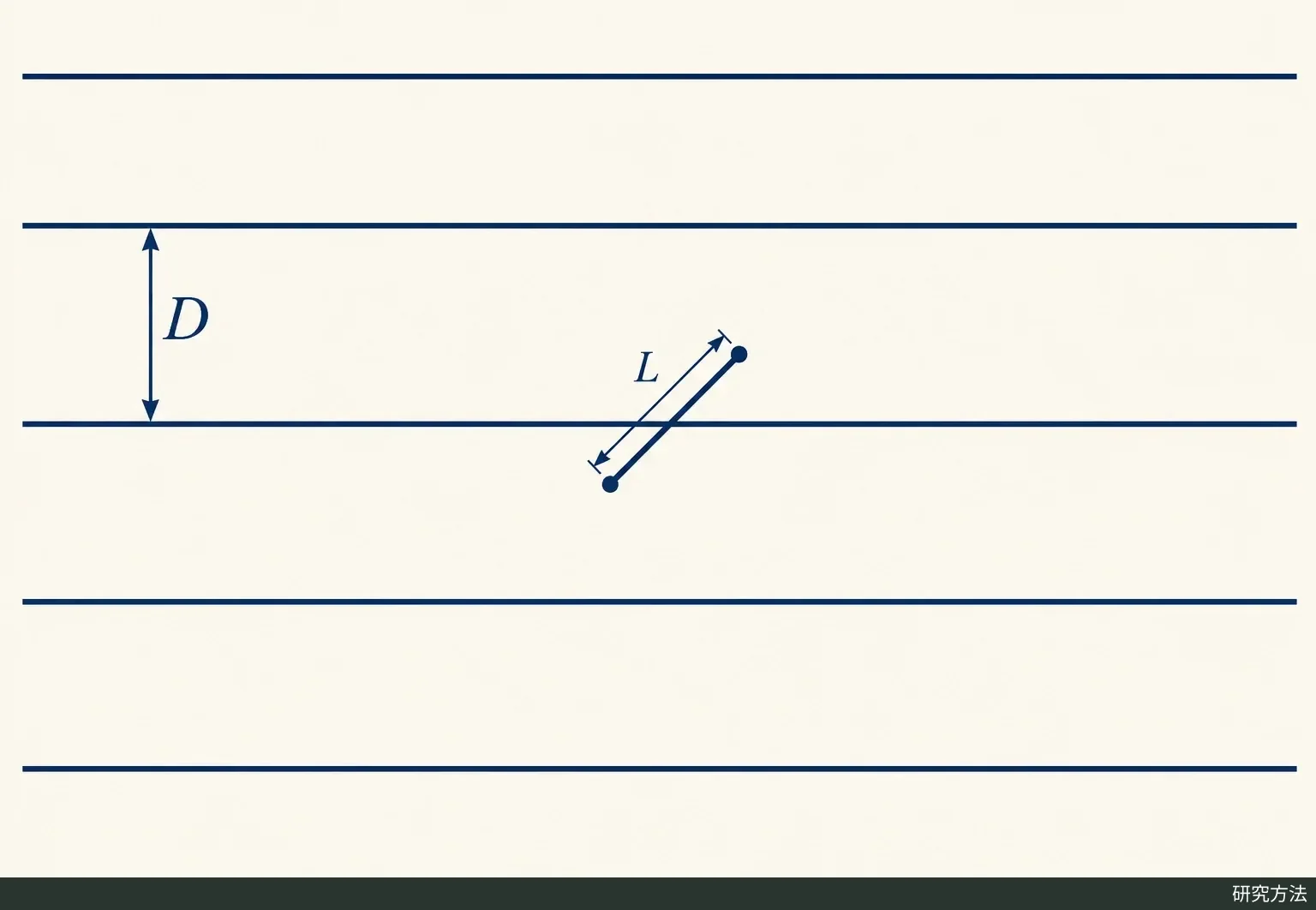
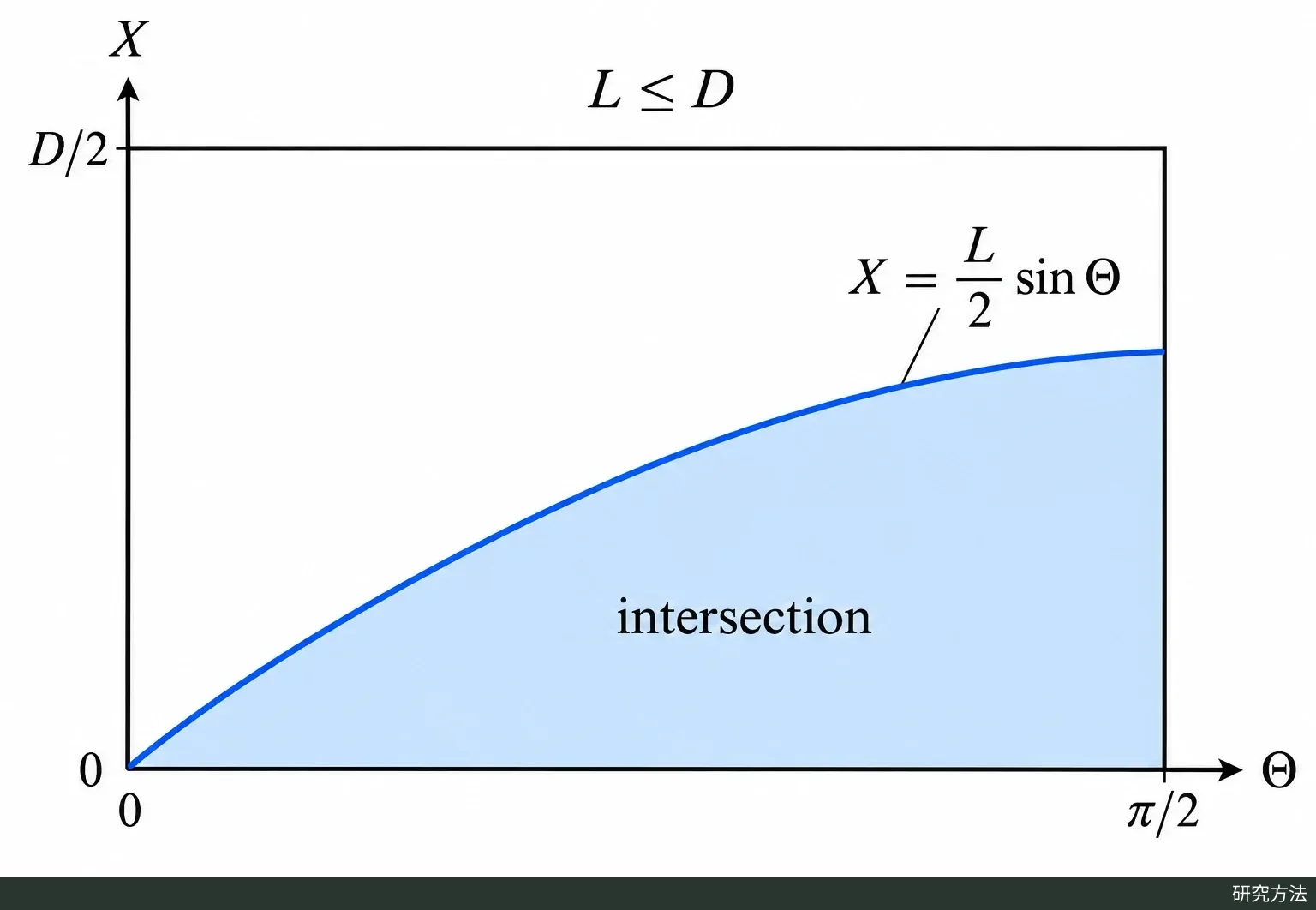
Let the spacing between the parallel lines be D and the needle length be L, with 0<L≤D. After each drop, only two quantities need recording: the distance X from the needle's center to the nearest line, and the acute angle Θ between the needle and the lines. By symmetry, X ranges from 0 to D/2 and Θ from 0 to π/2. An idealized random throw assumes the center's position is uniform within one line-to-line period, the orientation is uniform, and the two are independent, so (X, Θ) is uniformly distributed over this rectangular state space.
The needle's half-projection perpendicular to the lines is (L/2)sinΘ. The needle therefore touches a line exactly when X≤(L/2)sinΘ: the closer the center is to a line and the closer the needle is to perpendicular, the greater the chance of crossing. Put the angle on the horizontal axis and the distance on the vertical axis, and the region under the curve is the crossing region.
Averaging over Angles, and π
In a uniform state space, probability equals the area of the crossing region divided by the total area of the rectangle. The area under the curve is
and the rectangle's area is . Hence
This explains where π comes from: when averaging over all orientations, the numerator accumulates the needle's perpendicular projection, while the denominator contains the length π/2 of the angle interval. It does not appear out of nowhere from the line spacing; the geometry of random orientation enters the probability.
Estimating π from a Frequency
If N independent throws are made and H of them cross, the crossing frequency H/N can be used to estimate the probability. Substituting it into the formula above and solving backward gives
For example, when L=D the crossing probability is 2/π, about 0.6366. Suppose 637 of 1000 throws cross; the estimate is then 2000/637, about 3.14. These counts are illustrative: another set of throws would give a different H and a different estimate.
Whether each throw crosses can be treated as a Bernoulli observation; with independence and a fixed probability, the standard deviation of the crossing frequency is √[p(1−p)/N], so typical fluctuation shrinks at a rate of 1/√N. When π is worked back from the frequency, the frequency's error also propagates to the estimate: the denominator is sensitive when H is small, and when H=0 the estimate cannot even be computed. More throws usually reduce random error, but they do not guarantee that each result is closer to π than the last.
What the Random Experiment Means
The problem converts a measure ratio of geometric regions into a crossing frequency in a random sample, showing the basic idea of the later Monte Carlo method: approximating a quantity that is hard to measure directly by random sampling. In his 1777 Essai d’arithmétique morale, Buffon discussed the problem of a needle falling on the joints of parallel wooden boards; later discussions then used the crossing frequency to estimate π.
The formula relies on a well-defined random mechanism: if the orientation is biased toward some angle, the position is biased toward the lines, or throws are correlated, the actual frequency need not follow the idealized model. When the needle is longer than the line spacing, the short-needle crossing formula cannot be applied as is. The needle experiment offers a way of working back to a constant from random observations, which differs from calculating with an analytic formula that plugs in π directly, or from numerical integration on a deterministic grid.
References
-
Buffon, G.-L. Leclerc, comte de. Essai d’arithmétique morale. Histoire naturelle, Supplément, tome IV, 1777.
-
University of Illinois, MSTE. Buffon's Needle.
-
Research Methods · Rituals can be imitated; understanding cannot be faked
-
Compiled and published by the Scholay all-in-one academic platform. Please contact us to have it taken down in case of infringement.
-
Also published at Enter Scholar, a scholar community for the age of intelligence