When an experimental sample shows a signal, researchers also need to know whether that signal could have come from contamination, the measurement process, or the way samples were selected. A negative control brings into the comparison a result that, under the study hypothesis, should not occur, and so helps check these possibilities. It can be used in laboratory procedures and in observational studies alike; what the two settings share is that one first states what should not happen and then explains why this control is able to reveal the bias of concern.

Illustration: putting the sample and the control through comparable handling. Original hand-drawn illustration by Scholay (AI-assisted).
Start the design from a blank control
Imagine an experiment that tests water samples for a target component. Alongside the actual water samples, prepare a blank material that does not contain the target component, and put it through the same containers, reagents, processing, and detection steps. If the blank also shows the target signal, then reagent contamination, residue on the equipment, or the detection background needs to be checked, rather than immediately interpreting the whole of the sample readings as the target component.
Which problems this control can check depends on which steps it has gone through. A blank added only at the instrument-reading stage cannot test whether the sampling containers were contaminated in the field. In designing the study, one can look for risks stage by stage along sampling, storage, processing, and measurement, and then decide where to place the control. Any differences in handling between the control and the actual samples should be deliberate and explainable.
Before implementation, this can be written up as a short plan: first list the sources of contamination to be ruled out; then specify the blank material and the step at which it is introduced; have the samples and the controls handled under the same operating procedure and record the batches; and finally agree in advance on how to recheck if an anomalous signal appears. Where necessary, also set up a positive control known to contain the target, to check whether the detection process can read out a signal. A negative control by itself cannot prove that the instrument is sensitive enough.
Observational studies need a different kind of control
Observational studies usually do not have a tube that is truly "blank." Researchers can look for a negative control outcome: according to sound causal knowledge the study exposure does not affect it, yet it shares certain sources of bias with the primary outcome. They can also look for a negative control exposure: it should not affect the target outcome, yet it shares the relevant bias mechanisms with the primary exposure. Lipsitch et al. (2010)[1] discuss both arrangements systematically.
What follows is an illustrative design. Researchers want to compare later health outcomes between people who took part in a health screening and those who did not, but they worry that the two groups had different health-management habits to begin with. They can examine a measure of healthcare use from before the screening took place as a candidate negative control outcome: today's screening cannot change healthcare records that already exist from the past, whereas health-management habits may affect both participation in screening and prior healthcare use.
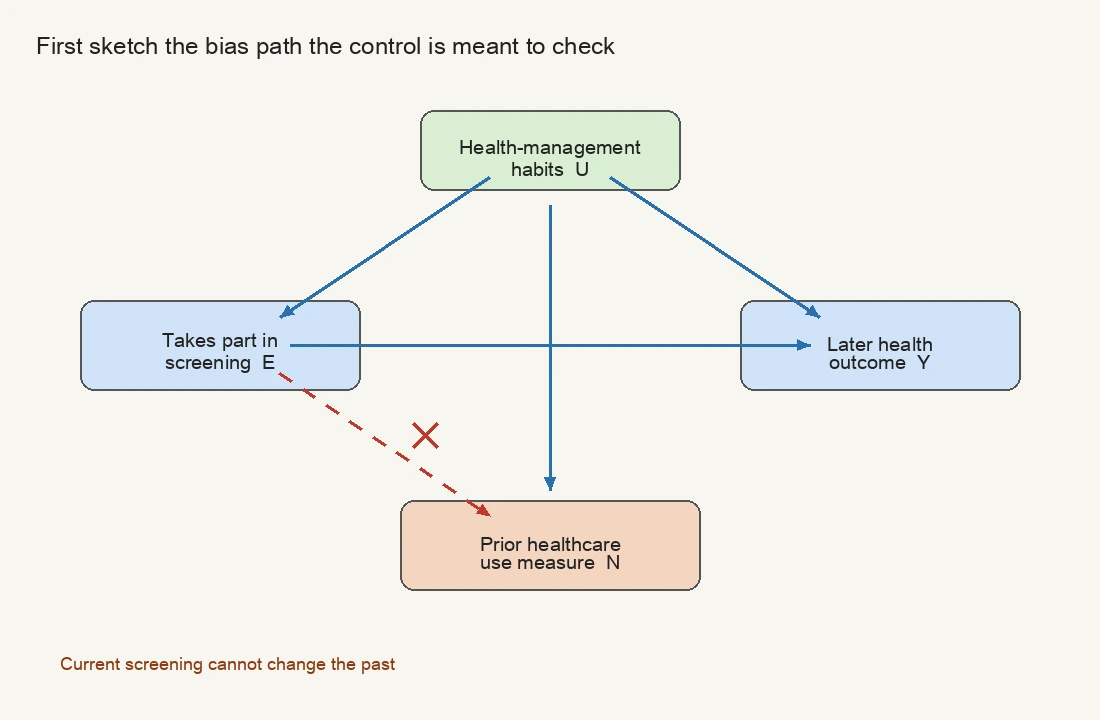
Figure 1 | Schematic of the causal structure of a candidate negative control outcome. Arrows show the paths of influence considered in the design; the orange cross indicates that the causal direction "the current screening changes past records" does not hold. The figure contains no estimates.
"Having happened in the past" only guarantees that the current screening cannot have caused it in reverse; it does not automatically guarantee that it is a good control. Prior healthcare use may also directly affect eligibility for screening, or the two may come from the same recording process. Before choosing it, one still has to explain why this measure shares the bias of concern with the main analysis, whether it introduces additional selection pathways, and whether the time of recording really does precede the exposure.
Spell out the comparison and the follow-up in advance
Continuing with the screening illustration, the study protocol should first fix the time windows for the primary exposure, the later outcome, and the candidate control, and then write out the sources of bias they are expected to share. The main analysis and the control analysis should use comparable inclusion criteria and covariate handling as far as possible, with an item-by-item account of where they cannot be kept the same. The presentation of results should retain the direction of the association, the size of the estimate, and its uncertainty, and not merely record "significant" or "not significant."
If screening is still associated with the measure of past healthcare use, one needs to go back and examine explanations such as health-management habits, eligibility screening, and the way records are kept. Such an association suggests that the main analysis may contain a non-causal component, but it does not directly tell us how large the bias in the primary outcome is. The control measure and the primary outcome may differ in how they are measured, how often they occur, and how strongly they are affected by confounding. Arnold et al. (2016)[2] further show that negative controls can also be designed for selection and measurement processes, with the focus always on the corresponding bias pathway.
How control results change the conclusions
When an unexpected association appears, it can be the basis for checking the data further, revising the inclusion or measurement procedures, and carrying out targeted sensitivity analyses. If no association is observed, that too should be interpreted in light of the uncertainty of the estimate and how sensitive the control is to the bias in question; a very small sample, or a measure that does not share the key bias, may simply not have enough power to detect anything.
The most valuable part of a negative control therefore often takes place before the analysis: it forces researchers to state the bias mechanism concretely and to prepare a traceable path for anomalous results. Unless additional identifying assumptions and methods have been established, the association found in the control cannot simply be subtracted from the main result. A well-designed control can help reveal a problem; correcting it still requires going back to the process that produced the bias.
References
-
Lipsitch, M., Tchetgen Tchetgen, E., & Cohen, T. (2010). Negative controls: A tool for detecting confounding and bias in observational studies. Epidemiology, 21(3), 383–388. DOI.
-
Arnold, B. F., Ercumen, A., Benjamin-Chung, J., & Colford, J. M., Jr. (2016). Brief report: Negative controls to detect selection bias and measurement bias in epidemiologic studies. Epidemiology, 27(5), 637–641. DOI.
-
Research Methods · Rituals can be imitated; understanding cannot be faked.
-
Compiled and published by the Scholay one-stop academic platform. If anything here infringes your rights, please report it and it will be taken down.
-
Also published on Enter Scholar, a community for scholars in the age of AI.