In 1961, Albert Bandura, Dorothea Ross and Sheila Ross ran the Bobo doll experiment with 72 preschool children at the Stanford University Nursery School. Children were matched on sex and baseline aggression and placed in an aggressive-model, a non-aggressive-model or a no-model control group, and delayed imitation over 20 minutes was measured in a new room with the adult model absent, to test observational learning across settings.
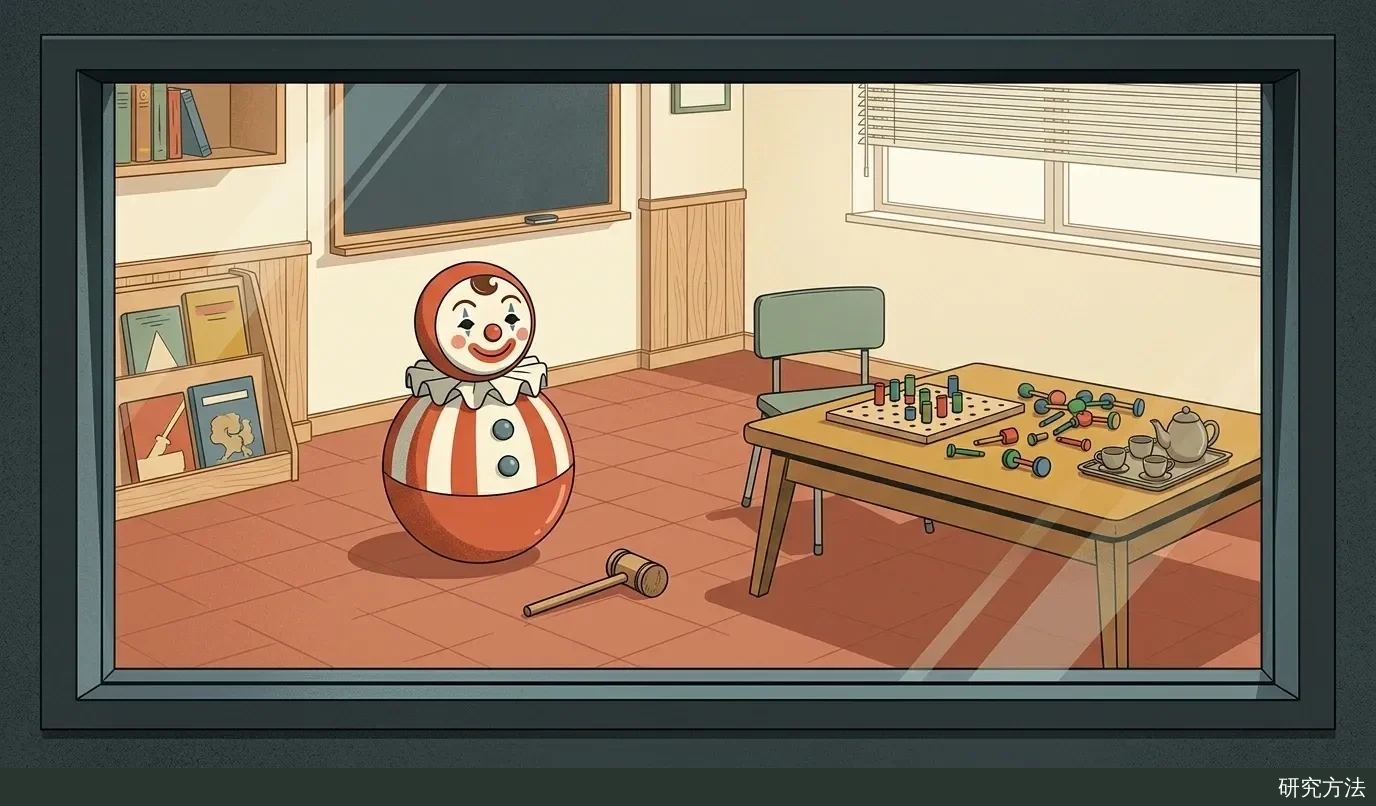
AI-generated illustration: the Phase 3 test setting of the Bobo doll experiment. Through the one-way observation window one can see the inflatable doll, mallet, peg board and tea set in fixed positions, with the adult model completely absent.
Separating "Generalized Imitation" from On-the-Spot Compliance: Framing the Problem and Matched Blocks
In social learning research, showing that "observing other people's behavior can change one's own behavior" runs into a core design problem. If subjects reproduce an action while the model is still present, in the same room, it is hard for researchers to tell whether this is observational learning that has carried across settings or immediate compliance triggered directly by the presence of the model. Earlier, the imitation experiments of Miller and Dollard (1941) required both the model and the observer to receive direct rewards, which made them in effect instrumental learning in which another person's behavior serves as a discriminative cue; and although Bandura and Huston (1961) showed that preschool children in incidental learning imitate an adult model's aggressive actions, testing was still completed with the model present. For this reason, in the Bobo doll experiment that Bandura, Ross and Ross (1961) published in the Journal of Abnormal and Social Psychology, "observational exposure" and "imitation measurement" were separated completely in space and in persons: in the first phase children only observed, without handling anything and without any external reward or punishment, and were then moved to a new room, with the adult model entirely absent, where delayed imitation was measured.
The subjects were 72 preschool children from the Stanford University Nursery School, 36 boys and 36 girls, aged 37 to 69 months, with a mean age of 52 months. One female experimenter ran the whole experiment, and one adult man and one adult woman served as models. Children's everyday aggressiveness is likely to strongly affect how ready they are to imitate aggression, and simple randomization within finely divided subgroups (only 6 children per cell) could easily let unbalanced baseline aggression mask or distort the treatment effect. Matching and block assignment therefore formed the core of the design. Before the experiment began, the experimenter and a nursery school teacher who knew the children rated each child on baseline behavior in everyday social interaction, using four 5-point scales covering physical aggression, verbal aggression, aggression toward inanimate objects, and aggression inhibition (the tendency to suppress aggressive responses when strongly provoked, used to measure aggression anxiety). For the 51 children rated independently by both raters, the Pearson product-moment reliability of the total of the four scales (the composite aggression score) was r = 0.89.
With baseline composite aggression scores in hand, the researchers ranked children by score within boys and within girls and formed matched triplets of 3 children each, then randomly assigned the 3 children in each triplet to one of the three treatment conditions: the aggressive-model group (24 children), the inhibited non-aggressive-model group (24 children) and the no-model control group (24 children). Within the two experimental conditions (48 children in all), the design further divided the children by "child sex (male / female) × model sex (same / opposite)" into 8 experimental subgroups of 6 children each: boys and girls each had 6 children who observed a male aggressive model, 6 who observed a female aggressive model, 6 who observed a male non-aggressive model and 6 who observed a female non-aggressive model. The 24 control children (12 boys and 12 girls) had no adult-model exposure in the first phase and took part only in the later mild frustration and generalization test, providing a baseline reference for responses without a model.
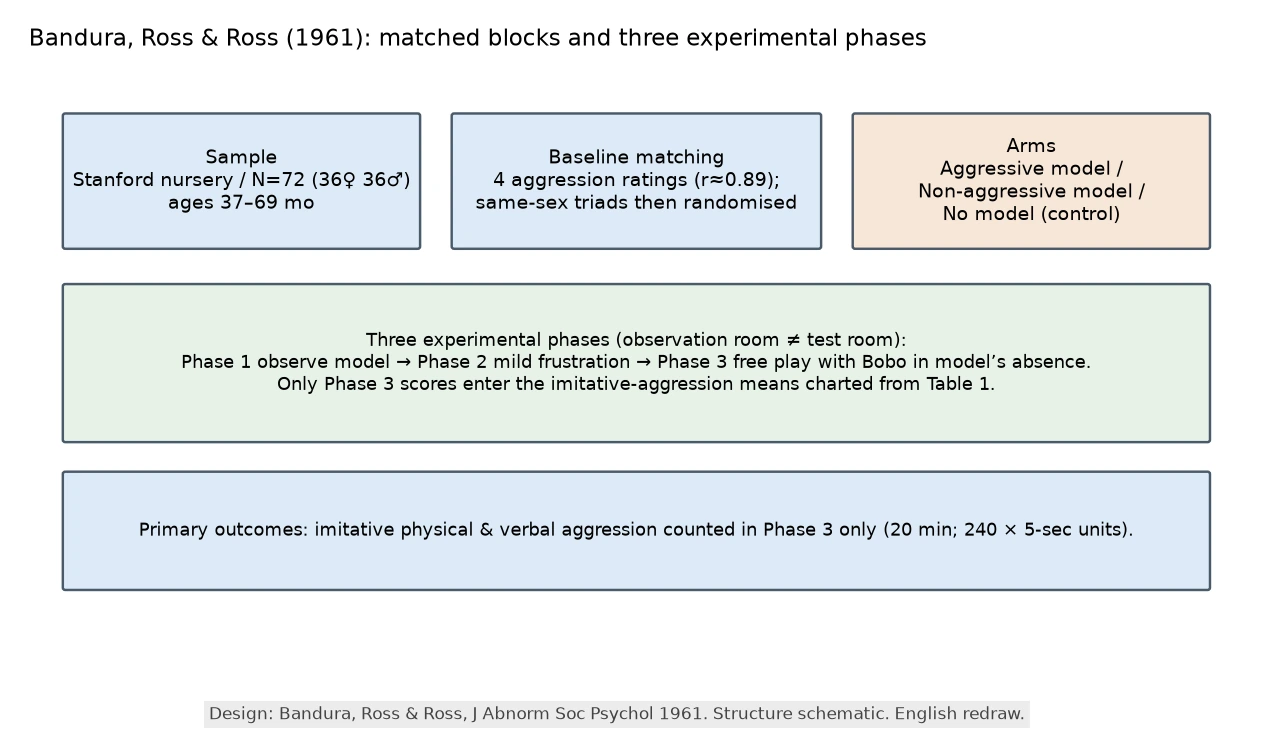
Drawn in code: baseline block matching, assignment to experimental conditions and the three-phase measurement procedure of Bandura's Bobo doll experiment (1961) (data and design basis: Bandura, Ross, & Ross, 1961).
Three-Phase Procedure and Controls: Coding Novel Actions, Equalizing Frustration and One-Way-Mirror Timing
The first phase was a 10-minute one-to-one observational exposure. The experimenter led the child into the first experimental room and seated the child at a small table in one corner, where the child made potato-print pictures and stuck on colored stickers of animals, flowers and western figures. This highly attractive distraction both held the child's attention and ensured that learning was purely observational: the child was given no instruction to "watch carefully" or "do what they do" and could not touch the model's toys. The adult model was taken to the opposite corner, where there were a small table and chair, a set of tinker toys, a mallet and a 5-foot inflatable Bobo doll, and the experimenter then left the room. In the non-aggressive condition, the model assembled the tinker toys quietly throughout and ignored the Bobo doll completely. In the aggressive condition, the model first assembled the tinker toys for about 1 minute and then turned to the Bobo doll and carried out a highly standardized sequence of attacks, repeated about 3 times: laying the doll on its side, sitting on it and punching it repeatedly on the nose; raising the doll, picking up the mallet and hitting it on the head; tossing the doll into the air and kicking it around the room. Interspersed were specific verbal aggression ("Sock him in the nose," "Hit him down...," "Throw him in the air," "Kick him," "Pow") and two non-aggressive lines ("He keeps coming back for more" and "He sure is a tough fella"). This distinctive, coherent set of actions and lines, which rarely occurs spontaneously in natural settings, was designed so that, at the measurement stage, true imitative learning could be told apart from the ordinary pushing and shoving that children do naturally.
After the 10-minute exposure, the experimenter took the child to say goodbye to the model and led the child to another experimental room far from the main nursery school building, so that many children believed they were no longer on the school grounds; this separated the exposure setting from the test setting both physically and psychologically. Before entering the test room proper, all 72 children (including the controls) first received about 2 minutes of "mild aggression arousal" in a transitional anteroom. The anteroom held a fire engine, a locomotive, a jet fighter plane, a cable car, colored spinning tops, and an elaborate doll set with a wardrobe, a baby carriage and a crib. After the child had played for about 2 minutes, the experimenter announced that these were her very best toys, that she had decided to save them for the other children, and that the child could play with any of the toys in the next room. Why apply this mild frustration uniformly to every group? The original paper gives two design considerations. First, earlier work (Rosenbaum & deCharms, 1960) suggested that watching others' aggression may produce vicarious catharsis and actually lower the observer's own immediate aggressive impulse; without uniform arousal, the aggressive-model group might enter the test room less provoked than the non-aggressive and control groups. Second, only with children in a state of mild frustration could one test whether observing a quiet model would activate aggression-inhibiting processes under provocation, leading the non-aggressive-model group to show lower aggression than the no-model control group.
The third phase was a 20-minute delayed imitation test. In the adjoining test room the adult model was completely absent; because a pilot study found that preschool children left alone in an unfamiliar room would refuse to stay or leave early, the female experimenter stayed at a desk in the far corner of the room, busy with paperwork, and avoided any interaction with the child. To remove behavioral variation due to where toys were placed, the toys in the room were arranged in a fixed order in every test, and included both toys that could evoke aggression (a 3-foot Bobo doll, a mallet and peg board, two dart guns, and a ceiling-hung tether ball with a face painted on it) and non-aggressive toys (a tea set, crayons and drawing paper, a ball, two dolls, three bears, cars and trucks, and plastic farm animals). Raters watched through a one-way mirror from the adjoining observation room, using an electric interval timer to divide the 20 minutes into 5-second segments, so that each child yielded 240 response units, which were coded according to predefined specific behavior categories into three tiers of measures: ① full imitation (imitative physical aggression, imitative verbal aggression, imitative non-aggressive verbal responses); ② partial imitation (hitting objects other than the Bobo doll with the mallet, laying the Bobo doll on its side and sitting on it without hitting it); ③ non-imitative aggression (ordinary punching and shoving of the Bobo doll, physical and verbal hostility directed at other objects, aggressive gun play); the number of units of non-aggressive play and of sitting quietly without playing was also recorded.
Results, the Sex Interaction and Methodological Limits
In the statistical analysis, because about 70% of the children in the non-aggressive-model and control groups scored 0 on the imitative aggression measures, the data were severely skewed and did not meet the homogeneity-of-variance assumption. The researchers therefore did not apply a conventional parametric analysis of variance to the whole sample; instead they used the triplet matching structure with the Friedman rank two-way analysis of variance (χ²r) to test the overall treatment effect, the sign test for paired comparisons between conditions, and the Cochran Q test for the dichotomous measure of imitative non-aggressive verbal responses. The results clearly supported the hypothesis of generalized imitation across settings: in the new room without the model, the three groups differed highly significantly on imitative physical aggression (χ²r = 27.17, p < .001) and imitative verbal aggression (χ²r = 9.17, p < .02), and paired sign tests showed that the difference came entirely from the aggressive-model group scoring significantly higher than the non-aggressive-model and control groups. Even for the model's two casual non-aggressive lines, about a third of the children in the aggressive-model group repeated them spontaneously, whereas not one child in the non-aggressive or control groups did (Q = 17.50, p < .001). On partial imitation and non-imitative aggression, mallet aggression (χ²r = 11.06, p < .01), sitting on the doll (Q = 13.44, p < .01) and non-imitative physical and verbal aggression (χ²r = 8.96, p < .02) were also significantly affected by the treatment condition; but ordinary punching of the Bobo doll (χ²r = 2.87, ns) and aggressive gun play (χ²r = 2.75, ns) did not differ significantly across the three groups, which shows that an aggressive model did not amplify all rough play indiscriminately but specifically transmitted the modeled patterns of action and aggression directed at particular equipment.
The table below summarizes the mean number of aggressive responses of each subgroup over the 240 five-second observation units in Table 1 of Bandura, Ross and Ross (1961), together with the corresponding nonparametric overall tests and paired-comparison p values in Table 2:
| Response category and subject sex | Aggressive model: female model (n=6) | Aggressive model: male model (n=6) | Non-aggressive model: female model (n=6) | Non-aggressive model: male model (n=6) | No-model control (n=12 per sex) | Overall test (Table 2) | Aggressive vs non-aggressive / aggressive vs control / non-aggressive vs control |
|---|---|---|---|---|---|---|---|
| Imitative physical aggression (girls) | 5.5 | 7.2 | 2.5 | 0.0 | 1.2 | , | / / |
| Imitative physical aggression (boys) | 12.4 | 25.8 | 0.2 | 1.5 | 2.0 | (same as above, boys and girls pooled in matching) | (same as above) |
| Imitative verbal aggression (girls) | 13.7 | 2.0 | 0.3 | 0.0 | 0.7 | , | / / |
| Imitative verbal aggression (boys) | 4.3 | 12.7 | 1.1 | 0.0 | 1.7 | (same as above, boys and girls pooled in matching) | (same as above) |
| Mallet aggression, partial imitation (girls) | 17.2 | 18.7 | 0.5 | 0.5 | 13.1 | , | / ns / |
| Mallet aggression, partial imitation (boys) | 15.5 | 28.8 | 18.7 | 6.7 | 13.5 | (same as above, boys and girls pooled in matching) | (same as above) |
| Ordinary punching of the Bobo doll (girls) | 6.3 | 16.5 | 5.8 | 4.3 | 11.7 | , ns | Not broken down (overall not significant) |
| Ordinary punching of the Bobo doll (boys) | 18.9 | 11.9 | 15.6 | 14.8 | 15.7 | (same as above, boys and girls pooled in matching) | (same as above) |
| Non-imitative physical and verbal aggression (girls) | 21.3 | 8.4 | 7.2 | 1.4 | 6.1 | , | / ns / ns |
| Non-imitative physical and verbal aggression (boys) | 16.2 | 36.7 | 26.1 | 22.3 | 24.6 | (same as above, boys and girls pooled in matching) | (same as above) |
| Aggressive gun play (girls) | 1.8 | 4.5 | 2.6 | 2.5 | 3.7 | , ns | Not broken down (overall not significant) |
| Aggressive gun play (boys) | 7.3 | 15.9 | 8.9 | 16.7 | 14.3 | (same as above, boys and girls pooled in matching) | (same as above) |
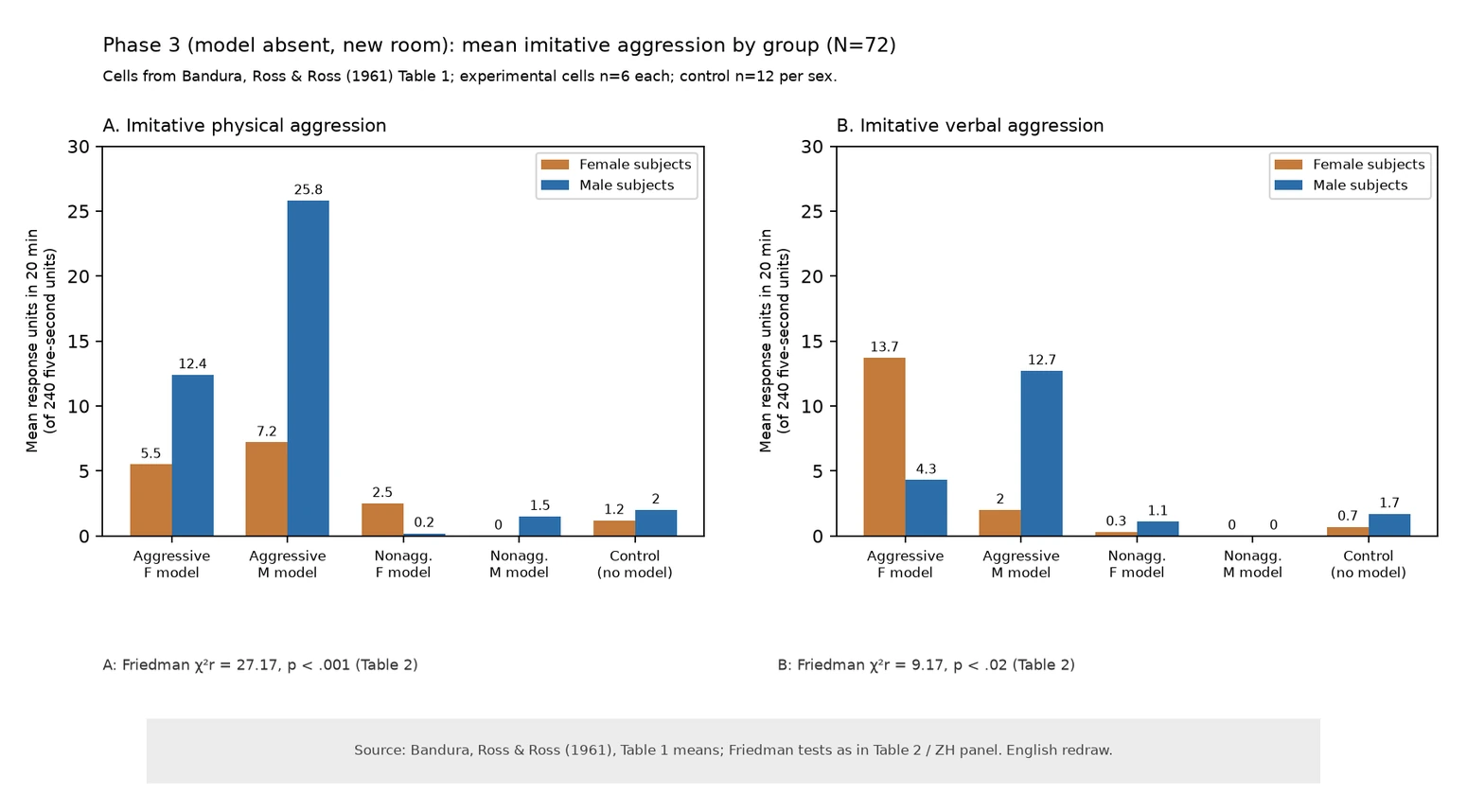
Drawn in code: comparison of the mean imitative physical aggression and imitative verbal aggression of each group of children over the 20 minutes (240 five-second units) of Phase 3 (new room, model absent). Data source: Bandura, Ross, & Ross (1961), Table 1 & Table 2.
Regarding the interaction of sex and model, t tests within the aggressive-model group showed that boys reproduced significantly more imitative physical aggression than girls (t = 2.50, p < .01), but the two sexes did not differ significantly in total imitative verbal aggression. The subgroup means in Table 1 further reveal a trend in which a "same-sex model preference" and a "gender stereotype of physical aggression" are superimposed: after observing a male aggressive model, boys scored significantly higher than girls on imitative physical aggression (25.8 vs 7.2, t = 2.07, p < .05), imitative verbal aggression (12.7 vs 2.0, t = 2.51, p < .05), non-imitative aggression (36.7 vs 8.4, t = 3.15, p < .025) and aggressive gun play (15.9 vs 4.5, t = 2.12, p < .05). Conversely, girls who observed a female aggressive model had higher means than boys on imitative verbal aggression (13.7 vs 4.3) and non-imitative aggression (21.3 vs 16.2), but with only n = 6 per cell and large within-group variance, the differences in this direction did not reach statistical significance. As for the hypothesis that "a non-aggressive model can inhibit aggression", at the level of whole groups the significant difference between the non-aggressive and control groups showed mainly as less mallet aggression (p = .005, with the girls' mean falling from 13.1 in the control group to 0.5). But when children who observed a quiet male model were compared separately with the controls using the sign test, the former showed a consistent decline in imitative physical aggression (p = .06), imitative verbal aggression (p = .002), mallet aggression (p = .003), non-imitative aggression (p = .03) and punching the doll (p = .07), and children who observed a non-aggressive model spent more than twice as much time as the aggressive-model group sitting quietly in the test room without touching any toy (t = 3.07, p < .01). The authors also caution that splitting into subgroups when the overall test is not significant easily capitalizes on chance, so the subgroup inhibition trend serves only as directional supporting evidence.
Viewed through experimental design methodology, this classic study has four clear limits on inference. First, the observers' coding was not strictly blind: the methods section of the original paper admits that the researcher who played the male model himself did all the scoring in the test phase for all 72 children (another independent rater double-coded half the sample, with inter-rater reliability above 0.90); he not only knew the group assignment of the 24 children for whom he had been the model, but 22 of the 24 children in the aggressive-model group performed highly recognizable specific imitative actions as soon as they entered, so an observer behind the one-way mirror could easily tell which group a subject belonged to. Second, the single-cell sample sizes after the factorial split were small (n = 6 per subgroup), and the many zero scores in the non-aggressive and control groups limited the power of overall parametric tests for higher-order interactions. Third, the outcomes were measured in a laboratory response within the 20 minutes right after exposure, directed at an inflatable doll that cannot hit back and was designed to spring upright after being knocked down; it strictly demonstrates "cross-room acquisition of actions and disinhibition without direct reinforcement and without the model present", but cannot be equated directly with long-term retention of aggressive habits, interpersonal violence against real peers, or the effects of film and screen media (the latter was a question the authors tested separately only in their later 1963 experiments with film and cartoon models). Fourth, all the subjects came from one particular highly educated population, the Stanford University Nursery School, and showing preschool children adult violent actions and deliberately creating the frustration of toy deprivation reflect the experimental routines of the early 1960s, which differ markedly from today's ethics review and post-session debriefing standards for child development research.
1. References
- Bandura, A., Ross, D., & Ross, S. A. (1961). Transmission of aggression through imitation of aggressive models. Journal of Abnormal and Social Psychology, 63(3), 575–582. https://doi.org/10.1037/h0045925
- Bandura, A., Ross, D., & Ross, S. A. (1961). Transmission of aggression through imitation of aggressive models (full-text reprint in Classics in the History of Psychology at York University, including the original Tables 1 and 2). https://psychclassics.yorku.ca/Bandura/bobo.htm
- Bandura, A., & Huston, A. C. (1961). Identification as a process of incidental learning. Journal of Abnormal and Social Psychology, 63(2), 311–318. https://doi.org/10.1037/h0040351
References
-
Research Methods · Rituals can be imitated; understanding cannot be faked
-
Compiled and published by the Scholay all-in-one academic platform; if any rights are infringed, please contact us and we will take the content down.
-
Also published at Enter Scholar, a scholar community for the age of intelligence