In 1967, Seligman and Maier gave three groups of dogs different pretreatments: one group could end the shock by pressing a panel with the head while in a hammock; a yoked group received exactly the same shocks, but pressing the panel did nothing; a third group received no shock. Twenty-four hours later, in a shuttle box test, the yoked dogs failed to escape on an average of 7.25 of 10 trials, while the other two groups failed on only a little over 2. The key to the design is that yoked shocks separate "being able to control" from "the shock itself."
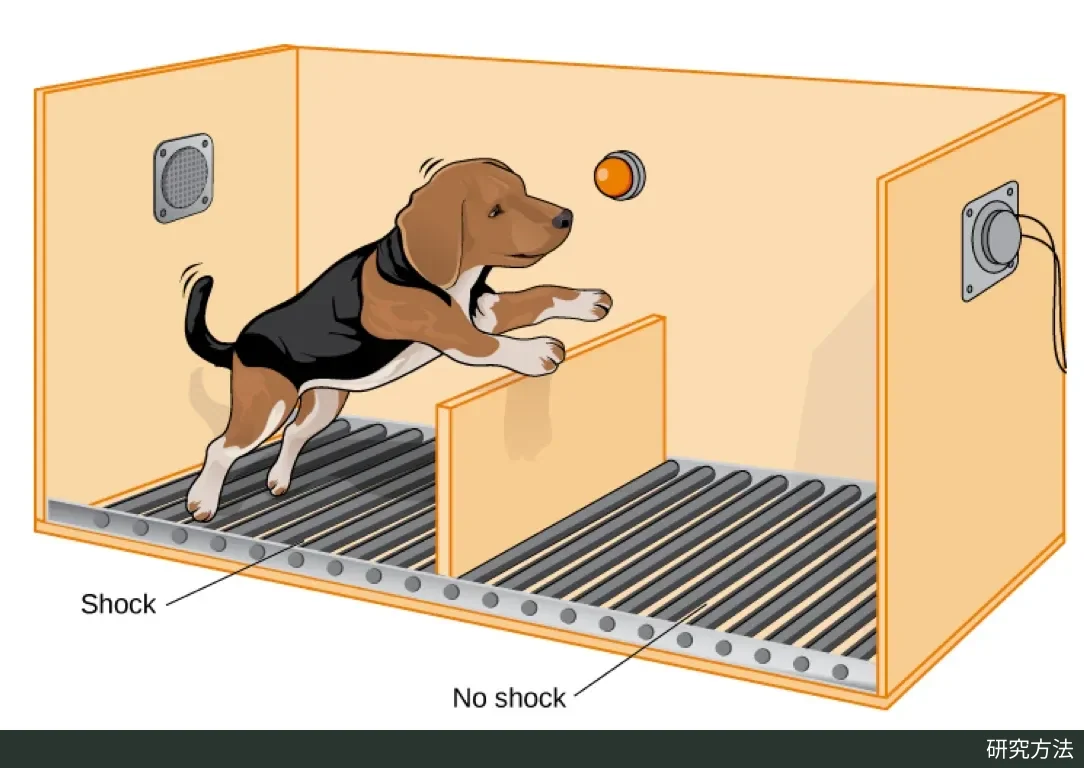
A textbook illustration of the shuttle box used in Seligman's learned helplessness experiments: a low barrier separates the two compartments, and a dog can leave the electrified side by jumping over it. Image: Rose M. Spielman, PhD, OpenStax Psychology, Figure 14.22, via Wikimedia Commons, CC BY 4.0.

The Design Problem: The Shock Itself, or Its Uncontrollability
This line of research began with an accident. According to Maier and Seligman's (2016) retrospective, in the early 1960s students of Richard Solomon at the University of Pennsylvania wanted to know how prior Pavlovian fear conditioning would affect later instrumental learning: dogs were restrained in a hammock and given 64 shocks signaled by a tone, then put into a shuttle box 24 hours later to learn to jump over a low barrier to escape the shock. According to the two-factor avoidance theory of the time, the tone that frightened the dogs should speed up jumping; but the experimenters could not test this, because many dogs in the shuttle box did not escape at all and simply waited passively for the shock to end.
Overmier and Seligman (1967) made this anomaly itself the object of study. They compared dogs that had received inescapable shock with dogs that had received none, and found that under a variety of shock conditions the former were later impaired in learning both escape and avoidance in a new situation. Two supplementary manipulations ruled out two common explanations. Raising the shock intensity at test did not reduce the interference, which shows that the dogs had not simply "adapted" to the shock so that it no longer hurt enough; and dogs that had been paralyzed with curare during the inescapable shock, and so could not move at all, still showed the interference afterward, which shows that they had not learned some response in the hammock that conflicts with jumping. The interference appeared at 24 hours, while dogs tested after 48 hours behaved normally.
But the comparison of "inescapable-shock group versus no-shock group" still left a gap: the two groups differed on two things at once, namely whether they were shocked and whether the shock was uncontrollable. The later failure could come from the pain, fatigue, or fear brought on by the shock itself, not necessarily from uncontrollability. To show that uncontrollability is the active ingredient, one more group is needed: shock of the same intensity, number, and duration, but with the animal able to turn it off itself. This is the question that Experiment 1 of Seligman and Maier (1967) set out to answer: if dogs first receive yoked shock equal in amount to that of an escapable group but impossible to terminate, then in a shuttle box with an open escape route, will they escape less often and more slowly than the escapable group and the no-shock group?
A Two-Phase, Three-Group Procedure
Experiment 1 used 30 naive mongrel dogs, 15–19 inches tall at the shoulder and weighing 25–29 pounds. Three dogs were dropped from the escape group (2 never learned to press the panel to escape in the hammock, and 1 was lost to a procedural error) and three from the yoked group (2 had necks too thin to be secured in the hammock, and 1 died during handling), leaving 8 dogs per group. Two sets of apparatus were used, one for the pretreatment and one for the test.
The first phase took place in a hammock. The hammock was placed in a white soundproof chamber; the dog's four legs hung through four holes in the hammock and were secured, and a panel on each side of the head could be pressed with the head. Electrodes were attached to the rear footpads, and the shock intensity was 6.0 mA. The escape group received 64 unsignaled shocks at an average interval of 90 seconds (60–120 seconds); pressing either panel during a shock ended it, and otherwise it terminated automatically after 30 seconds. The yoked group's treatment was identical except that pressing the panel had no effect: the duration of each trial's shock was set to the average duration of that trial for the escape group, so each yoked dog received a series of progressively shorter shocks, totaling 226 seconds. The no-shock control group did not go through this phase.
Twenty-four hours later, all three groups received the same test: a two-way shuttle box, with the barrier between two black compartments adjusted to the dog's shoulder height. Each trial was signaled by turning off four 50-watt lights so that the box became dim, and 10 seconds later a 4.5 mA shock was applied through the floor grid. Jumping the barrier during the signal, which ended the signal and prevented any shock, was an avoidance; if the dog did not jump, the shock continued until it jumped, which was an escape; if the dog had still not jumped 60 seconds after the signal appeared, the trial ended automatically, the latency was recorded as 60 seconds, and one escape failure was counted. Each dog ran 10 trials, with an average intertrial interval of 90 seconds; if the dog failed on all of the first 5 trials, it was moved to the other side of the box to continue. Photocells recorded jumps automatically, and latency was timed from the onset of the signal to the nearest 0.01 second.
| Design element | Escape group | Yoked group | No-shock control group |
|---|---|---|---|
| Phase 1 (hammock) | 64 unsignaled 6.0 mA shocks, ended by pressing the panel, otherwise ended after 30 seconds | 64 6.0 mA shocks; pressing the panel had no effect; each shock lasted as long as the escape group's average for that trial, 226 seconds in total | None |
| Phase 2 (24 hours later, shuttle box) | 10 trials: shock 10 seconds after the dimming signal, up to 60 seconds each | Same | Same |
| Dependent variables | Mean latency, mean number of escape failures, proportion of dogs failing on 9 or more of the 10 trials | Same | Same |
| Final sample | 8 dogs | 8 dogs | 8 dogs |
This procedure can be broken down into four design levers. First, controllability is made an independent variable with three levels: comparing the yoked group with the escape group holds the shock constant and varies only controllability; comparing the escape group with the no-shock group checks whether "controllable shock" itself has any effect. Second, yoking controls physical exposure: both groups receive the same shock intensity and number, durations are matched trial by trial, and shock onset is independent of the dog's actions, so the chance that an action happens to coincide with shock onset and looks like it is being punished is the same for both groups. Third, the two phases use different apparatus and different responses: pretreatment involves being restrained, pressing a panel with the head, and footpad electrodes, whereas the test involves free movement, jumping a barrier, and a shocked floor; all groups face the same test task, so differences between groups can be traced only to the previous day's treatment and not to the difficulty of the test. Fourth, escape and avoidance are recorded separately: jumping within the 10 seconds of the signal is avoidance, jumping only after the shock begins is escape, and still not jumping at 60 seconds is an escape failure; latency is timed from the onset of the signal and covers both kinds of response.
Shuttle Box Results and the Immunization Experiments
During the hammock phase, all the dogs in the escape group learned to press the panel: each dog's pressing latency fell across trials (trials 1–8 versus trials 57–64, sign test p = .008), eventually settling into a single press as soon as the shock came on; yoked dogs generally stopped pressing the panel altogether after about 30 trials. In the shuttle box, Table 1 of the original paper shows mean latencies of 48.22 seconds for the yoked group, 27.00 seconds for the escape group, and 25.93 seconds for the no-shock group; mean escape failures out of 10 trials of 7.25, 2.63, and 2.25 respectively; and, among dogs failing on 9 or more of 10 trials, 75% of the yoked group (6 of 8 dogs), none of the escape group, and 12.5% of the no-shock group. On both latency and failures, the yoked group differed significantly from the other two groups (Duncan's multiple range test, p < .05), and there was no difference between the escape group and the no-shock group.
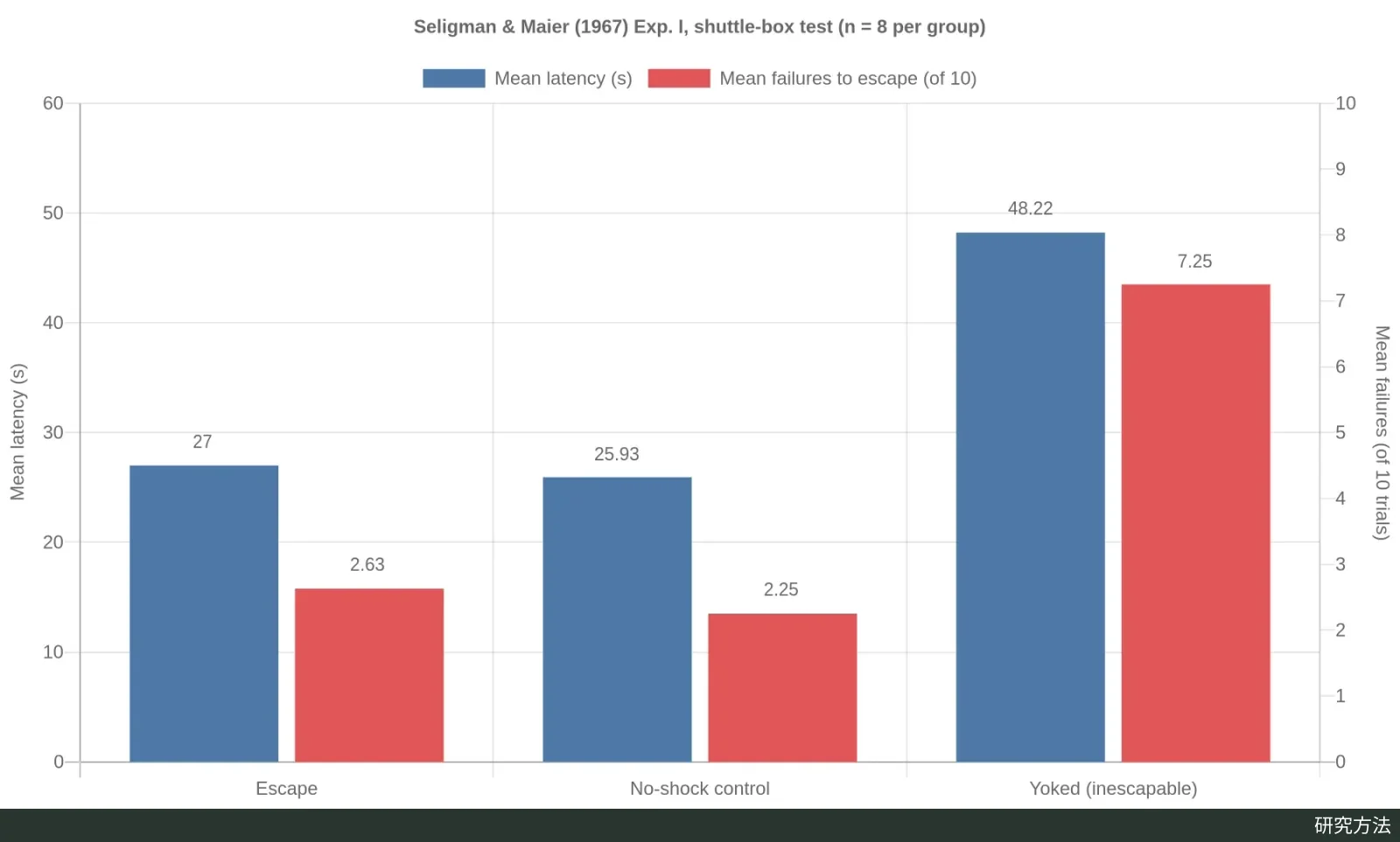
Experiment 1 of Seligman and Maier (1967): performance of three groups of 8 dogs each over 10 shuttle box trials. Escape is the escapable group, No-shock control is the no-shock control group, and Yoked (inescapable) is the yoked inescapable group. Blue (left axis): mean latency (seconds, timed from the onset of the dimming signal, with 60 seconds recorded when there was no jump within 60 seconds); red (right axis): mean number of escape failures (out of a maximum of 10). Data are from Table 1 of the original paper, which reports no standard deviations; plotted by this site with QuickChart (Chart.js).
The near overlap of the escape group and the no-shock group is the most important cell in that table: the escape group, which had endured the same 64 shocks, was not impaired, which shows that the problem lies not in the shock itself but in whether it can be ended by one's own action. The authors accordingly proposed an explanation: yoked dogs learned in the hammock that when the shock stopped had nothing to do with what they did, that is, the conditional probability of shock termination given a response is the same as without one; the motivation to initiate a response originally comes from the expectation that the response will make the shock stop, and once that expectation is gone, then in the shuttle box, even when the shock comes on, the dogs seldom try again. This is a systematic difference between the groups, not one that holds for every dog: 2 of the 8 yoked dogs did not show severe failure.
How long does the effect last? Overmier and Seligman found that the interference had disappeared when dogs were tested 48 hours after inescapable shock. Experiment 1 followed 6 yoked dogs that had failed on 9 or more trials: tested again 7 days later on 10 trials, 5 of them still failed to escape on every trial. The authors speculated that the failure in the shuttle box 24 hours later might itself have become conditioned to the shuttle box cues and so prolonged the interference; they listed the relation between the "learning factors that produce the interference" and the "emotional factors that determine its time course" as an issue still to be clarified.
Experiment 2 asked the reverse question: can prior experience of control offset later uncontrollable shock? Twenty-seven dogs were randomly assigned to three groups of 9. The "prior escape" group received 10 escapable trials in the shuttle box on day 1, 64 inescapable 5-second 6.0 mA shocks in the hammock on day 2, and another 30 trials in the shuttle box on day 3; the "no prior experience" group received only the same inescapable shocks in the hammock, and 24 hours later ran 40 trials in the shuttle box; the "no inescapable shock" group followed the same procedure as the prior escape group, but on day 2 was only restrained in the hammock for 90 minutes without any shock. As a result, the no prior experience group had longer latencies and more failures over the 40 trials (p < .05), the prior escape group and the no inescapable shock group did not differ, and on the number of avoidances only the block-of-trials effect was significant, with no group differences, so the interference showed up mainly in latency and escape failures. In the hammock, the prior escape group also pressed the panel more often than the no prior experience group (Mann-Whitney U = 9, p < .02).
Here another confound lurks: the prior escape group may have been protected simply because it had been in the shuttle box and been shocked there beforehand, not because it could escape there. The authors therefore ran an additional control group after the fact: 9 dogs ran 10 trials in the shuttle box on day 1, but the duration of each trial was preset to the average duration of the corresponding trial for the other two groups, so jumping or not made no difference, which amounts to moving the yoked logic into the shuttle box. These dogs performed on day 3 just like the no prior experience group, and pressed the panel in the hammock significantly less than the prior escape group (U = 14, p < .05). What protected them was the earlier experience of being able to escape, which later literature calls immunization.
What Was Measured, Mechanism Revisions, and Ethical Limits
What these two papers measured was operational performance: latencies, failures, and avoidances in the shuttle box, and the number of panel presses in the hammock. "Learning that responses and outcomes are independent" is an explanation the authors inferred from the behavioral pattern, and it was not measured directly. In their general discussion the authors also list alternative explanations, such as that "not moving" itself was reinforced in the hammock, or that the whole procedure could be viewed as a kind of generalized extinction, and they acknowledge that the latter differs from their own explanation only in wording. The papers contain no depression scale and no neural measurements.
Fifty years later, Maier and Seligman (2016) revised the mechanism on the basis of neuroscience research in rats. These studies used the same three-group design: a prolonged aversive stimulus itself activates and sensitizes serotonergic neurons in the dorsal raphe nucleus, producing passivity and anxiety, which is a default response that requires no learning; when the shock is escapable, the ventromedial prefrontal cortex detects control and in turn inhibits the dorsal raphe. In the review the two authors state frankly that the original theory "got it backwards": what is learned is not helplessness but control. The behavioral conclusion was not overturned, and the yoked group still does worse than the escapable and no-shock groups; what changed is which group carries the active learning process. This is also a reminder for design: the three-group design can establish that controllability is at work, but it cannot, on the basis of "escape group and no-shock group are comparable" alone, determine which side is the one that is learned.
The original design itself also has several features worth improving if borrowed. The escape group excluded 2 dogs that had not learned to press the panel, who may have been precisely the more vulnerable individuals; with them excluded, the escape group's performance may have been biased favorably. In a footnote the authors report that 1 of these dogs behaved normally in the shuttle box after 48 hours and the other was too ill to test. In Experiment 1, the yoked group was matched to the average duration of each trial for the escape group rather than matched one-to-one; Maier and Seligman (2016) mention that later experiments mostly switched to pairwise matching, so that two paired animals receive exactly identical shocks. There were only 8 dogs per group, Experiment 1 gives no account of how dogs were assigned to groups, whereas Experiment 2 states explicitly that assignment was random.
Extrapolation has to be done in steps. From dogs to humans: according to the review by Maier and Seligman (2016), Hiroto and Seligman (1975) obtained similar "human shuttle box" results in college students using three groups (escapable noise, yoked noise, no noise) and solvable versus unsolvable anagrams, but these remain brief laboratory tasks. From laboratory to clinic: learned helplessness was later used as a laboratory model of depression, but between passive responding in a shuttle box and clinical depression there still lie diagnosis, course of illness, and social circumstances. What the original studies support is that "prior uncontrollable aversive stimulation impairs later instrumental escape responding," not that "people who meet with setbacks will give up," and certainly not that the effect is permanent: the interference observed by Overmier and Seligman dissipated within 48 hours.
The ethical costs are recorded in the original papers themselves. In Experiment 1 the dogs were restrained in a hammock and given 64 shocks of 6.0 mA, 1 died during the procedure, and 1 dog that was excluded was too ill to test after 48 hours; the procedure of Experiment 2 states that a dog that failed to escape on any of the 40 trials would receive a cumulative 2000 seconds of shock in the shuttle box. The methods sections of the Seligman and Maier papers do not describe any ethical review or measures to reduce suffering. Subsequent animal research quickly moved from dogs to rodents. Today, any design repeating this kind of uncontrollable stress would first have to explain why uncontrollable aversive stimuli must be used, whether the same question could be answered with fewer animals and milder stimuli, and would need to pass animal ethics review.
If you want to borrow this design to study other questions about controllability, five elements can be extracted: first, set up controllable, yoked uncontrollable, and untreated groups, using the two comparisons to answer separately "does controllability matter?" and "does the treatment itself matter?"; second, match the yoked group pair by pair on the intensity, number, timing, and duration of the stimuli, so that controllability is the only systematic difference; third, change the apparatus and the response between pretreatment and test, and give all groups the same test, in order to distinguish a transfer effect from test difficulty; fourth, break test performance into avoidance, escape, and failure and report them separately; and fifth, when a conclusion such as "prior experience is protective" comes up, add a control that receives yoked stimulation in the same setting, to distinguish "having been exposed" from "being able to control."
References
-
Overmier, J. B., & Seligman, M. E. P. (1967). Effects of inescapable shock upon subsequent escape and avoidance responding. Journal of Comparative and Physiological Psychology, 63(1), 28–33. DOI
-
Seligman, M. E. P., & Maier, S. F. (1967). Failure to escape traumatic shock. Journal of Experimental Psychology, 74(1), 1–9. DOI; Full-text PDF (Hanover College course page)
-
Maier, S. F., & Seligman, M. E. P. (2016). Learned helplessness at fifty: Insights from neuroscience. Psychological Review, 123(4), 349–367. DOI; PMC full text
-
Research Methods · Rituals can be imitated; understanding cannot be faked
-
Compiled and published by the Scholay all-in-one academic platform; if any infringement is found, please let us know and it will be taken down.
-
Also published at Enter Scholar, a community for scholars in the age of intelligence