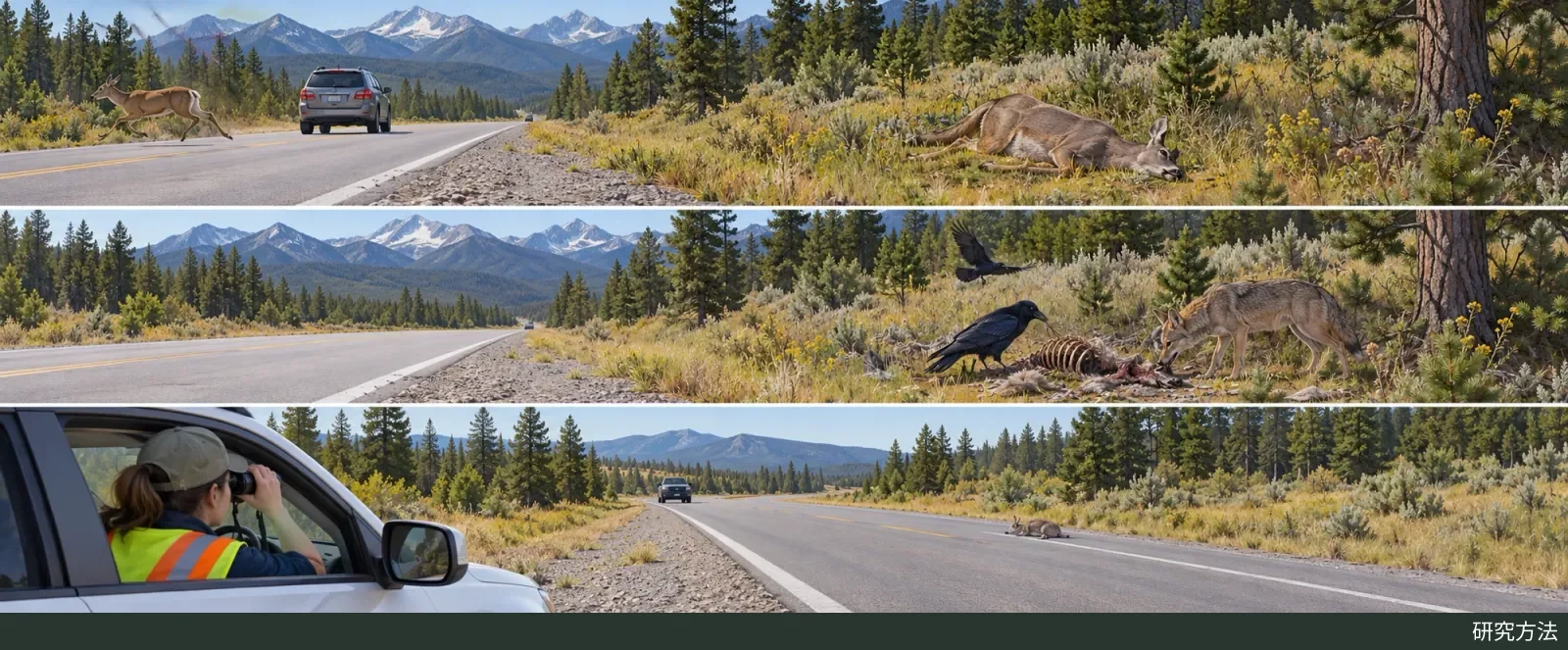
Carcasses counted on road surveys are only part of road mortality. In Methods in Ecology and Evolution, Gómez-Peña and colleagues propose a hierarchical Bayesian model that adds the probabilities that a carcass lands in the survey area, persists, and is observed, so that mortality can be inferred back from survey counts. In the Spanish case study, songbirds were observed at about 8 per kilometre while the model estimated about 49.
Three Layers of Missed Detection, and the Model
A routine carcass survey reports how many carcasses could be seen and recorded at survey time, not total deaths. An animal struck by a vehicle may die outside the surveyed strip; a carcass left in the strip may be removed by scavengers, crushed or washed away before the survey; and even a carcass still in place may be missed because of survey speed, the animal's size or vegetation. Species are affected by these steps to different degrees, so comparing raw counts directly can change judgments about the level of threat and conservation priorities.
The new framework treats true mortality as a latent quantity and links it to the actual count through three layers: location, persistence and observation. Intuitively, deaths pass through three probability filters before they become records. Using the survey data and prior information for each layer, the model works backward to estimate mortality and carries parameter uncertainty into the posterior distribution. It builds on N-mixture models for imperfect detection and adds a layered treatment of whether a carcass enters the surveyed area and whether it persists.
Simulation and Road Surveys
The researchers first simulated survey data for different taxa, survey designs and prior information. In most simulated scenarios the model recovered true mortality; the largest gaps from the simulated truth appeared when variation in carcass persistence probability was large and the prior was highly diffuse. Counts alone cannot identify the location and persistence probabilities, so estimates for these two layers depend on external information, and inaccurate priors can also affect the results.
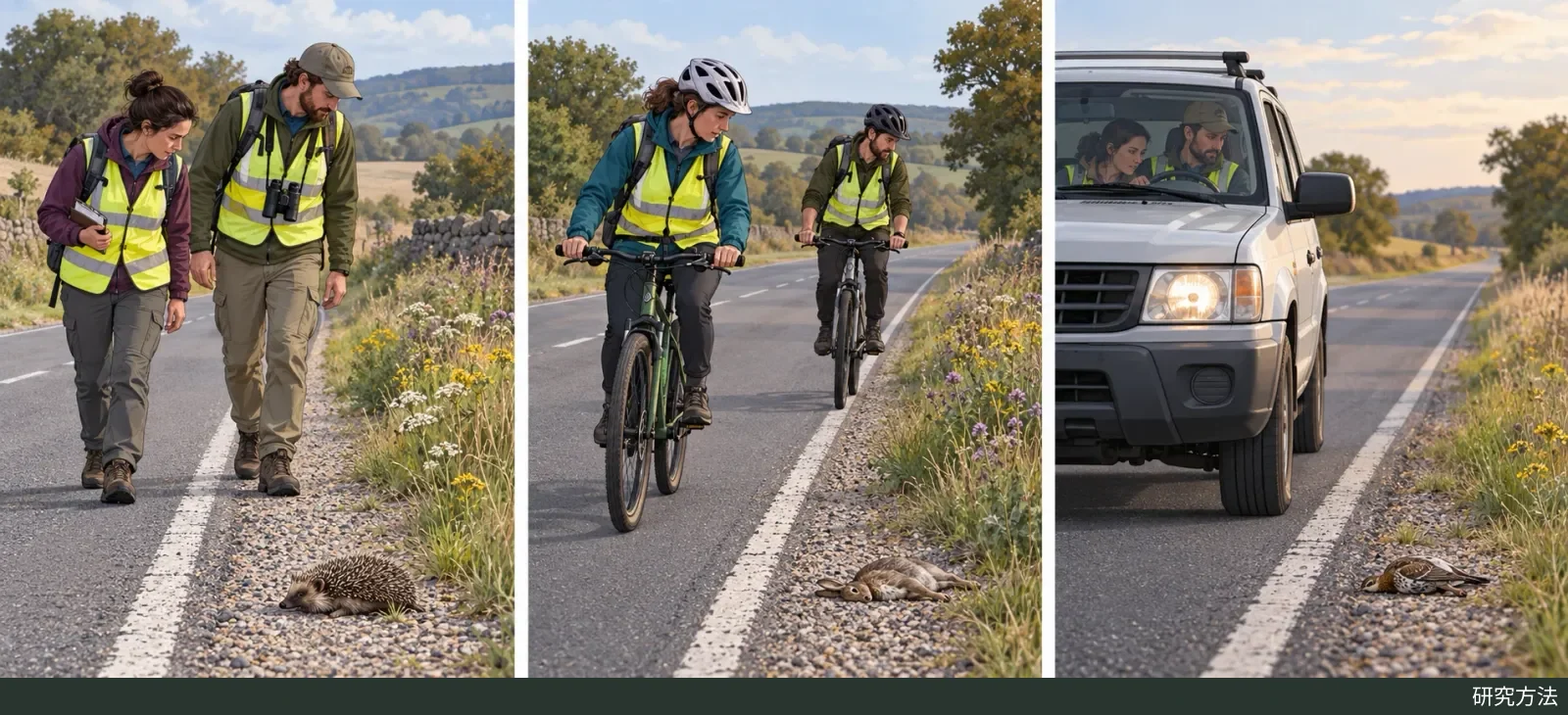
In the road case study around Doñana in southern Spain, mortality estimated by taxonomic group was 2.07 to 14.03 times the observed records. Songbirds were observed at 8.04 per kilometre, corresponding to a model estimate of 48.92; this is a result for a specific group in this case and should not be taken as a uniform correction factor for all roads and animals. Carcass observation rates were higher on foot and by bicycle than by car, and the species and carcass sizes recorded by the two do not fully overlap, so combined surveys can provide complementary information.
Conditions for Use and Generalization
The value of this approach lies in separating the sources of missed detection rather than multiplying every record by one coefficient. Reliable application requires information on location and persistence probabilities for the target site, taxa and survey method, along with attention to survey replication, prior sensitivity and the uncertainty of the results. The paper provides a checklist to help judge whether the data and assumptions can support absolute mortality estimates, or whether the results are better treated as relative indices. The framework can also be used to study mortality caused by infrastructure such as power lines and wind turbines, but the corresponding probabilities must still be calibrated for each specific context.
References
-
Gómez-Peña, G., D’Amico, M., et al. A method to estimate actual infrastructure-induced mortality by integrating hierarchical sources of imperfect detection. Methods in Ecology and Evolution, 2026, 17: 2943–2960. First published 2026-08-25; appeared in the October journal issue online.
-
Estación Biológica de Doñana–CSIC. New study reveals that the actual number of animals killed on roads is far higher than official counts suggest, 2026-10-08.
-
Research Methods · Rituals can be imitated; understanding cannot be faked
-
Compiled and published by the Scholay all-in-one academic platform. Please contact us to have it taken down in case of infringement.
-
Also published at Enter Scholar, a scholar community for the age of intelligence