In observational studies, people who receive an intervention often differ from those who do not even before the intervention, and comparing outcomes directly tends to mix in these differences. Entropy balancing assigns weights to the sample so that the covariate features chosen by the researcher are aligned between the two groups, and then compares outcomes. It writes the balance conditions directly into the process of solving for the weights, but balance by itself cannot guarantee that unmeasured confounding is removed.

Balance constraints and solving for the weights
Entropy balancing (EB) is a data reweighting method used in observational studies. Taking a binary treatment as an example, the common practice is to leave the treated group unchanged and assign weights to the control group so that its weighted means of specified covariates such as education and age equal those of the treated group; squared terms or interaction terms can also be added so that selected higher-order moments or combined features are aligned. The weighted control-group outcome mean is then subtracted from the treated-group outcome mean to estimate the average treatment effect on the treated (ATT).
Specifically, first choose the functions c(X) to be balanced and compute their averages in the treated group. The control-group weights w are nonnegative and sum to 1, and the weighted mean of each c(X) must equal these target values; among the weights satisfying the constraints, choose the set with the smallest KL divergence from the base weights. If the base weights are uniform, this is also equivalent to maximizing the entropy of the weights: adjust only as far as needed to achieve balance, and avoid unnecessary differences in the weights as far as possible. The dual form of the solution gives exponentially tilted weights, written wᵢ ∝ exp(−λ′c(Xᵢ)); λ is the multiplier on the corresponding constraints, and its sign depends on the definition.
A worked application and comparison with other methods
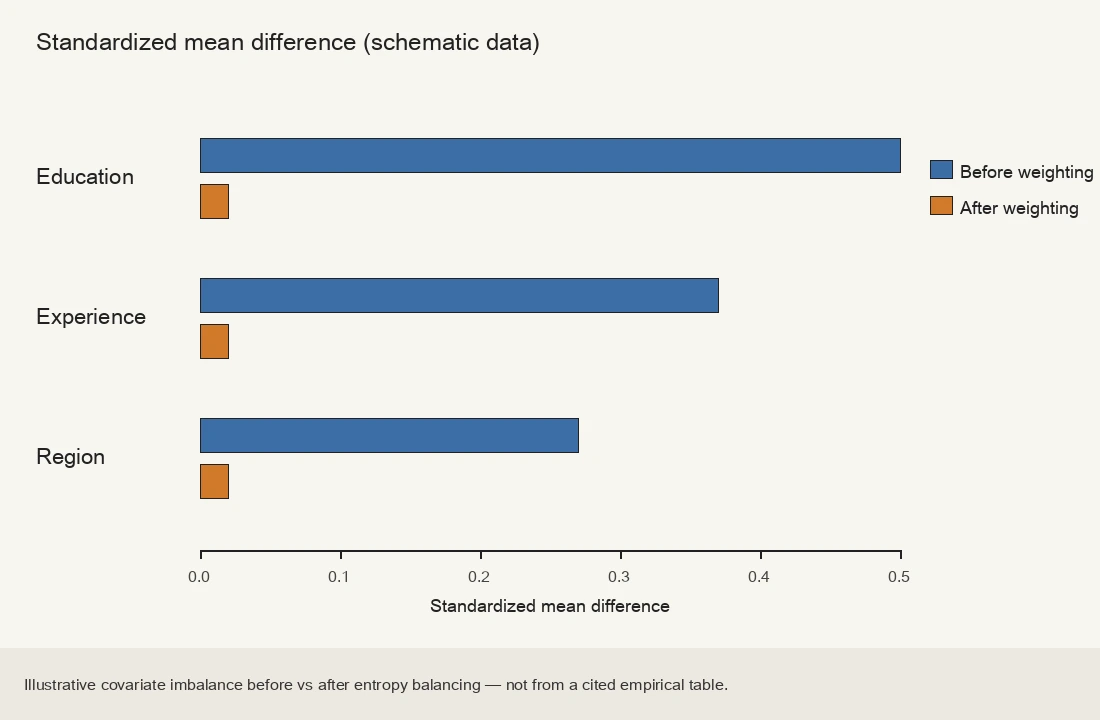
For example, consider studying the effect of job training on later earnings, where the treated group consists of those who took the training and the control group of those who did not. The researcher first selects pre-training years of education, work experience, and region indicators, and then solves for weights on the control group so that its weighted means equal the means of the participants. Finally, the average earnings of the participants are compared with the weighted average earnings of the non-participants; the target is the average effect of training on the participants, not the average effect for everyone. This example illustrates the method and does not represent the results of an actual study.
Inverse probability weighting usually estimates the propensity score first and then constructs weights from the score; entropy balancing instead directly requires the chosen moments to hit their targets, without first having to estimate the propensity score explicitly. Overlap weighting also uses the propensity score, and its target is usually the overlap population in which both groups could plausibly receive treatment, so it cannot be treated as having the same target as the ATT estimate above. Matching selects comparable units according to rules and may discard part of the sample; entropy balancing adjusts the control group with continuous weights and usually keeps more units, but when the weights are concentrated the nominal sample size does not equal the effective amount of information.
Assumptions for use and diagnostics
To interpret the weighted difference as a causal effect requires consistency, conditional ignorability given pre-treatment covariates, and the existence of comparable controls within the covariate range of the target treated population. What is balanced is only the variables and functions explicitly placed in the constraints: equal means of years of education do not automatically imply that the distribution of education, the interaction between education and experience, or unmeasured factors are also the same. The covariates and their functions should be chosen on the basis of the study design and domain knowledge, before looking at the outcomes.
After solving, report a balance table before and after weighting, including the standardized mean difference for each covariate; variables, nonlinear terms, and interaction terms that were not directly constrained should be checked as well. Then look at the distribution of the weights and the effective sample size ESS = (Σwᵢ)²/Σwᵢ²: a few very large weights lower the ESS and make the estimate less stable. Report the target population, the balanced moments, the weights, and the uncertainty, and compare where possible with other methods aimed at the same target population; differences in point estimates for different target populations cannot be attributed directly to one method being better or worse than another.
If the target moments of the treated group cannot be reached by any nonnegative weighted combination of the control group, the exact constraints are infeasible; extreme weights may also arise close to the boundary of feasibility. In that case, check overlap and variable coding, simplify or suitably relax the constraints in light of the research question, and describe the changed specification; if comparable controls are lacking, optimization alone cannot create information. Blindly adding large numbers of higher-order moments may worsen the concentration of the weights, and balance on specified moments must not be misdescribed as the removal of all confounding.
References
-
Hainmueller J. Entropy Balancing for Causal Effects: A Multivariate Reweighting Method to Produce Balanced Samples in Observational Studies. Political Analysis. 2012;20(1):25–46. https://doi.org/10.1093/pan/mpr025.
-
Research Methods · Rituals can be imitated; understanding cannot be faked.
-
Compiled and published by the Scholay one-stop academic platform. If anything here infringes your rights, please report it and it will be taken down.
-
Also published on Enter Scholar, a community for scholars in the age of AI.