From 1994 to 1998, the U.S. Department of Housing and Urban Development (HUD) used a lottery in five major cities to divide 4,604 families with children living in high-poverty public housing into three groups, testing what moving to a low-poverty neighborhood could itself achieve. After 10–15 years, there were no detectable changes in adults’ employment or income, but extreme obesity, diabetes, and psychological distress had decreased; children who moved with their families before age 13 had higher incomes as adults, while children who moved during adolescence did not benefit.

A light-colored Pontiac Grand Am parked on a snowy street in February 1995, with high-rise buildings of Chicago’s Robert Taylor Homes public housing behind it. The site copy adds a “研究方法” watermark at the bottom right. The photograph was taken during MTO enrollment; whether the buildings shown were an MTO recruitment site has not been verified. Photographer: artistmac; source: Flickr; license: CC BY-SA 2.0.
Three-Group Lottery and Compliance
Moving to Opportunity (MTO) was authorized by Section 152 of the Housing and Community Development Act of 1992 and launched by HUD in 1994. The experiment took place in Baltimore, Boston, Chicago, Los Angeles, and New York; eligibility was limited to low-income families with children living in public housing or other government-subsidized housing in selected high-poverty areas. Most participating families were minority families headed by women; at enrollment, an average of about 53% of residents in their census tracts had household incomes below the poverty line.
Families that applied were randomly assigned to three groups:
- Experimental group: Received Section 8 rental vouchers restricted to census tracts with poverty rates below 10% in the 1990 census, along with relocation counseling and help finding housing; after one year following the move, they could use their vouchers to move anywhere.
- Section 8 group: Received regular rental vouchers with no location restrictions and no specialized counseling.
- Control group: Did not receive rental vouchers through MTO but retained their existing eligibility for project-based housing and other benefits.
The lottery determined only whether families were offered the opportunity, not whether they moved. In the experimental group, 48% of families actually used MTO rental vouchers to move to low-poverty neighborhoods; the figure was 63% in the Section 8 group. Researchers therefore reported two types of effects: intent-to-treat effects (ITT), which compare all families assigned to a given group with the control group and rely only on random assignment itself; and treatment-on-the-treated effects (TOT), which estimate effects for families that actually used vouchers to move. TOT estimates are approximately ITT divided by the voucher-use rate, but require the additional assumption that assignment had no effect on families assigned to a treatment group who did not use a voucher. Unless marked TOT, all figures below are ITT estimates.
The final evaluation took place 10–15 years after enrollment and surveyed 3,273 adult household heads and 5,105 young people who were ages 10–20 at the end of 2007, with effective response rates of 90% and 89%, respectively. Over the entire follow-up period, the control group’s average neighborhood poverty rate, weighted by time spent living in each neighborhood, was about 40%; the experimental and Section 8 groups were 9 and 7 percentage points lower, respectively, while families that actually used vouchers (TOT) were about 18 and 11 percentage points lower. The gaps between groups narrowed over time: some control families moved to better neighborhoods on their own, while some voucher-using families later moved to places with somewhat higher poverty rates.
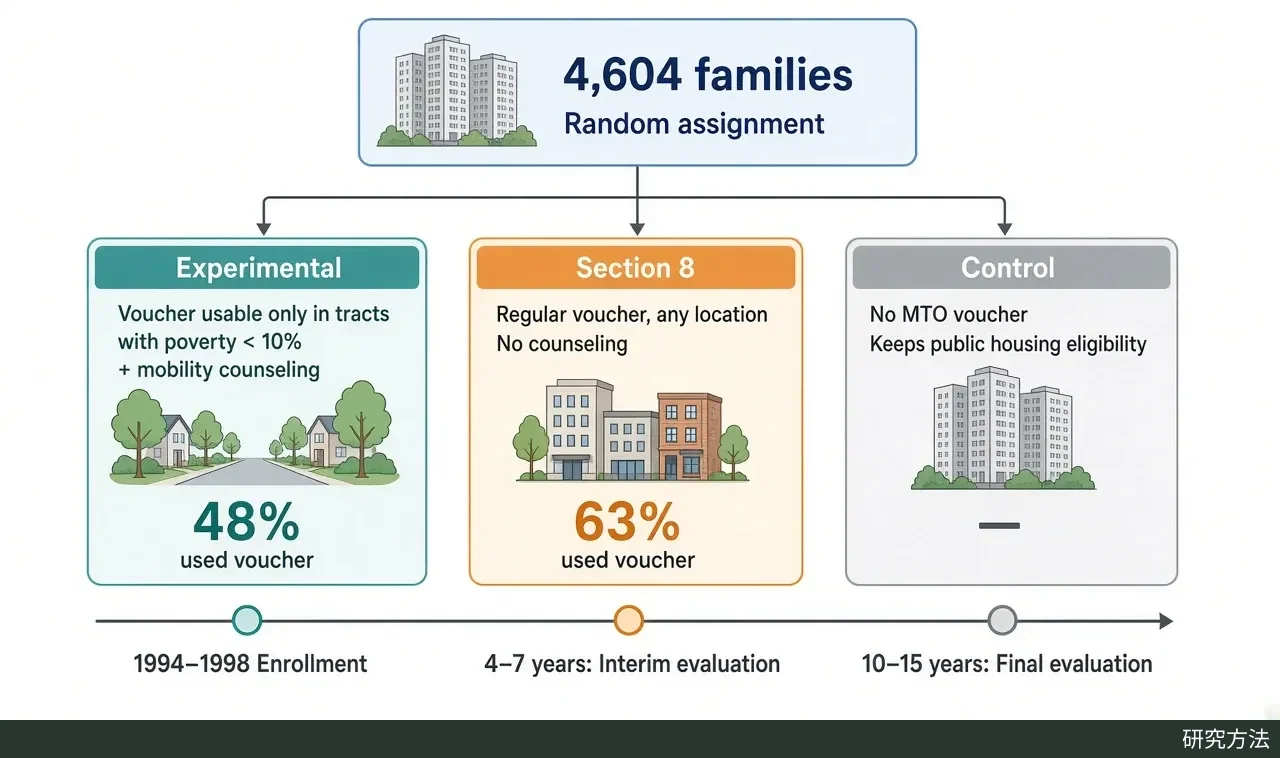
MTO’s three-group random assignment and follow-up timeline: 4,604 families were assigned to the experimental group (restricted to census tracts with poverty rates below 10%, with relocation counseling; voucher-use rate 48%), the Section 8 group (no location restrictions or counseling; voucher-use rate 63%), and the control group (no MTO rental vouchers); the timeline shows enrollment in 1994–1998, an interim evaluation 4–7 years after enrollment, and a final evaluation after 10–15 years. Data source: HUD’s 2011 final impacts evaluation report. AI-generated schematic. The site copy adds a “研究方法” watermark at the bottom right.
Adult Health and Economic Outcomes
The interim evaluation 4–7 years after enrollment, published by Kling, Liebman, and Katz in Econometrica in 2007, had already shown that the opportunity to receive rental vouchers did not significantly change adults’ economic self-sufficiency or physical health, but provided clear mental health benefits for adults and girls.
The final evaluation after 10–15 years continued to find no economic effects (amounts are in 2009 USD). The current employment rate among control-group adults was 52.5%, with an experimental-group difference of −0.7 percentage points (standard error 2.1); control-group individual income in the previous year was about 12,289 USD, with an experimental-group difference of +327 USD (standard error 583); control-group total household income was about 20,026 USD, with an experimental-group difference of +608 USD (standard error 728). None was significant. The Section 8 group’s self-reported current employment rate was 7.7 percentage points lower, but employment in 2007 measured using unemployment insurance records showed no difference. During the first two years after moving, employment rates in both treatment groups were temporarily below those of the control group; the report suggested that this might reflect difficulties finding work or arranging childcare in a new location.
Health differences appeared mainly in metabolic and psychological measures. The prevalence of measured body mass index BMI≥40 (extreme obesity) was 17.5% in the control group and 3.4 percentage points lower in the experimental group (standard error 1.6), with a TOT reduction of 7.1 percentage points; there was no difference in the prevalence of general obesity, BMI≥30. The prevalence of glycated hemoglobin HbA1c≥6.5% (the diabetes threshold), measured using dried blood spots, was 20.4% in the control group and 5.2 percentage points lower in the experimental group (standard error 1.8), with a TOT reduction of 10.8 percentage points; the Section 8 group showed no significant difference on this measure, but self-reported diabetes was 6.1 percentage points lower. The experimental group’s K6 psychological distress index declined by 0.107 standard deviations; depression prevalence in the two groups was about 3 and 5 percentage points lower, respectively, with the experimental-group result only marginally significant. The report also indicated a slight increase in drug or alcohol abuse among experimental-group adults.
Ludwig and colleagues analyzed subjective well-being using the same data in Science in 2012. They estimated that the increase in well-being associated with a reduction of 1 standard deviation in neighborhood poverty (13 percentage points) was equivalent to the well-being gap between people whose annual incomes differed by 13,000 USD, while the control group’s average income was about 20,000 USD. The paper also found that subjective well-being responded more strongly to neighborhood economic disadvantage than to racial segregation.
Child Outcomes and Long-Term Follow-Up
Early results for young people were mixed. The interim evaluation found that gains for girls in education, risky behavior, and physical health were offset by adverse changes for boys. In the final evaluation, there were almost no detectable effects on young people’s academic or economic outcomes; the lifetime prevalence of post-traumatic stress disorder (PTSD) among boys in the Section 8 group was about 3 percentage points higher than in the control group, while there was only “some evidence” of reduced drug dealing among boys.
The turning point came from administrative data. A study by Chetty, Hendren, and Katz published in the American Economic Review (AER) in 2016 linked MTO records to federal tax data from 1996–2012 using Social Security numbers: among 11,892 people born in 1991 or earlier whose Social Security numbers had been recorded before enrollment, 99% (11,780 people) were successfully linked. The authors divided children into two groups based on age at random assignment: under 13 (average age 8.2; in practice ages 4–12, because they were required to be at least 21 in 2012) and ages 13–18 (average age 15.1). The voucher-use analysis included 5,044 and 2,358 people in these groups, respectively.
For children assigned before age 13, annual individual income in their twenties was 1,624 USD higher in the experimental group than in the control group (p<0.05); adjusting for the 48% voucher-use rate, children who actually used vouchers to move earned 3,477 USD more (TOT), or 31% above the control-group mean of 11,270 USD. Their college attendance rate at ages 18–20 was 2.5 percentage points higher (compared with 16.5% in the control group, a relative increase of 16%); they also lived in lower-poverty neighborhoods as adults, and girls were less likely to become single mothers later in life. Effects for the Section 8 group fell between those of the experimental and control groups: the income TOT was 1,723 USD, about half the experimental-group effect, consistent with its reduction in neighborhood poverty being about half as large.
Children assigned at ages 13–18 showed no gains: most differences were not significant, and point estimates tended to be negative, such as the experimental group’s individual income difference of −967 USD. The authors’ explanation was a “disruption effect”: moving to a very different environment during adolescence could sever existing social networks. Benefits declined with age at moving, consistent with an exposure model in which more time spent in a better environment during childhood is beneficial; however, the authors also noted that age at moving and duration of exposure were perfectly collinear in MTO, so the experiment itself could not separate them.
Health outcomes also received longer follow-up. A secondary analysis by Pollack and colleagues, published in Housing Policy Debate in 2023, linked MTO participants to up to 21 years of all-payer hospital records and Medicaid data. Among 9,170 people who were children at random assignment, the rental voucher groups had a 36% lower asthma hospitalization rate than the control group (rate ratio 0.64, 95% confidence interval 0.41–1.00, with the upper bound exactly touching 1) and a 30% lower hospitalization rate for mental disorders (rate ratio 0.70, 95% confidence interval 0.51–0.95); differences among adults were not significant.
Limits to Generalizability
First, the sample consisted of extremely low-income families who volunteered to participate, lived in high-poverty public housing in five major cities, and were mostly minority families headed by women. The results describe the effects of offering relocation opportunities to families like these; they cannot be directly generalized to all low-income families, smaller cities, or people unwilling to apply.
Second, the treatment was a package. The experimental group received rental subsidies, location restrictions, and relocation counseling together, and the location restrictions applied only during the first year; the 48% of families who used vouchers were a self-selected subgroup, and TOT describes only these families. Neighborhood changes were also mainly in poverty rates: 88% of the control group’s neighbors were members of minority groups, and the experimental group’s figure was only nearly 6 percentage points lower. Families that used vouchers to move still lived in census tracts where about three-quarters of residents were members of minority groups. MTO therefore primarily answers questions about the effects of reducing neighborhood poverty, while offering very limited answers about racial integration.
Third, there were many outcomes and subgroups. The final evaluation reported numerous measures across housing, health, economics, risky behavior, and education, with breakdowns by gender and age; individual significant findings need to be considered alongside other measures in the same domain. The age 13 cutoff for child benefits was an analytical choice made by the researchers. The authors tested robustness using cutoffs such as ages 12 and 14 and models with linear age interactions, but also acknowledged that the sample at each age was small, making it difficult to estimate the age profile precisely.
Fourth, implementation stands between experimental findings and policy. The Creating Moves to Opportunity study, published in AER in 2024, conducted a new randomized trial with families receiving rental vouchers: providing information, financial support, and personalized housing-search assistance increased the proportion moving to areas with high upward mobility from 15% to 53%, with the effect driven mainly by personalized housing-search assistance. This study measured where families moved, without including children’s long-term outcomes; whether MTO’s child benefits can be replicated in other cities and housing markets still requires subsequent follow-up.
References
-
Sanbonmatsu, L., Katz, L. F., Ludwig, J., Gennetian, L. A., Duncan, G. J., Kessler, R. C., Adam, E., McDade, T. W., & Lindau, S. T. (2011). Moving to Opportunity for Fair Housing Demonstration Program: Final Impacts Evaluation. U.S. Department of Housing and Urban Development. HUD USER; Executive Summary PDF
-
Kling, J. R., Liebman, J. B., & Katz, L. F. (2007). Experimental Analysis of Neighborhood Effects. Econometrica, 75(1). doi:10.1111/j.1468-0262.2007.00733.x
-
Ludwig, J., Duncan, G. J., Gennetian, L. A., Katz, L. F., Kessler, R. C., Kling, J. R., & Sanbonmatsu, L. (2012). Neighborhood Effects on the Long-Term Well-Being of Low-Income Adults. Science, 337(6101), 1505–1510. doi:10.1126/science.1224648
-
Chetty, R., Hendren, N., & Katz, L. F. (2016). The Effects of Exposure to Better Neighborhoods on Children: New Evidence from the Moving to Opportunity Experiment. American Economic Review, 106(4), 855–902. doi:10.1257/aer.20150572
-
Pollack, C. E., Bozzi, D. G., Blackford, A. L., DeLuca, S., Thornton, R. L. J., & Herring, B. (2023). Using the Moving to Opportunity Experiment to Investigate the Long-Term Impact of Neighborhoods on Healthcare Use by Specific Clinical Conditions and Type of Service. Housing Policy Debate, 33(1), 269–289. doi:10.1080/10511482.2021.1951804
-
Bergman, P., Chetty, R., DeLuca, S., Hendren, N., Katz, L. F., & Palmer, C. (2024). Creating Moves to Opportunity: Experimental Evidence on Barriers to Neighborhood Choice. American Economic Review, 114(5), 1281–1337. doi:10.1257/aer.20200407
-
Creating Moves to Opportunity: Experimental Evidence on Barriers to Neighborhood Choice
-
Research Methods · Rituals can be imitated; understanding cannot be faked
-
Information compiled and published by Scholay One-Stop Academic Platform. Please report any infringement so the material can be removed.
-
Information also published on EnterScholar, a community for scholars in the age of intelligence