
AI-generated illustration: a stack of printed resumes, a fax machine and a classified job-ads page on a desk.
In 2004, Bertrand and Mullainathan published a resume field experiment in the American Economic Review: they sent 4870 fictitious resumes in response to more than 1300 help-wanted ads in Boston and Chicago newspapers, randomly changing only the names. Resumes with White-sounding names received interview callbacks at a rate of 9.65%, compared with 6.45% for those with African American–sounding names. In 2022, Kline and colleagues ran a larger replication with more than 83,000 applications. The gap was smaller but still present, and it was concentrated in a small number of companies.
Fictitious Resumes and the Random Assignment of Names
The difficulty with using ordinary survey data to study labor market discrimination is that researchers have far less information than employers do. A White job seeker and a Black job seeker who look identical in the data may not look identical to an employer, so differences in outcomes cannot be attributed directly to discrimination. Bertrand and Mullainathan used correspondence testing: instead of sending real people to apply, they sent written resumes whose content the researchers controlled completely. The authors point out a problem with earlier audit studies that sent real-person “auditors” to interviews: the auditors knew the purpose of the study and might, consciously or not, influence their own performance. Written resumes avoid this problem and are also much cheaper, which makes much larger samples possible.
The racial signal came from names. Using Massachusetts birth certificate data, the authors selected names whose frequency in one race was highest relative to the other race. They then ran a survey in public places in Chicago, asking 30 respondents per name to judge its race, and dropped names whose perceived race did not match expectations. Examples of the names ultimately used include Emily Walsh, Greg Baker and Lakisha Washington, Jamal Jones.
The resumes were modeled on real resumes from job-search websites. To avoid resembling actual job seekers, Boston resumes were given Chicago schools and employers in the same industry and then sent to Chicago, while Chicago resumes were adapted the other way and sent to Boston. The resumes came in two qualities, high and low: high-quality resumes had slightly more work experience on average and fewer employment gaps, and were more likely to list an email address, professional certifications, foreign-language skills or awards. To keep applicants from appearing overqualified, these features were not all added to the same resume at once.
Mailings ran from July 2001 to January 2002 in Boston and from July 2001 to May 2002 in Chicago. The research team collected sales, administrative support, clerical and customer service ads from the Sunday editions of The Boston Globe and the Chicago Tribune, excluding ads that required applicants to call or apply in person. Each ad typically received 4 resumes matching the job requirements, 2 high-quality and 2 low-quality. Within each quality level, 1 resume was randomly assigned an African American–sounding name and the other 1 a White-sounding name. Administrative and clerical jobs used female names almost exclusively, while sales jobs used both male and female names. Each resume was assigned a phone number according to gender, race, city and quality, and the voicemail messages were recorded by people of the corresponding race and gender. Layout, font and cover-letter style were also chosen at random. The outcome variable was whether the employer invited the applicant to an interview by phone or email.
In experimental design terms, this is randomization with each ad as a block. The same employer received resumes with both types of names during the same period, so the employer's own preferences, the job requirements and the labor market conditions at the time were automatically balanced between the two groups. Resume quality was also balanced within blocks, so the authors could estimate the average effect of names and also compare how much each type of name gained from a better resume.
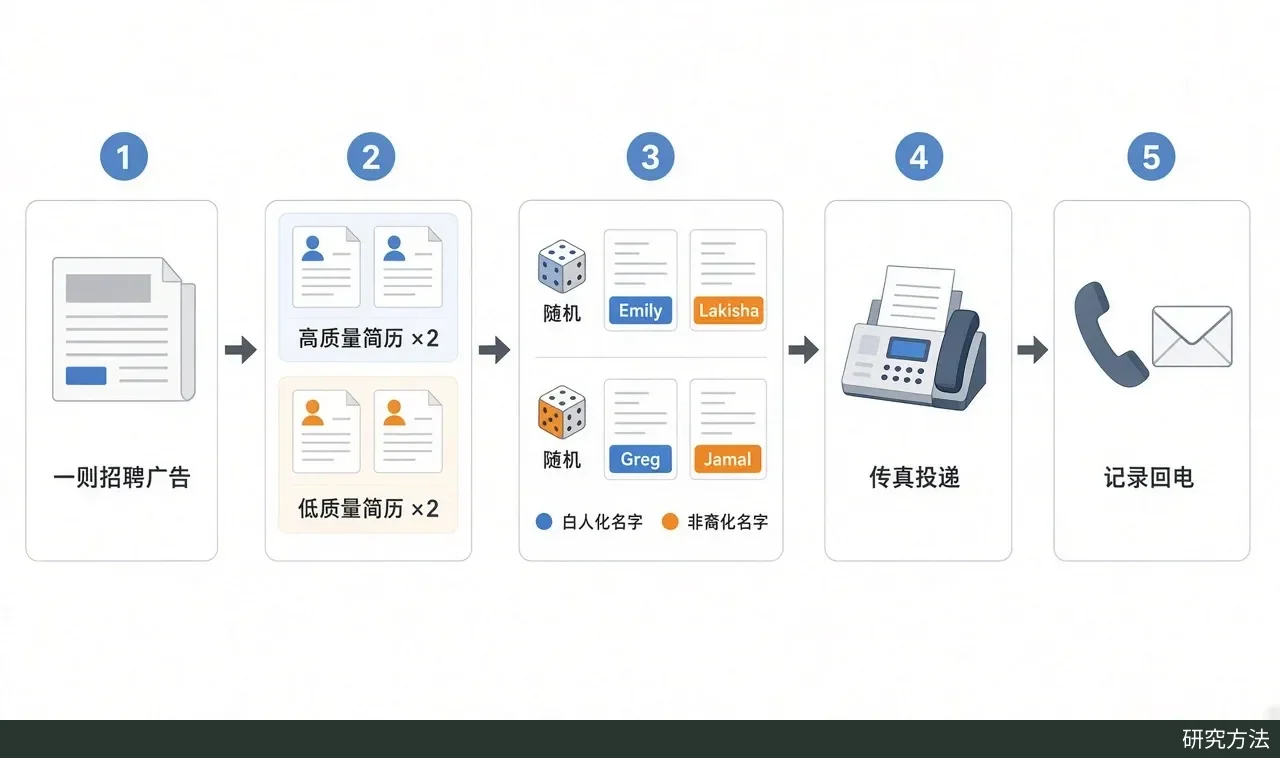
AI-generated illustration: each job ad receives 4 resumes, stratified by high and low quality. Within each stratum, 1 resume is randomly given a White-sounding name and 1 an African American–sounding name, and employer callbacks are then recorded. The procedure follows Bertrand and Mullainathan (2004).
Main Callback Results
The experiment sent out 4870 resumes in total, 2435 for each of the two types of names. The callback rate was 9.65% for White-sounding names and 6.45% for African American–sounding names. That is a difference of 3.20 percentage points, with the former 1.50 times the latter. The p-value of the test of proportions appears as 0.0000 in Table 1 of the original paper. Put another way, White-sounding names received one callback for every 10 ads applied to on average, while African American–sounding names needed about 15. Callback levels differed between the two cities, at 8.06% versus 5.40% in Chicago and 11.63% versus 7.76% in Boston, but the relative gap was about 1.5 times in both.
The authors used work experience as a yardstick for this gap: at the sample's average level of experience, one additional year of experience raised the callback rate by about 0.4 percentage points. Converting at this point estimate, the advantage of a White-sounding name is roughly equivalent to 8 additional years of work experience. This is a rough conversion based on a single regression coefficient, not a separately measured result.
Better resumes also paid off differently for the two types of names. Under the researchers' subjective quality classification, the callback rate for White-sounding names rose from 8.50% for low-quality resumes to 10.79% for high-quality resumes, while for African American–sounding names it rose only from 6.19% to 6.70%. When quality was instead classified using predictions from resume characteristics, African American–sounding names also benefited clearly, but their ratio of high-quality to low-quality callback rates was 1.60, still below the 1.89 for White-sounding names. The racial gap was broadly similar across occupations, industries and employer sizes. Gaps were no smaller among federal contractors or among employers that described themselves as “Equal Opportunity Employers” in their ads.
When reading these numbers, it is important to distinguish two scales. “50% more callbacks” is a relative difference, while the absolute difference is 3.2 percentage points. Because the baseline callback rates of both groups were below 10%, the relative difference looks large. When comparing later studies, one needs to look at both the absolute and the relative difference.
Ethics and External Validity Controversies
The authors themselves listed three limitations in the paper. First, the results measure only interview callbacks and cannot be converted into hiring rates or wage gaps. Second, the resumes did not state race directly but signaled it through names. Some employers may not have noticed the names, and ordinary African Americans do not necessarily have such distinctive names, so the results cannot represent the situation of African American job seekers in general. Third, newspaper ads are only one job-search channel, and this design cannot study job searches through social networks such as friends and relatives.
Whether names also convey family social class is another common question. Bertrand and Mullainathan tested this using mothers' educational attainment from birth certificates and found little relationship between the social background associated with a name and that name's callback rate. Gaddis (2017), however, used a survey experiment to show that the share of people who perceive different “Black names” as Black varies widely. Names more often given by more educated Black mothers (such as Jalen and Nia) were less often perceived as Black than names more often given by less educated mothers (such as DaShawn and Tanisha). On this basis, he argued that the conclusions of correspondence tests may be fairly sensitive to which names researchers choose.
There is also a critique concerning statistical identification. Heckman and Siegelman (1993) pointed out that even if two groups of fictitious applicants have exactly the same means on both observable and unobservable characteristics, a correspondence test can still produce spurious evidence of discrimination in either direction, as long as employers believe the dispersion of unobserved productivity differs between the two groups. Neumark (2012) proposed that if resumes include differences in qualifications that affect hiring, this difference in variance can be estimated separately from discrimination, and he demonstrated the method using Bertrand and Mullainathan's data.
The ethical controversy centers on deception: employers became subjects without their knowledge or consent and had to spend time reading resumes from job seekers who did not exist. Riach and Rich (2004) discussed this kind of deceptive field experiment specifically. They argued that misinformation is already widespread in market transactions, that discrimination causes great social harm, and that the method is accurate and transparent, and that these reasons can justify deceiving the employers being tested. Deceiving the people who carry out the tests, however, could harm them, violates the ethical codes of psychology and sociology, and is unnecessary.
The 2022 Replication Across 108 Large Companies
The study by Kline, Rose and Walters, published in The Quarterly Journal of Economics in 2022, kept the approach of randomly assigning names but turned to the largest employers in the United States. Starting from the Fortune 500, they split holding companies into brands with their own hiring websites, ultimately including 108 companies. According to Compustat data, these companies had about 15 million employees in the United States in 2020. Up to 125 entry-level jobs were sampled per company, each in a different county. Sampling was carried out in 5 waves, and the first wave was interrupted by the COVID-19 pandemic. Each job received 8 applications, sent in pairs: in each pair, one application was randomly given a Black-sounding name and the other a White-sounding name, and adjacent pairs were sent 1–2 days apart to make detection by employers less likely. Characteristics such as gender, age and experience in LGBTQ organizations were also randomly assigned. The pre-analysis plan was registered in the AEA RCT Registry (AEARCTR-0004739). The final sample comprised 83,643 applications covering 11,114 jobs.
The name pool built on the names used by Bertrand and Mullainathan and added names from North Carolina speeding ticket data for 2006–2018. Surnames were drawn from the 2010 U.S. Census. Each combination of race and gender had about 500 distinct full names, so the conclusions no longer depended on only a handful of names.
The results showed that 24% of applications were contacted by the employer within 30 days, which the authors note is close to 3 times the callback rate in Bertrand and Mullainathan. Black-sounding names were 2.1 percentage points less likely to be contacted than White-sounding names, equivalent to 9% of the Black group's average contact rate. The average gap between male and female applicants was not significant.
The study's most important new finding concerns differences between companies. After removing sampling error, the standard deviation of company-level racial contact gaps was 1.9 percentage points. The most discriminatory one fifth of companies accounted for about 46% of the lost contacts suffered by Black applicants in the experiment. With the false discovery rate controlled at 5%, 23 companies could be identified as discriminating against Black applicants. On gender, although the average gap was not significant, the standard deviation across companies reached 2.7 percentage points, indicating that some companies favored men and others favored women. Two-digit industry codes explain about half of the variation in racial and gender gaps across companies, while geographic differences are small.
The two studies cannot be compared point by point. They are nearly 20 years apart, the application channel changed from newspaper ads to company hiring websites, the employers changed from all kinds of businesses that advertised in newspapers to very large corporations, and the outcome variable changed from interview callbacks to contact within 30 days. Kline and colleagues suggest that the smaller relative effect they measured may be related both to less bias among very large employers and to the higher overall contact rate. The two studies point in the same direction: when names are randomly assigned, Black-sounding names receive fewer contacts. The later study further shows that this gap is not evenly distributed across all employers.
References
-
Bertrand, M., & Mullainathan, S. (2004). Are Emily and Greg More Employable Than Lakisha and Jamal? A Field Experiment on Labor Market Discrimination. American Economic Review, 94(4), 991–1013. https://doi.org/10.1257/0002828042002561
-
Francis, D. R. (2003, September 1). Employers' Replies to Racial Names. NBER Digest. https://www.nber.org/digest/sep03/employers-replies-racial-names
-
Kline, P., Rose, E. K., & Walters, C. R. (2022). Systemic Discrimination Among Large U.S. Employers. The Quarterly Journal of Economics, 137(4), 1963–2036. https://doi.org/10.1093/qje/qjac024
-
Kline, P., Rose, E. K., & Walters, C. R. (2021, revised 2022). Systemic Discrimination Among Large U.S. Employers. NBER Working Paper 29053. https://www.nber.org/papers/w29053
-
Gaddis, S. M. (2017). How Black Are Lakisha and Jamal? Racial Perceptions from Names Used in Correspondence Audit Studies. Sociological Science, 4, 469–489. https://doi.org/10.15195/v4.a19
-
Neumark, D. (2012). Detecting Discrimination in Audit and Correspondence Studies. Journal of Human Resources, 47(4), 1128. https://doi.org/10.3368/jhr.47.4.1128
-
Riach, P. A., & Rich, J. (2004). Deceptive Field Experiments of Discrimination: Are they Ethical? Kyklos, 57(3), 457–470. https://doi.org/10.1111/j.0023-5962.2004.00262.x
-
Research Methods · Rituals can be imitated; understanding cannot be faked
-
Compiled and published by Scholay, the one-stop academic platform. If any content infringes your rights, please let us know and it will be taken down.
-
Also published on EnterScholar, a community for scholars in the age of intelligence