
Card catalog cabinets at the University of Michigan Library. Photo: dfulmer. Source: Flickr. License: CC BY 2.0.
If a language model reads the first round of search results and decides for itself whether to rephrase and search again, does it find more relevant literature? On October 22, 2026, engineer Abdullahi Dattijo published a personal test: on 2,000 arXiv abstracts and 298 questions, agentic retrieval achieved a top-5 hit rate of 96.9%, compared with 95.6% for plain retrieval, and the interval for the difference spans zero. The only discernible improvement came from reranking, which does not call a language model.
Four retrieval methods and the comparison baseline
Retrieval-augmented generation (RAG) has two halves: relevant text is first retrieved from a document collection and then handed to a language model, which writes the answer. Citing a survey by Singh et al., the author takes agentic RAG to mean “an AI agent installed in the retrieval system that can plan, check its own results, and call tools.” This survey first appeared on arXiv in January 2025 and was revised to version 4 in April 2026, and its abstract lists evaluation and efficiency as open problems. In this test, the “agent” takes the form of one concrete procedure: the language model reads the retrieval results and decides whether to stop or to write a new query. The author tests only the first half, retrieval, and does not generate answers, so the original article has no answer-accuracy metric. What is compared is whether the correct paper was found and at what rank.
The four retrieval methods use the same document collection and the same set of questions:
- Plain retrieval (dense, baseline): The embedding model
BAAI/bge-small-en-v1.5converts both questions and abstracts into vectors, and the closest abstracts are taken. It searches only once and does not call a language model. - Reranking (rerank): Plain retrieval first takes the top 50 papers. The cross-encoder
cross-encoder/ms-marco-MiniLM-L-6-v2then scores each “question–abstract” pair and reorders them. This model only scores and does not generate text. - Query rewriting (multiquery): Claude Haiku 5.5 rewrites the question into three versions. Together with the original question, four searches are run, and the four rankings are then merged.
- Agent (agent): The original question is searched first. Claude Haiku 5.5 looks at the titles of the top 5 papers and either answers “stop” or provides a new query, with at most three searches. The rankings from all rounds are finally merged into one.
Multiple rankings are merged with reciprocal rank fusion (RRF): a paper scores 1/(60+rank) in each ranking, the scores are summed across rankings, and the papers are sorted by the total, so papers that rank high in several rankings win out. The method comes from a 2009 SIGIR paper by Cormack, Clarke, and Büttcher, whose experiments showed that a constant of 60 is close to optimal, though the exact value is not critical. In a pilot, the author found that his initial approach of having the agent merge by “taking the highest raw similarity” went wrong: a score of 0.8 means different things under different queries, and one rewritten query pushed the correct paper from rank 1 down to rank 4. He therefore switched to the same RRF used for query rewriting and left the constant 60 untuned.
The document collection and the origin of the 298 questions
The collection consists of 2,000 arXiv papers from four categories, cs.AI, cs.CL, cs.IR, and cs.LG, with submission dates spread across the 92 days from July 1 to September 30, 2026. The author chose this window because Anthropic's model overview lists the training-data cutoff for the models used as June 2026, so these papers should not be in the models' training data. This relies on the vendor's published cutoff date, and the original article did not verify it independently. All methods could see only titles and abstracts.
The questions were fixed before any retrieval run. The author randomly drew 300 “source papers,” and Claude Sonnet 5.5 read each title and abstract and wrote one question that the paper could answer. It was not allowed to copy four or more consecutive words from the title. The questions rotated among three styles: specific, which names the method; problem, which describes only the problem; and vague, which is short and fuzzy. Each question has exactly one correct paper. In the pilot (300 papers and 17 questions that passed review), plain retrieval ranked the correct paper first for all 17 questions, so the test lost its power to discriminate between methods. The author therefore added the 5 most similar papers by TF-IDF term-frequency similarity as distractors for each source paper and expanded the collection to 2,000 papers. He chose distractors with TF-IDF rather than the embedding model used for retrieval so that the same model would not both create the hard questions and answer them.
Review had two layers. First, the coding assistant Claude Code compared each question against its source abstract and the three most similar papers and judged whether it passed. The author then manually spot-checked 30 of the passing questions and found no case in which the abstract could not support the question. Another 2 questions were removed because they asked about results not reported in the abstract, leaving 298, of which 268 were judged only by the coding assistant. The author states that after seeing the results for plain retrieval and reranking, he reread the 13 questions that plain retrieval missed, but he did not modify or delete any question because of the results.
Paired comparisons of hit rate and ranking
There are two main metrics. recall@5 is the proportion of questions for which the correct paper appears in the top 5 results. MRR@10 (mean reciprocal rank over the top 10) gives 1 point when the correct paper ranks first, 1/2 when it ranks second, and 0 when it falls outside the top 10, then averages over all questions. Each method is compared with plain retrieval in a paired fashion on the same questions: the 298 questions are resampled with replacement 2,000 times, the difference is recomputed each time, and the middle 95% is taken as the bootstrap interval. Claude Haiku 5.5 does not allow the temperature parameter to be set, so its output varies from run to run. For this reason, query rewriting and the agent were each run three times and the results averaged. The author also reported searches per question, median latency, and model cost.
| Method | Top-5 hit rate (%) | MRR@10 | Searches per question | Median latency (s) | Model cost per thousand queries |
|---|---|---|---|---|---|
| Plain retrieval (dense) | 95.6 | 0.895 | 1.0 | 0.01 | $0 |
| Reranking (rerank) | 97.0 | 0.959 | 1.0 | 1.46 | $0 |
| Query rewriting (multiquery) | 93.6 [93.0–94.3] | 0.868 [0.866–0.871] | 4.0 | 1.37 | $0.06 |
| Agent (agent) | 96.9 [96.6–97.0] | 0.906 [0.902–0.909] | 1.7 | 1.40 | $0.09 |
Data are taken from the results table in the original article. Values in square brackets are the lowest and highest values across the three runs, not confidence intervals.
The paired differences show that only reranking's improvement in ranking quality has an interval that excludes zero: its MRR@10 rises by 0.064 (95% interval +0.037 to +0.093). Its top-5 hit rate rises by 1.3 percentage points (−0.7 to +3.7), an interval that still includes zero. The agent's top-5 hit rate rises by 1.2 percentage points (−0.8 to +3.5) and its MRR@10 by 0.011 (−0.006 to +0.029), and both intervals span zero. The author's reading is that the agent may be slightly better, no different, or slightly worse, and this test cannot tell which. Query rewriting's hit rate falls by 2.0 percentage points (−4.6 to +0.4) and its MRR@10 by 0.026 (−0.057 to +0.002), intervals that likewise include zero. However, in every run it lost 11 to 13 of the 285 papers that plain retrieval had found, and on that basis the author considers it possibly worse.
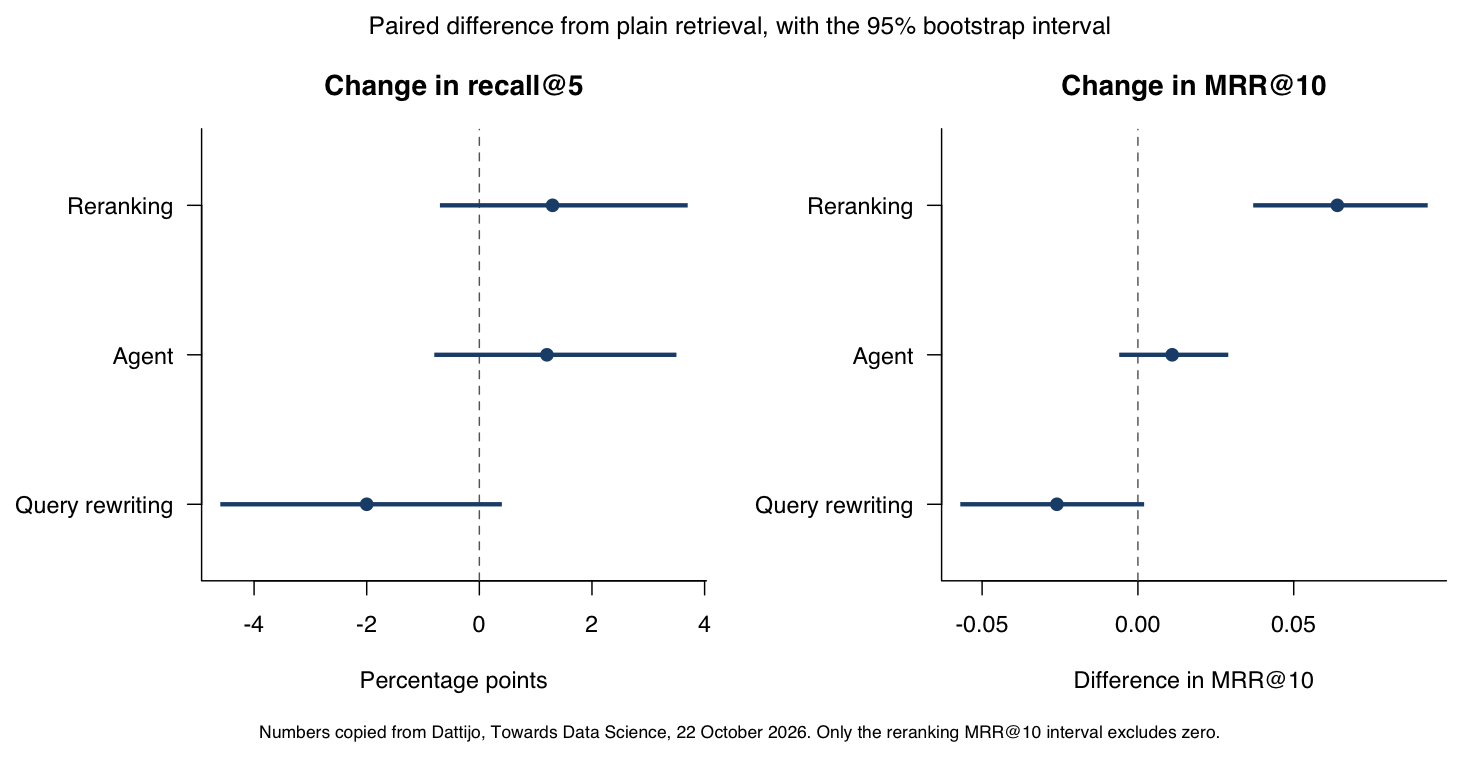
Paired differences from plain retrieval. Each dot is the estimate and each line is the 95% bootstrap interval reported by Dattijo on 22 October 2026: reranking, recall@5 +1.3 (−0.7 to +3.7) and MRR@10 +0.064 (+0.037 to +0.093); agent, recall@5 +1.2 (−0.8 to +3.5) and MRR@10 +0.011 (−0.006 to +0.029); query rewriting, recall@5 −2.0 (−4.6 to +0.4) and MRR@10 −0.026 (−0.057 to +0.002). Only the reranking MRR@10 interval excludes zero. The plot was drawn from these published numbers.
Looking more closely, of the 13 questions that plain retrieval missed, the agent recovered 7 to 8 in each run while losing 3 to 5 that plain retrieval had found. Across the three runs, it lost questions 12 times in total, and only 2 questions were lost in all three runs. For about 59% of the questions, the agent stopped after one search, and for about 26% it used all three. The author read through each of the 16 questions whose results changed and saw the following pattern. Rewrites that replaced everyday wording with the field's terminology helped. For example, in a question about “hiding rarely used intermediate tokens to improve BPE vocabulary efficiency,” the correct paper rose from rank 6 to rank 1 or 2 after rewriting. Adding terms that were not in the question, drawn from the model's memory, tended to lead the search astray. For example, adding “continuous thought” and “Coconut” to one question, and “LSTM” and “learned optimizer” to another, brought in other papers, which after merging ranked above the correct paper. The author stresses that this is his reading of individual cases, not a measured effect.
Limitations and the scope of the conclusions
The first limitation is that there was too little room for improvement. Plain retrieval already found the correct paper for 285 of the 298 questions, so the hit rate could rise by at most 13 questions, or 4.4 percentage points. Meanwhile, the difference intervals extend about 2 to 3 percentage points on each side, so smaller true improvements cannot show up here. The variation between runs (0.3 percentage points for the agent and 1.3 percentage points for query rewriting) is far smaller than the interval width. The author therefore points out that the intervals are wide mainly because there are only 298 questions. Running the test more times would not change the conclusion; that would require more questions or a harder document collection.
The second limitation is that the question set and scenario are narrow. All the papers are AI preprints from the same quarter. The questions were written by a language model from the abstracts, so their wording is close to that of the abstracts, which naturally favors retrieval that matches by meaning. The questions are 14 to 54 English words long, with a median of 32, which is far more specific than the few words a real user types into a search box. The author explicitly declines to draw inferences about enterprise documents, other languages, or long texts. In addition, the agent used only one model and one untuned version of the instructions, and a stronger model, better instructions, or a different merging method could move the results in either direction. Only 30 questions were manually reviewed. 1 replacement question had no distractor papers and may be easier. 12 source papers overlapped between the pilot and the main test. Finally, the test covers only retrieval, so it cannot show whether the final answers are better.
Two kinds of claims therefore need to be kept apart. The conclusion supported by the author's experiment is that, on this test of 2,000 abstracts and 298 model-written questions, this version of the agent cannot be distinguished from plain retrieval, while reranking yields a discernible improvement in ranking quality. “First count how many questions plain retrieval misses,” “add reranking before considering an agent,” and “limit the number of searches, merge by rank rather than raw score, and watch for new terms appearing in queries” are engineering recommendations the author draws from these results, and they have not been validated on other document collections or tasks. Nor is this test sufficient to refute general claims about agentic RAG, because it examined only one design: a single agent with at most three searches. From a statistical standpoint, two further points deserve attention. First, the bootstrap resamples only the questions, while the construction of the collection, the question-writing model, and the prompts are all fixed, so variation from these sources is not reflected in the intervals. Second, the six comparisons (three methods across two metrics) were not corrected for multiple comparisons, although the lower bound of reranking's MRR@10 interval, +0.037, is clearly above zero, so it is less affected by this. This is a personal blog experiment that has not been peer reviewed. The code, questions, and all run results are publicly available on GitHub so that others can rerun and check them.
References
-
Dattijo, A. (2026, October 22). Does Agentic RAG Actually Retrieve Better Evidence? I Tested It on 298 Questions. Towards Data Science. https://towardsdatascience.com/does-agentic-rag-actually-retrieve-better-evidence-i-tested-it-on-298-questions/
-
Dattijo, A. (2026). agentic-rag-evidence-test (code, questions, and run results). GitHub. https://github.com/abduldattijo/agentic-rag-evidence-test
-
Singh, A., Ehtesham, A., Kumar, S., Talaei Khoei, T., & Vasilakos, A. V. (2025; v4 revised 2026, April 1). Agentic Retrieval-Augmented Generation: A Survey on Agentic RAG. arXiv:2501.09136. https://arxiv.org/abs/2501.09136
-
Cormack, G. V., Clarke, C. L. A., & Büttcher, S. (2009). Reciprocal rank fusion outperforms Condorcet and individual rank learning methods. Proceedings of the 32nd International ACM SIGIR Conference on Research and Development in Information Retrieval. https://doi.org/10.1145/1571941.1572114
-
Research Methods · Rituals can be imitated; understanding cannot be faked
-
This information was compiled and published by Scholay, a one-stop academic platform. If it infringes your rights, please let us know and it will be taken down.
-
This information is also published on EnterScholar, a community for scholars in the age of intelligence.