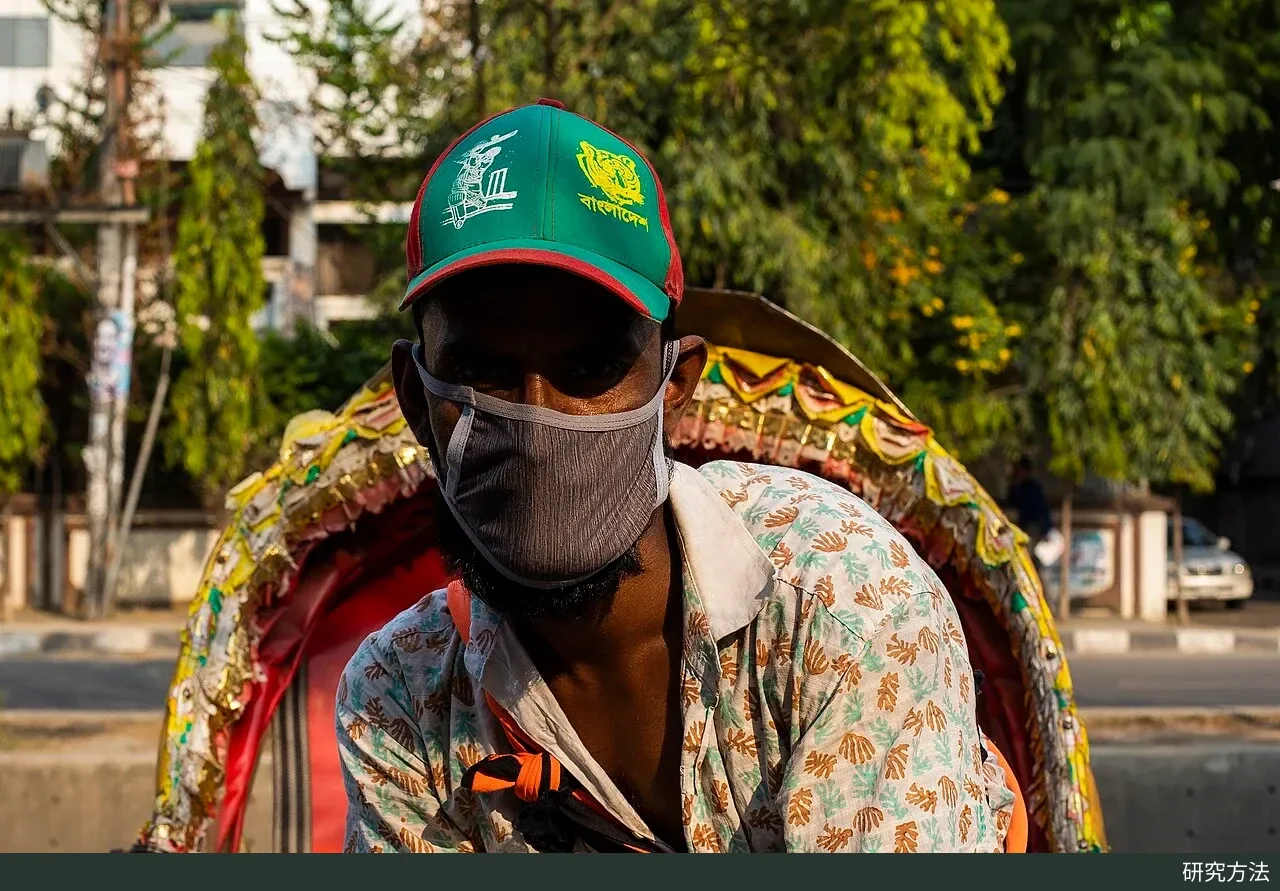
A masked rickshaw driver on a street in Dhaka, Bangladesh, on March 23, 2020. The photograph was taken in the capital's urban area, not in the rural villages where the trial took place. Photograph: Jubair1985 (Jubair Bin Iqbal). Source: Wikimedia Commons. License: CC BY-SA 4.0 (resized and converted to a different format).

From November 2020 to April 2021, Abaluck, Mobarak, and colleagues conducted a cluster-randomized trial in 600 rural villages in Bangladesh, covering 342,183 adults, to test whether distributing masks for free and promoting their use could reduce symptomatic COVID-19 infections. The intervention increased proper mask wearing from 13.3% to 42.3%, with an approximately 9% relative reduction in the primary outcome (adjusted prevalence ratio 0.91, 95% CI 0.82–1.00). The paper was published online in Science in December 2021.
Cluster-Randomized Design
The research team chose villages rather than individuals as the unit of randomization. The paper gives three reasons: a substantial share of the benefits of masks accrues at the community level; mask wearing is readily visible, so one person's choice can influence their neighbors; and village-wide promotion allows the effect to include reduced outward transmission by wearers (source control). Randomizing individuals would only answer whether masks protect the wearers themselves. Accordingly, the analysis calculated standard errors using villages as clusters. Statistical precision was primarily constrained by the number of villages and differences between them, rather than determined by the 340,000 participants.
The trial first matched the 600 villages into pairs based on geographical location and existing case data, then randomly selected one village in each pair to receive the intervention, with the other serving as a control. Control villages received no intervention and were at least 2 kilometers from intervention villages. The intervention was rolled out in 7 waves, with the first beginning on November 17–18, 2020, and the last on January 5–6, 2021. Both villages in each pair always started in the same wave, and the intervention lasted 8 weeks in each village.
Outcomes were measured at three levels. Observers in plain clothes directly observed mask wearing and distancing at mosques, markets, main roads into villages, tea stalls, and other locations at least once a week. A mask counted as being worn properly only if it covered both the mouth and nose. Symptoms were assessed through household visits or telephone calls in weeks 5 and 9, using the World Health Organization's (WHO) definition of a probable case. People who reported symptoms were invited to provide finger-prick blood samples in weeks 10–12 for COVID-19 IgG antibody testing. The primary outcome was “symptomatic seropositivity”: the authors reasoned that the ultimate public health objective was to reduce symptomatic infections, and testing only symptomatic people could reduce the number of blood tests required by an order of magnitude.
Neither participants nor observers were told the group assignments, but the project masks had distinctive colors, making intervention villages readily identifiable. Preregistered analyses and sample exclusions were performed by analysts blinded to group assignment. The analysis plan was preregistered on OSF, and the trial registration number was NCT04630054. After excluding villages where the intervention could not be implemented because local authorities did not cooperate, or where baseline and intervention-period observational data were missing, along with their matched villages, 572 villages (286 pairs) remained in the analysis.
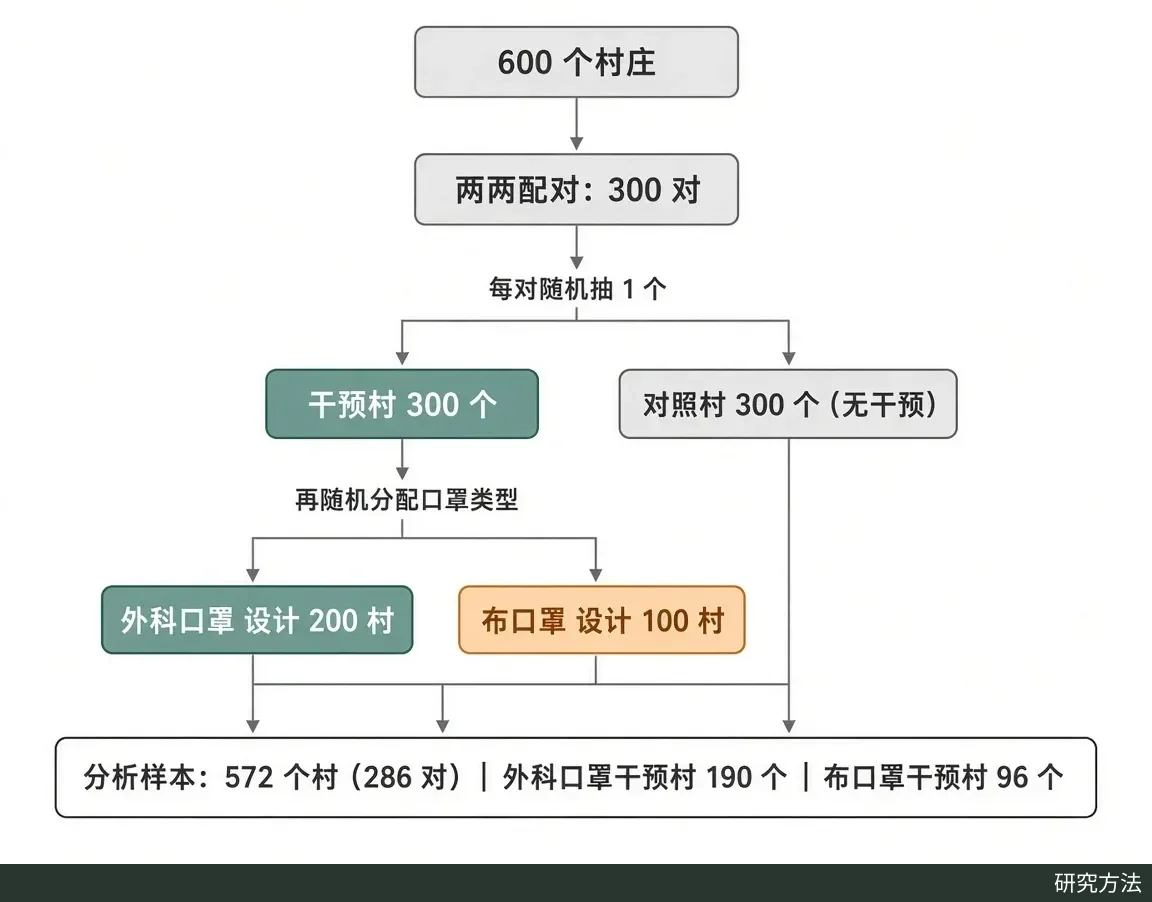
Trial allocation flow: 600 villages were matched into pairs and randomized, and intervention villages were then randomly assigned surgical or cloth masks. Data are from the main text and notes to Table 1 in Abaluck et al. (2022). AI-generated schematic.
Mask Types and Distribution Methods
All intervention villages received the same core program, consisting of five components: a one-time household visit to distribute free masks and explain proper use; mask distribution at markets 3–6 days per week for 8 weeks; distribution at mosques on 3 selected Friday occasions during the first 4 weeks; promoters reminding people without masks to put them on at markets and in public places; and village officials and imams modeling mask wearing, with imams reading a script supplied by the research team during congregational prayers on Friday. During household visits, residents were also shown a short video featuring Prime Minister Sheikh Hasina, the head of the imam training academy, and cricket star Shakib Al Hasan, and received a mask-wearing guide based on WHO materials.
Mask type was randomized at the village level: by design, 200 of the 300 intervention villages received surgical masks and 100 received cloth masks; 190 and 96, respectively, entered the analysis. The surgical masks used in the study had a filtration efficiency of 95% (standard deviation 1%), which remained at 76% after 10 washes with soapy water. The specially designed cloth masks had a filtration efficiency of 37% (standard deviation 6%), higher than common three-layer cotton masks but substantially lower than surgical masks. At bulk purchase prices, surgical masks cost USD 0.13 each (including USD 0.06 for a “washable and reusable” sticker), and cloth masks cost USD 0.50 each.
On top of the core program, the study cross-randomized several promotional measures. Village-level measures included whether households were asked to post a “mask-wearing household” sign on their doors; incentives for village leaders (no incentive, a certificate, or USD 190 in funding for a community project, conditional on adult mask wearing exceeding 75% in week 8); and whether households were sent text reminders. Household-level measures included altruistic versus self-protection messaging, whether residents verbally pledged that the whole household would wear masks, and whether they received text messages. Observers could only record observations anonymously in public places and could not trace them to households, so the study used mask colors to distinguish household-level treatments: surgical-mask villages received blue or green masks, and cloth-mask villages received purple or red masks. The mapping between colors and treatments was also randomized by village to avoid mistaking color preferences for treatment effects.
Almost none of these additional measures produced extra effects: apart from small differences between colors, signs, incentives, text messages, altruistic messaging, and verbal pledges did not significantly change mask wearing. Nor was there a significant difference in mask wearing between surgical-mask and cloth-mask villages. After comparing two pilot rounds, the authors concluded that face-to-face reminders from promoters were a key component, accounting for approximately 65% of the total effect (19.2 percentage points). However, this comparison was neither randomized nor preregistered and can only be treated as a clue.
Mask Wearing and Infection Outcomes
The clearest finding was behavioral change. Proper mask wearing was 13.3% in control villages (806,547 person-observations) and 42.3% in intervention villages (797,715 person-observations), a regression-adjusted difference of 28.8 percentage points (95% CI 26–31). The increase was largest at mosques (37.0 percentage points), compared with 25–29 percentage points at other locations. The proportion maintaining an arm's-length distance rose from 24.1% to 29.2%, with no evidence of risk compensation in which people relaxed distancing because they wore masks. Crowd sizes in public places did not differ between groups. Mask wearing was largely maintained during the 2 weeks after the intervention ended and declined several months later, but remained approximately 10 percentage points higher than in control villages. Note that men accounted for 88.2% of adults observed in public places.
The infection outcome passed through a fairly long sample funnel. At baseline, 342,183 adults were enrolled (178,322 in the intervention group and 163,861 in the control group). Of these, 336,010 provided symptom data in week 5 or week 9, and 27,160 reported COVID-like symptoms. The researchers attempted to collect blood from everyone with symptoms, but only 10,790 (39.7%) consented. Consent rates were 40.2% and 39.3% in the two groups, respectively (p = 0.24), and 9,512 samples were ultimately tested.
The primary outcome was calculated after excluding symptomatic people who did not consent to blood collection, as specified in the preregistered plan: symptomatic seropositivity was 0.76% in control villages and 0.68% in intervention villages, with an adjusted prevalence ratio of 0.91 (95% CI 0.82–1.00), equivalent to an approximately 9% relative reduction. The upper bound of the confidence interval sits at 1. The authors performed randomization inference by reassigning treatment within each village pair, obtaining a p value of approximately 0.07. Because people who did not consent to blood collection remained in the denominator, both proportions underestimate the true levels.
Broken down by mask type, the adjusted prevalence ratio was 0.89 (95% CI 0.78–1.00) in surgical-mask villages and 0.94 (95% CI 0.78–1.10) in cloth-mask villages. The latter interval accommodates both an effect comparable to surgical masks and no effect. Effects were concentrated among older adults: in surgical-mask villages, the ratio was 0.77 (95% CI 0.60–0.95) for those aged 50–59 and 0.65 (95% CI 0.45–0.85) for those aged 60 and above. However, the age gradient was highly sensitive to how missing data were handled: imputing results for people who did not consent to blood collection using the average positivity rate among symptomatic people made the overall estimate more precise and also showed an effect for cloth masks, while the ratio for those aged 60 and above in surgical-mask villages became 0.70.
The secondary outcome, “COVID-like symptoms,” had a larger sample: the reported proportion was 8.60% in control villages and 7.63% in intervention villages, with an adjusted prevalence ratio of 0.88 (95% CI 0.83–0.93). However, the WHO probable-case definition has high sensitivity but limited specificity, so some of this reduction might have come from other respiratory infections. It is also worth remembering that these figures measure the effect of a promotional program that increased mask wearing by approximately 29 percentage points, rather than the effect of everyone wearing masks. The authors speculated that universal mask wearing could produce an effect several times larger, but this is an extrapolation that the trial itself did not test.
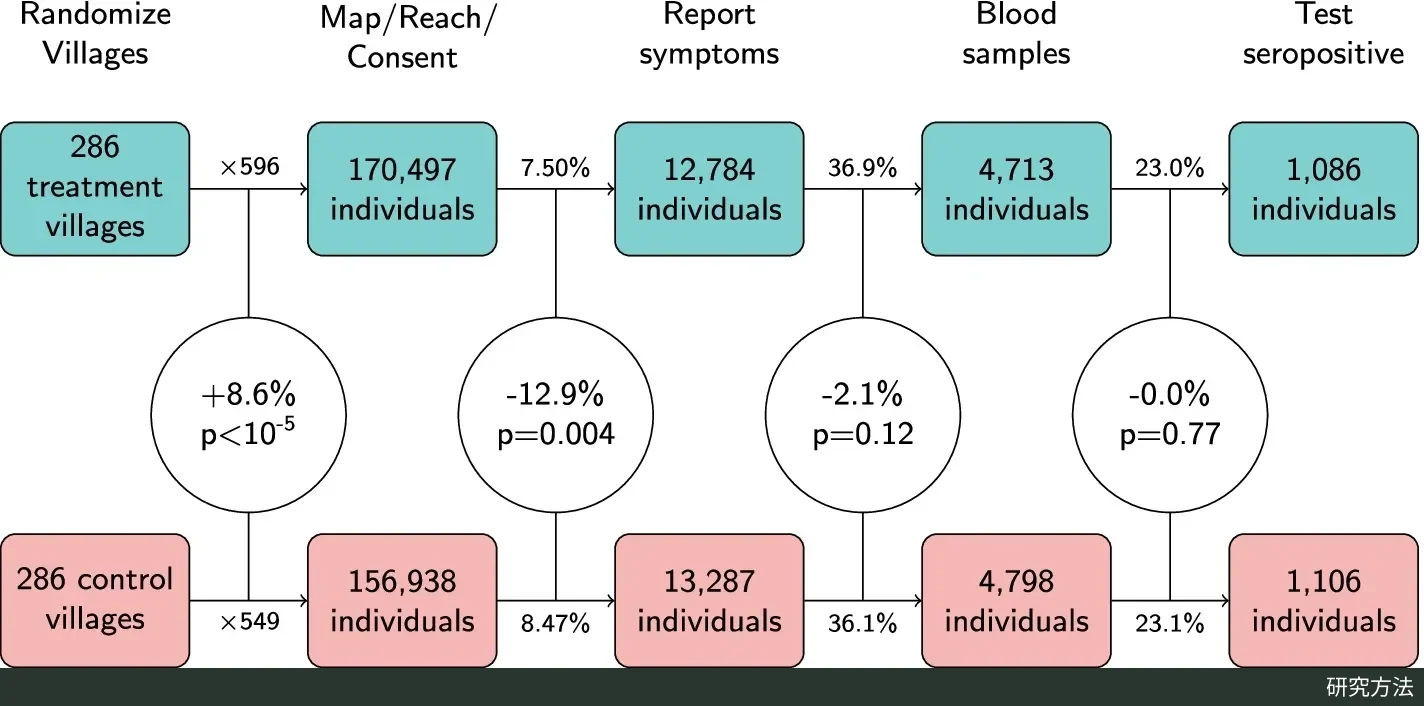
A step-by-step comparison of the two groups from enrollment to “symptomatic seropositivity”: each circle indicates how much higher or lower the conversion rate at that step was in the intervention group than in the control group, with significance from a paired Wilcoxon test indicated. The starting point is the 286 village pairs in the public data, and the endpoint is 1,086 cases in the intervention group and 1,106 in the control group. Figure source: Chikina, Pegden, and Recht (2022), Figure 3, Trials[2]. License: CC BY 4.0.
Limitations and Reanalysis
The limitations listed by the authors include the following: the distinctive project masks prevented genuine blinding of observers, and villagers might also have realized they were being observed; symptoms were self-reported, and residents in intervention villages might have paid different levels of attention to symptoms; although blood-collection consent rates were similar between groups, the composition of those consenting could still have differed; residents of control villages might have traveled to intervention villages to obtain masks, diluting the effect; the study did not systematically assess potential harms such as discomfort, dermatitis, and headaches; and it could not distinguish whether masks reduced infections or made symptoms milder after infection. The predominant circulating variant during the trial was Alpha (B.1.1.7), and whether the findings generalize to subsequent variants such as Delta remains uncertain.
In September 2022, Chikina, Pegden, and Recht published a reanalysis in Trials, using the authors' public data on 286 village pairs to identify another issue: a substantial imbalance in enrollment between the groups. The intervention group enrolled 170,497 people and the control group 156,938, a difference of approximately 9%. Even the household enumeration conducted by staff blinded to assignment found 4.5% more households in intervention villages (p = 0.0072). The staff obtaining consent also distributed masks in intervention villages and knew which group they were in. By the reanalysts' count, the raw numbers of primary-outcome cases were 1,086 in the intervention group and 1,106 in the control group, a difference of just 20 cases, with the difference in rates largely arising from different denominators. Using paired Wilcoxon and permutation tests, they concluded that the data were compatible with either a moderate effect of masks on infection or no direct effect. The original paper also reported an excess of adults aged 18–30 in the intervention group and stated that the results were robust to excluding that age group.
Taken together, the trial's most reliable conclusion is that a program combining free mask distribution with face-to-face promotion can increase mask wearing to approximately 3 times its original level in rural Bangladesh and sustain it for a period of time. The infection effects point in a consistent direction, but the evidence is at the threshold of statistical significance and is affected by enrollment imbalances, blood testing restricted to symptomatic people, and the handling of missing data. For those designing cluster-randomized trials, it offers several concrete lessons: staff responsible for enrollment and outcome measurement should be separate from those implementing the intervention and blinded wherever possible; outcomes that do not depend on self-report should be prioritized, such as consistently testing a randomly sampled population for antibodies; and raw case counts and denominators for each group should be published together so readers can check them directly.
References
-
Abaluck J, Kwong LH, Styczynski A, et al. Impact of community masking on COVID-19: A cluster-randomized trial in Bangladesh. Science, 2022, 375(6577): eabi9069 (published online December 2, 2021; published in print January 14, 2022). https://doi.org/10.1126/science.abi9069
-
Chikina M, Pegden W, Recht B. Re-analysis on the statistical sampling biases of a mask promotion trial in Bangladesh: a statistical replication. Trials, 2022 (published September 15, 2022). https://doi.org/10.1186/s13063-022-06704-z
-
Preregistered trial analysis plan and materials (as listed in the paper): https://osf.io/vzdh6/; ClinicalTrials.gov registration number NCT04630054; data and code: https://gitlab.com/emily-crawford/bd-mask-rct
-
Research Methods · Rituals can be imitated; understanding cannot be faked
-
Information compiled and published by the Scholay One-Stop Academic Platform. Please report any infringement so the content can be removed.
-
This information is also published on EnterScholar, a community for scholars in the age of intelligence