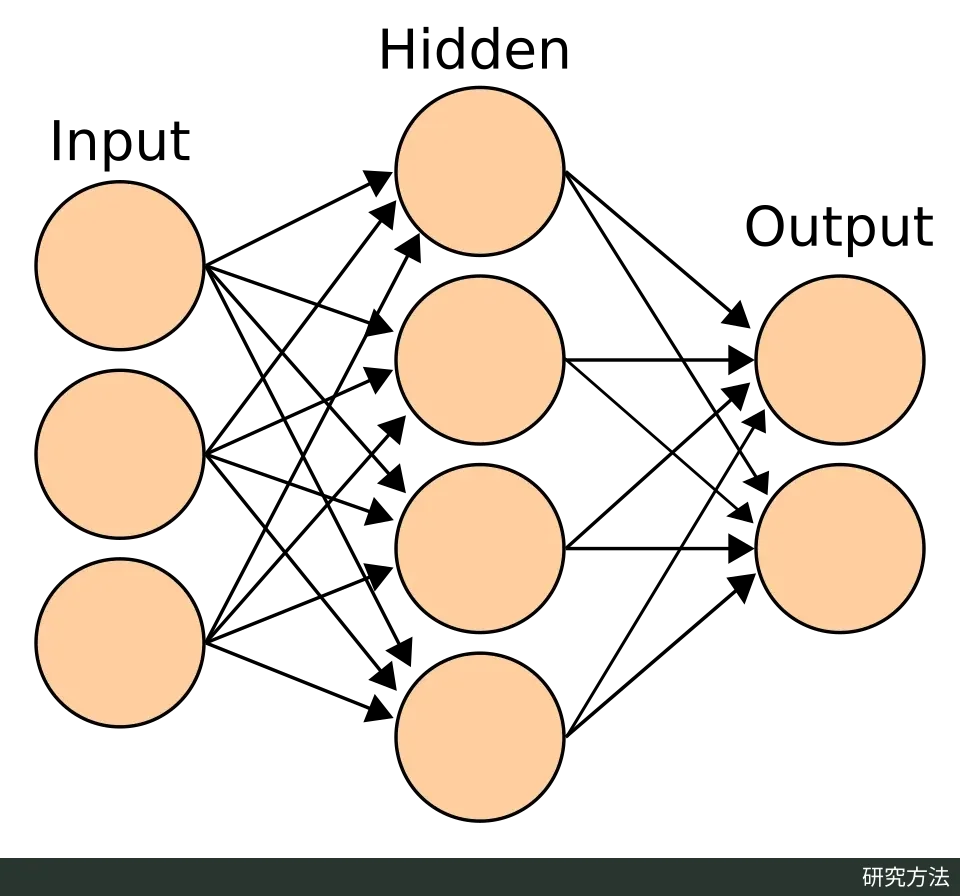
Towards Data Science published on October 23, 2026, an article co-written by Adrian Panasiewicz and Jacob Cybulski introducing the concept of 'effective dimension'. The article starts with the idea that a large number of parameters does not necessarily imply model complexity; what matters is how many independent parameter directions the data can distinguish. The article uses the Fisher information matrix to count these directions, and is the theoretical article in a two-part series, with specific calculations deferred to the second article.
Two-parameter examples and common indicators
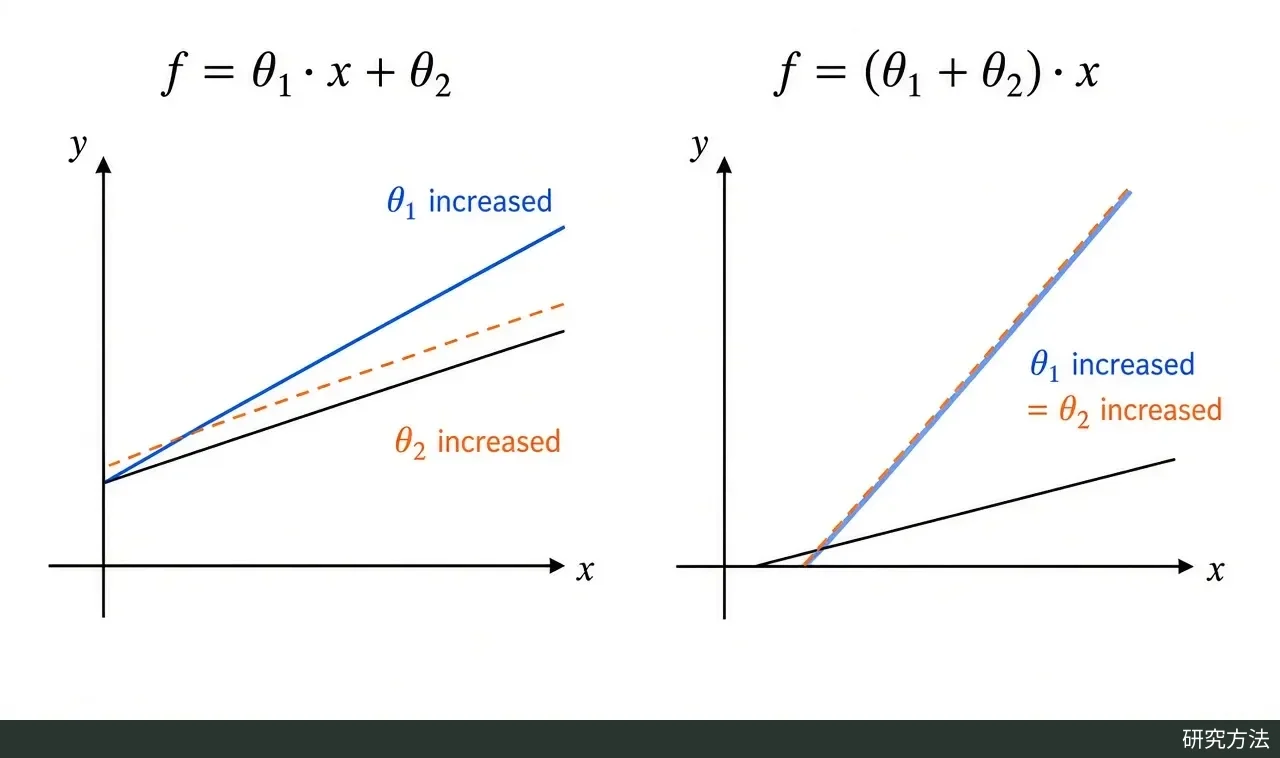
The author first gives a minimal example. Both models have only two parameters, θ₁ and θ₂: the first is f(x;θ) = θ₁x + θ₂, where one parameter controls the slope and the other the intercept, and changing each produces a different straight line; the second is f(x;θ) = (θ₁ + θ₂)x, where both parameters act on the same slope. In the second model, adding c to θ₁ and subtracting c from θ₂ leaves the output completely unchanged, so many parameter combinations correspond to the same function. Formally it has two parameters, but in reality it has only one degree of freedom, θ₁ + θ₂.
The author thus compiled a comparison table: the number of parameters only provides the nominal size of the parameter vector, without revealing redundant or ineffective parameters; training loss reflects how well the optimization process fits the training data, but does not distinguish whether poor performance arises from optimization, model specification, or initialization; test loss or accuracy reflects possible generalization performance, yet does not indicate whether switching to a different optimization method could further improve results. Effective dimension answers the question of 'how many parameter directions can the data distinguish,' but it itself still depends on the data distribution, the chosen parameter region, and sample size. The author emphasizes that it is a supplementary diagnostic tool beyond training curves, not a replacement.
From Fisher Information to Effective Dimension
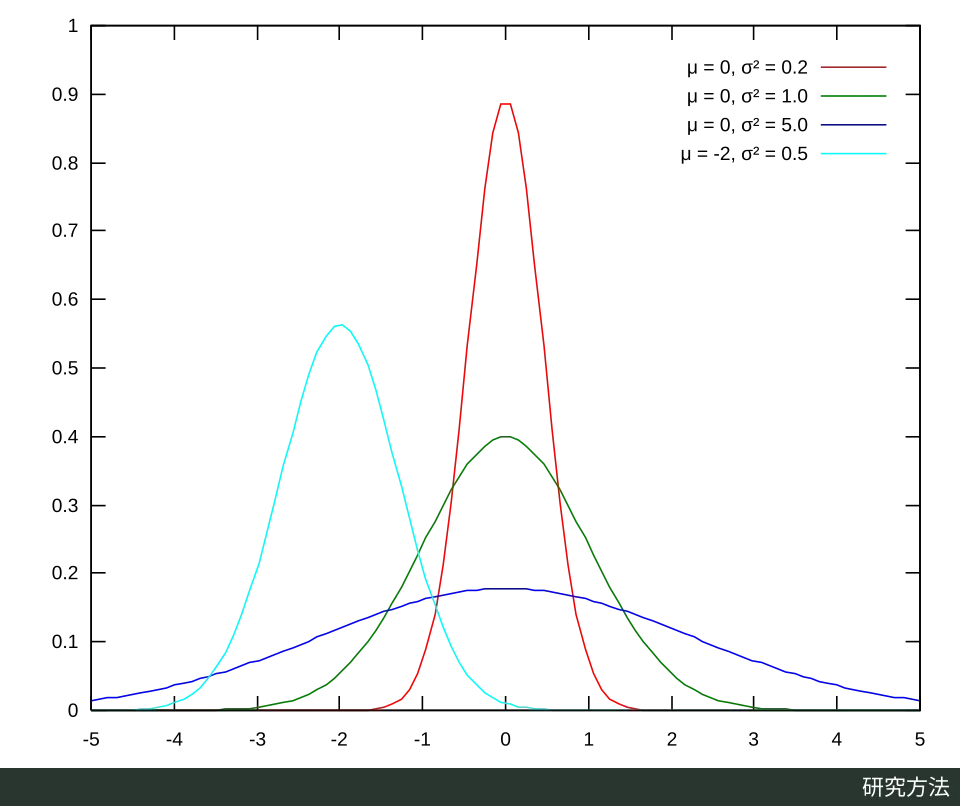
The tool for counting is the Fisher information, which measures how sensitive a model's probability distribution is to small changes in its parameters. The authors illustrate this with a normal distribution: if x follows a normal distribution with mean μ and known standard deviation σ, the Fisher information about μ from a single observation is 1/σ², and for n independent observations it becomes n/σ². The narrower the distribution, the more concentrated the sample is around the mean, and the better the mean can be estimated, resulting in greater information. When parameters are generalized to multiple ones, the Fisher information becomes a matrix: the diagonal elements describe the sensitivity of the model to individual parameters, while the off-diagonal elements describe whether the effects of different parameters overlap. If two parameters have nearly identical effects on the output, the matrix approaches singularity in some direction—this is the multidimensional version of the earlier example with θ₁ + θ₂.
The article adopts the definition by Abbas et al. (2021). Let the model have k parameters and sample size n, and let γ be a constant in the construction, denoting κ = γn / (2π log n). First, scale the Fisher matrix overall such that its average trace over the parameter space Θ equals k (i.e., the average eigenvalue is 1), obtaining F̂(θ), and then compute:
After diagonalizing F̂, the determinant is decomposed into a product over each eigendirection, with each direction contributing approximately log(1 + κλᵢ). If κλᵢ is much less than 1, this direction almost does not alter the predictive distribution, contributing close to 0; if κλᵢ is much greater than 1, after dividing by log κ, the contribution approaches 1. Thus, effective dimension is a form of 'soft counting': counting the number of parameter directions that can be distinguished under a resolution determined by the data volume. The authors write that, under the assumptions of this construction, as n tends to infinity, it approaches the maximum rank of the Fisher matrix.
The author cautions that n is typically understood as sample size, but it can also be viewed as resolution: the more data available, the better two closely spaced predictive distributions can be distinguished, and previously weak directions will gradually emerge. Therefore, they recommend computing effective dimension across a range of n values rather than reporting a single number, and emphasize examining values close to the actual training set size. Another option is the integration range. Global effective dimension averages over the entire parameter space and is independent of any particular initialization or optimization path, making it suitable for comparing different architectures, but it may include regions that training never reaches. Local effective dimension is computed only within a small ball of radius ε around the trained parameter θ*, reflecting the joint effect of architecture, data, initialization, and optimization processes; the results vary with both the radius and the obtained solution.
Proof and experiments of the original paper
The effective dimension is not a novel concept introduced in this blog post. A paper published by Abbas et al. on June 24, 2021, in Nature Computational Science, proposed this measure, demonstrating its utility in assessing the generalization capability of statistical models to new data and using Fisher information to evaluate the trainability of models. Numerical comparisons in the paper revealed that a class of quantum neural networks has a significantly higher effective dimension than comparable feedforward networks, trains faster, and was validated on real quantum hardware. According to the subsequent preprint by the same team, this concept was first introduced by Berezniuk et al. in 2020, originating from the principle of minimum description length.
The local version comes from the team's arXiv preprint 'Effective dimension of machine learning models' submitted in December 2021. The authors prove that the local effective dimension can set an upper bound on the generalization error of trained models with finite data; experiments use fully connected networks with two hidden layers trained on MNIST and CIFAR10, and the Fisher matrix is approximated using K-FAC. The results show that as the model size increases, the normalized local effective dimension decreases together with the generalization error; as the proportion of randomly shuffled training labels increases, both quantities increase. The paper itself states that the two 'seem to correlate well' and calls it a 'promising candidate' for a capacity measure.
Applicable limitations and scope of discussion
Both the blog post and the original paper provide numerous qualifications. The effective dimension depends on the data distribution, parameter region, and n, and is not a model property independent of the data; the upper bound on generalization error holds only under the framework assumptions, and the blog author explicitly states it cannot be directly used as a prediction of test accuracy. The original paper also specifies that the geometric interpretation only makes sense when n is sufficiently large (technically requiring n ≥ 19), and the usefulness of the error upper bound depends on how ε and γ are chosen; inappropriate choices render the bound meaningless as a constraint; the Fisher matrix is typically approximated in practice, and the paper proves that the effective dimension is continuous with respect to approximation error. The empirical section only covers two image datasets and simple feedforward networks, and the evidence is correlational rather than causal. The blog author also points out that in quantum machine learning, there exists another framework that directly characterizes capacity in the Hilbert space of quantum states, and the effective dimension is not involved.
When reading this article, it is advisable to separate the content into three categories. First, mathematical results, such as 1/σ² for the normal distribution, approximate eigenvalue contributions, and upper bounds on generalization error, which originate from the original paper's definitions and proofs and hold under its stated assumptions. Second, the author's judgments, for example, 'when two models perform similarly, the one with fewer effective directions is usually better,' which is a suggestion based on Occam's razor and is not supported by empirical evidence in the text; or cost arguments such as 'each additional parameter introduces one more circuit evaluation and more gates affected by noise,' which are primarily relevant to quantum circuits. Third, general statements, such as claiming that the effective dimension has been used for 'precise assessment' of expressiveness, trainability, and generalization, which is stronger than the original paper's phrasing of 'seems correlated' or 'a promising candidate,' and thus should be taken with caution and referenced back to the original paper. Additionally, in the blog post, one instance of the determinant for local effective dimension incorrectly prints 2n log n instead of 2π log n; this should be corrected according to the earlier definition of κ. The second article in the series will introduce how to practically compute these in machine learning experiments.
References
-
Panasiewicz, A., & Cybulski, J. (2026, October 23). Why Parameter Count Is Not Model Complexity: An Introduction to Effective Dimension. Towards Data Science. https://towardsdatascience.com/why-parameter-count-is-not-model-complexity-an-introduction-to-effective-dimension/
-
Abbas, A., Sutter, D., Zoufal, C., Lucchi, A., Figalli, A., & Woerner, S. (2021). The power of quantum neural networks. Nature Computational Science, 1(6), 403–409. https://doi.org/10.1038/s43588-021-00084-1
-
Abbas, A., Sutter, D., Figalli, A., & Woerner, S. (2021). Effective dimension of machine learning models. arXiv:2112.04807. https://arxiv.org/abs/2112.04807
-
Research methodology Rituals can be mimicked, but understanding cannot be feigned
-
Information provided by Scholay Academic One-Stop Platform Organize and publish; if there is any infringement, please provide feedback for removal.
-
Information synchronization published in EnterScholar, Scholar Community in the Age of Intelligence