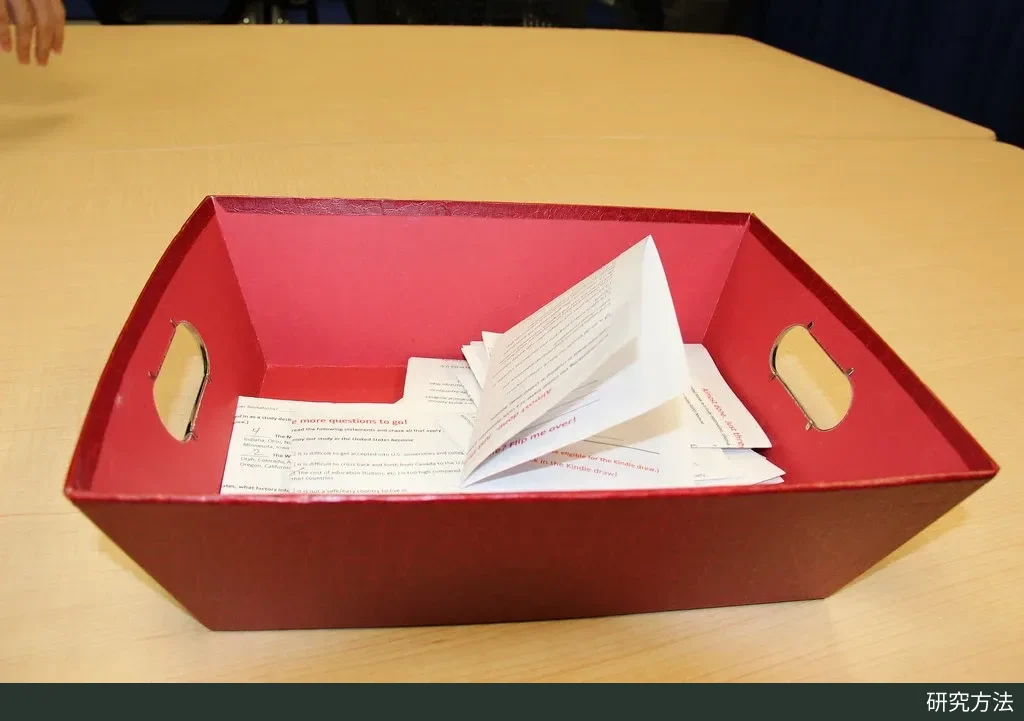
Several completed paper questionnaires are placed in a red basket on the table. According to the photograph title, these questionnaires were used for the Kindle raffle associated with the EducationUSA event; questionnaires voluntarily returned for the purpose of entering the raffle constitute self-selected samples with unknown inclusion probabilities if used to infer the population. Author: US Embassy Canada (U.S. Embassy in Canada); Source:Flickr; Permission:Public Domain Mark 1.0。
Shira Mitchell, a co-author of Andrew Gelman's blog, compiled on October 20 a list of recommended textbooks on survey statistics from readers, noting that three commonly used textbooks in their latest editions now include content on non-probability sampling: the second edition of Valliant et al.'s Practical Tools, the third edition of Lohr's Sampling: Design and Analysis, and the third edition of West et al.'s Applied Survey Data Analysis. This list comes from reader recommendations and is not the result of a systematic survey, but it illustrates how textbooks address non-random samples within a framework of probability sampling.
The newly added content in the three updated textbooks
This short piece belongs to Mitchell (blog signature shira) in the 'Survey Statistics' series on the blog Statistical Modeling, Causal Inference, and Social Science hosted by Gelman. On October 13, she listed five textbooks used in the series—Kish (1965), Särndal et al. (1992), Groves et al. (2009), Lumley (2010), and Lohr (2022)—and asked readers to supplement the list; a week later she compiled readers' replies, specifically highlighting three books that introduced non-probability sampling content in the new editions and noting which readers recommended each. The post title reads 'chapter,' while the body refers to 'sections.' Comparing the publisher's official table of contents and abstracts, the treatment of these three books is not the same.
- Valliant, Dever, Kreuter Practical Tools for Designing and Weighting Survey Samples, 2nd edition (Springer, 2018): Chapter 18, "Nonprobability Samples", has been added. The chapter summary states that this chapter introduces nonprobability data sources such as internet survey volunteer sample databases, criteria for assessing their quality, and three methods for inferring from such data to a finite population: quasi-randomization, model-based methods, and doubly robust methods that combine both.
- Lohr Sampling: Design and Analysis, 3rd edition (CRC Press, 2022): Chapter 15, "Nonprobability Samples", has been added. The table of contents includes types of nonprobability samples (administrative records, quota samples, judgment samples, convenience samples), selection bias and mean squared error, using weighting and imputation to reduce bias from missing units, uncertainty measures for nonprobability samples, and a comparison between nonprobability samples and low-response-rate probability samples.
- West, Heeringa, Berglund Applied Survey Data Analysis, 3rd edition (CRC Press, 2025): The publisher lists 'methods and software for analyzing non-probability survey data' as new content. According to the R command overview on the accompanying website, the relevant examples are located in Chapter 13 'Advanced Topics in the Analysis of Survey Data,' using specialized R packages such as nonProbEst and nonprobsvy, and are not presented as a standalone chapter.
The three lines of inquiry observed by the original post author
Mitchell did not review the new chapter content book by book in the post; she was more interested in another book: Thomas Lumley's "Complex Surveys: A Guide to Analysis Using R" (2010). She argued that although the book lacks a dedicated chapter on nonprobability sampling, it does contain material applicable to nonprobability samples, and cited her June 2025 article "2 flavors of calibration" as an example. In that article, she distinguished two types of "calibration" in survey statistics: post-stratification, which involves adjusting estimates of the overall mean using the known distribution of auxiliary variables (such as racial composition) in the population; and intercept correction, which ensures that the sum of group regression estimates matches the known overall mean, and pointed to Lumley's Chapter 7, "Post-stratification, Raking, and Calibration." She imagined that if the book were to publish a second edition, it might include an additional chapter on nonprobability sampling; in her reply to the post on October 13, she mentioned that Lumley seems to be considering a revised edition, but there is currently no confirmed information.
The second line of inquiry is terminology. The post ends by inviting readers to refer to her article from December 2025. According to the standard definition in Groves et al.'s textbook, a probability sample refers to a sample in which the probability of selection for each individual in the population is known and non-zero; a non-probability sample is one in which the selection probability is unknown, zero, or both. Equal probability of selection (EPSEM) requires that each individual has the same probability of being selected, while simple random sampling (SRS) further requires that each sample of size n has the same probability of being selected; these concepts are nested in this order. Mitchell admits that this definition feels awkward—an unknown probability does not mean there is no probability; readers in the comment section emphasize that this distinction depends on whether the sampling process itself allows the selection probabilities to be known.
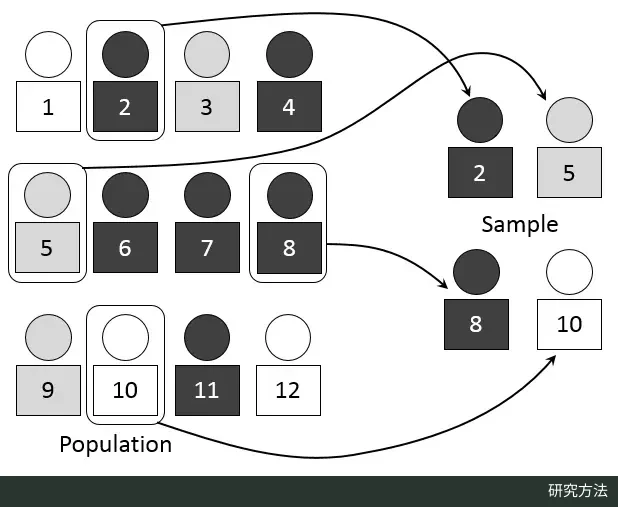
Illustration of simple random sampling: randomly selecting individuals numbered 2, 5, 8, and 10 from a population of 12 people to form a sample of 4, such that each possible 4-person combination has an equal probability of being selected. It is the most strictly required type of probability sample and is included within the framework of equal probability of selection (EPSEM). Author: Dan Kernler; Source:Wikimedia Commons; Permission:CC BY-SA 4.0(Format converted).
The third line of evidence appeared in the comment section. Reader Ben Schneider noted that Lohr's introduction to nonprobability samples in the book is excellent; Mitchell replied that Lohr's new Chapter 15 heavily draws upon Meng (2018)'s paper, while she has not yet read the new chapter by Valliant et al., so she cannot compare. In his paper, Meng provides an identity: for any sample, whether or not it is probability-based, the difference between the sample mean and the population mean equals the product of three terms—the 'data defect correlation' reflecting data quality (the correlation between selection and variable values), √((N−n)/n) reflecting data quantity, and the population standard deviation reflecting problem difficulty. Using CCES data from the 2016 U.S. presidential election, Meng estimated that the data defect correlation for self-reported votes for Trump is approximately −0.005; this small correlation causes the self-reported sample, which comprises about 1% of eligible voters and roughly 2.3 million people, to have a mean squared error comparable to a simple random sample of about 400 individuals. From the table of contents, Lohr's Section 15.2 discusses selection bias and mean squared error, beginning with 'a random variable describing the selection status'; the actual content of this section has not been read, so the extent of borrowing cannot be verified.
The relationship between new content and the probability sampling main line
Looking at the chapter arrangement, non-probability sampling is presented as an extension of the existing framework and does not replace the main thread of probability sampling. In the third edition of Lohr, the first 14 chapters still cover simple random, stratified, cluster, unequal probability, and complex sampling designs, with the newly added Chapter 15 placed after these chapters and before Chapter 16 'Survey Quality'. The preface explains that the new chapter compares probability samples with non-probability samples, providing guidance on how to assess the quality of non-probability samples, and also compares non-probability samples with probability samples that have low response rates; endorsements of the book mention that low response rates, non-probability surveys, and web-based data collection have become increasingly important issues in survey practice. The preface simultaneously maintains that design is the most critical aspect of surveying, and that no amount of statistical analysis can compensate for a poor design. Valliant et al. place the new chapter after sections on weighting, calibration, variance estimation, and multiphase designs, aligning it with the weighting and auxiliary information content covered in the earlier chapters.
This list comes from a call for recommendations on a blog and covers only books recommended by readers; it cannot establish that survey statistics textbooks are generally adding such chapters; classic textbooks by Kish, Särndal, and others still take probability sampling as their core focus, and readers in the comment section have listed Cochran's Sampling Techniques (3rd edition, 1977) as their favorite. The descriptions of the three books in this article are based on publisher pages, tables of contents, forewords, and chapter summaries, with no access to the full texts of new chapters; the original post webpage on October 20 could not be directly opened, and the main text is based on a retrieved full-text excerpt, while the comment section could not be fully viewed.
References
-
shira(Shira Mitchell). Survey Statistics: textbooks adding non-probability sampling chapters. Statistical Modeling, Causal Inference, and Social Science, 2026-10-20.
-
shira. Survey Statistics: favorite textbooks ? Statistical Modeling, Causal Inference, and Social Science, 2026-10-13 (including comments section replies).
-
Lohr, S. L. Sampling: Design and Analysis, 3rd ed. CRC Press, 2022. Publisher page;Preface and Table of Contents Preview.
-
Valliant, R., Dever, J. A., Kreuter, F. Practical Tools for Designing and Weighting Survey Samples, 2nd ed. Springer, 2018. Publisher page;Chapter 18 Summary.
-
West, B. T., Heeringa, S. G., Berglund, P. A. Applied Survey Data Analysis, 3rd ed. CRC Press, 2025. Publisher page;Complementary website R command overview.
-
Meng, X.-L. Statistical paradises and paradoxes in big data (I): Law of large populations, big data paradox, and the 2016 US presidential election. The Annals of Applied Statistics, 12(2): 685–726, 2018. doi:10.1214/18-AOAS1161SF.
-
shira. Survey Statistics: 2 flavors of calibration. 2025-06-03.
-
shira. Survey Statistics: probability samples vs epsem samples vs SRS samples. 2025-12-02.
-
Research methodology Rituals can be mimicked, but understanding cannot be feigned
-
Information provided by Scholay Academic One-Stop Platform Organize and publish; if there is any infringement, please provide feedback for removal.
-
Information synchronization published in EnterScholar, Scholar Community in the Age of Intelligence