How can one trial compare several drugs and then stop some arms as evidence accumulates? The final report of the REMAP-CAP immune modulation domain, published in 2025, offers an example: the study shared controls, allowed the randomization allocation to be adjusted, and made interim decisions under pre-specified rules. The key to understanding it is seeing which patients actually serve as controls, how the outcome is scored, and which critically ill population the results apply to.
1
This article is based on the final report first published online on 13 May 2025, and discusses the design rather than current prescribing recommendations. The study recruited critically ill patients from March 2020 to April 2021 in 133 hospitals in 9 countries. The target population was adults receiving respiratory or circulatory support in the ICU, who had to be enrolled within 24 hours of starting organ support; the year of publication is not the year the experiment took place.
Within the same treatment domain the interventions are mutually exclusive, and patients may also take part in other domains of the platform. Each site pre-selected at least two available interventions, which initially had to include a control that did not use the domain's immunomodulatory drugs; a central computer carried out the randomization, with proportions depending on the treatments available at the site and also allowed to be adjusted according to periodic adaptive analyses. A shared control can reduce duplicate recruitment, but patients in other treatment domains cannot all be counted as controls for this drug.
2
This Bayesian design had no pre-specified maximum sample size; it continued or stopped according to pre-specified statistical criteria. A total of 2,274 critically ill patients were enrolled: tocilizumab 972, sarilumab 485, anakinra 378, interferon β1a 21, control 418. Unequal group sizes cannot by themselves be taken as a randomization failure; withdrawal of consent and missing outcomes also change the number analyzed.
On 19 November 2020, tocilizumab met the superiority trigger relative to control, and the control arm was closed. On 9 April 2021, a planned analysis triggered an equivalence conclusion for the two IL-6 receptor antagonists and an inferiority conclusion for anakinra relative to the other active treatments, after which the arms were closed. Later patients therefore were not randomized against a concurrently open control without immune modulation.
Multi-drug comparisons and repeated interim looks change the chances of erroneous decisions. A posterior probability of superiority is not a frequentist Type I error rate, and 99.8% cannot be converted into an error rate of 0.2% for the whole trial. Before reusing the design, one must define the set of comparisons, the analysis time points and the rules for adding and dropping arms, and evaluate the error rate and precision of the whole rule set by simulation. This article did not independently run such simulations, and does not claim to have verified the global error rate.
3
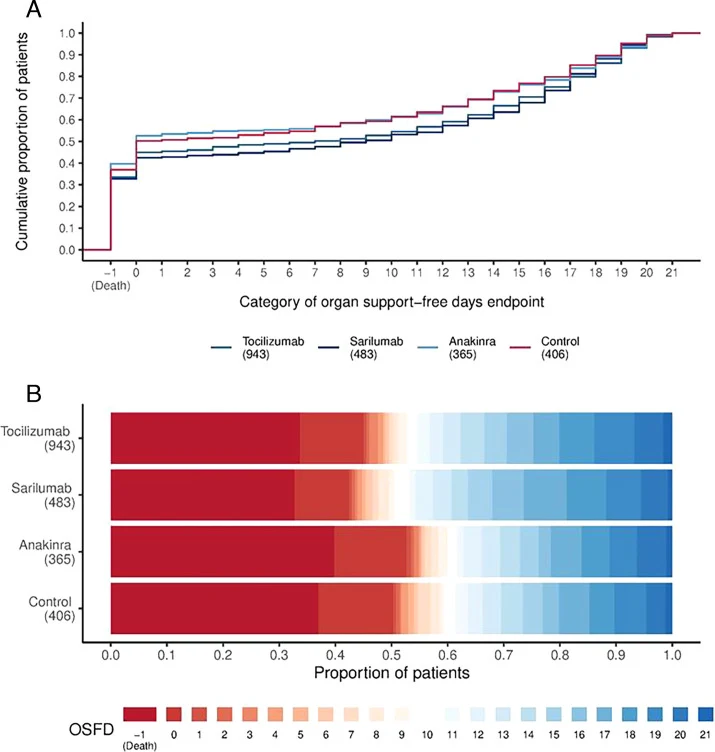
The primary outcome is an ordinal measure: death during this hospital stay is scored −1; for survivors, it is the number of days up to day 21 without respiratory and circulatory support, with higher being better. This avoids misrecording patients who died as recovering quickly because their time on support was short, but it also requires accepting this ordering. The model's odds ratio describes the overall ordinal outcome and cannot be interpreted directly as how many days of life are gained or by how much the risk of death falls.
The study was open-label, so clinical staff knew the treatment, but clinicians and the steering committee were not told the allocation proportions or aggregate outcomes. Death is relatively objective, while weaning from support and discharge may still be influenced by knowledge of the treatment. The model adjusts for site, age, sex and two-week calendar period to mitigate bias from changing supportive care over the course of the pandemic; missing outcomes were not imputed. Time adjustment cannot guarantee eliminating the risk of non-concurrent comparisons, and the paper also reports sensitivity analyses that remove some adjustments and restrict the analysis population.
4
The adjusted odds ratios for the primary outcome relative to control were 1.46 (95% credible interval 1.13–1.87) for tocilizumab, 1.50 (1.13–2.00) for sarilumab and 0.99 (0.74–1.35) for anakinra. The first two drugs point in a favorable direction; the third showed no benefit in this population. The interim equivalence trigger does not mean the two drugs have exactly the same effect; the final-analysis probability of equivalence was 84.9%, with the bound set as a relative odds ratio between 1/1.2 and 1.2, so the judgment depends on the model, the bound and the data cut-off.
There are three layers of limits on generalization: the population is adults at the early stage of ICU organ support; the recruitment period was 2020–2021, after which immune background, variants and care would change; and few immunosuppressed patients were included, so evidence for special populations is limited. The order for borrowing the design is to first define the population and measurements, then specify randomization and control eligibility, and finally pre-specify interim decisions and verify the operating characteristics. The results above come from the paper; this article did not carry out any new trial, software analysis or independent measurement.
4.1. References
- Derde L, Gordon AC, Mouncey PR, et al. Tocilizumab, sarilumab and anakinra in critically ill patients with COVID-19: a randomised, controlled, open-label, adaptive platform trial. Thorax. 2025;80:530–539. First published online: 2025-05-13.
- Institutional repository copy of the publisher's version of record and original figures and tables.
- Supplementary material: additional methods, sensitivity analyses, domain adjustment timeline.
References
-
Research Methods · Rituals can be imitated; understanding cannot be faked
-
Compiled and published by the Scholay all-in-one academic platform. If any content infringes your rights, please let us know and it will be taken down.
-
Also published at Enter Scholar, the scholar community for the age of intelligence