A group of candidates appears one by one in random order; each time you see one you must decide whether to choose that person, and a rejection cannot be undone. If the goal is to pick the very best of all, choosing only the first gives a success rate of 1/n, while waiting to compare everyone comes too late. The secretary problem offers a surprising compromise: observe about 37% first, then choose the first candidate who beats everyone seen so far. When the number of candidates is large, the success rate still approaches about 37%.

Relative ranks and the stopping rule
The classical model has n candidates, no two of equal ability, and all orders of appearance are equally likely. Each time a person is seen, only their relative rank among those seen so far is known, and they must be chosen or rejected immediately; a rejection cannot be reversed, only one choice may be made, and the goal is to choose the best of all n. If the k-th person is better than everyone before, that person is a "candidate," that is, the current record holder. A non-candidate can no longer be the best of all, so there is no need to choose one.
Pick a threshold r: reject the first r−1 people, then from the r-th person onward choose the first candidate; if no new record ever appears, one may choose the last person, but this does not change the probability of choosing the best. The early section provides a benchmark for comparison, and the later section keeps the chance of catching a better person. Observe too few, and the benchmark is unreliable; observe too many, and the best may already have been missed.
The six orders with three candidates
Start with n=3. Let 1, 2, 3 denote true ranks from best to worst; the six orders are equally likely. With r=1 the first person is chosen immediately, which succeeds only in the two orders 123 and 132, a success rate of 2/6. With r=2 the first person is rejected and then the first to break the record is chosen: this succeeds in the three orders 213, 312, and 321, a success rate of 3/6. In the last of these, the second person is not a new record and only the third is. Blindly choosing the last person also succeeds in only two orders.
Success probability and the optimal threshold
For r≥2, if the best of all appears in position k (k≥r), the probability of this event is 1/n. For the rule to choose that person at position k, the best of the first k−1 people must fall among the r−1 initially rejected: otherwise a new record would already have made the rule stop earlier. The conditional probability is therefore (r−1)/(k−1). Summing over the possible positions gives
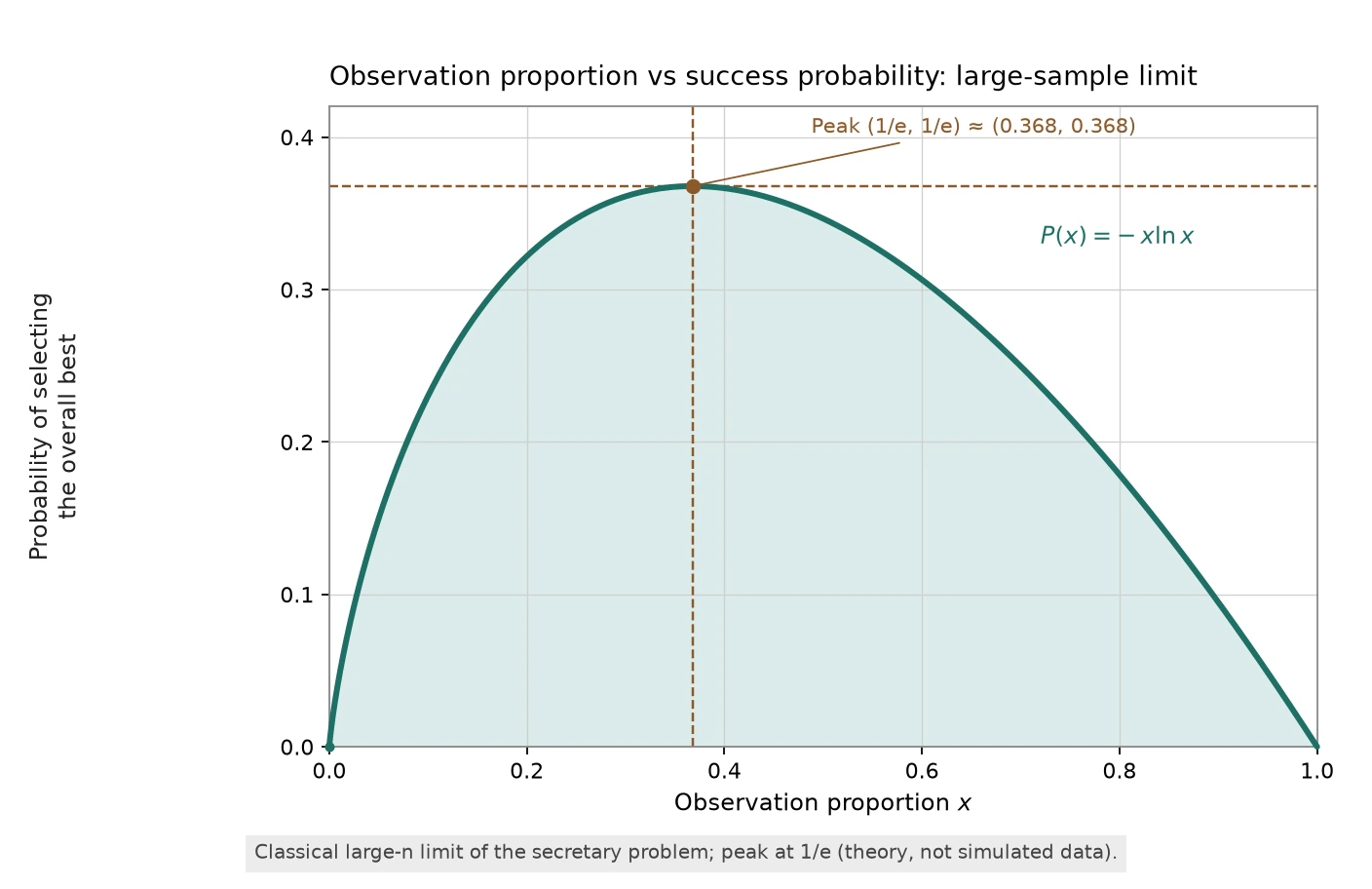
Let x=r/n. When n is large, the sum approximates an integral, and the success probability approaches −x ln x. Its derivative is −ln x−1, so the maximum occurs at x=1/e, and the maximum value is also 1/e, about 0.368. For the classical problem it can be proved that the optimal rule has this threshold form, so this is not merely an optimization of one guessed strategy but also gives the optimum among all permitted strategies. With a finite number of candidates, the discrete formula should be used to choose the threshold; there is no need to cling to a particular way of rounding, since nearby thresholds usually perform similarly.
Practical meaning and variants of the model
The 37% is not a success rate that comes from picking at random: it comes from a specific stopping rule under random order, relative ranks, and no recall. As the number of candidates grows, the 1/n of blind choice approaches zero, whereas this rule keeps a nonzero success rate by relying on the relative records obtained through observation. It puts the value of information and the cost of waiting on the same probability ledger.
Change the problem and the answer changes too: if the goal is to make the expected rank of the chosen person as good as possible, or if recall is allowed, the number of candidates is unknown, or absolute scores are observed, the optimal rule need not keep to 1/e. Real hiring and dating also involve choosing several people, preferences, and constantly changing information, so this threshold cannot be taken directly as a general rule for life.
References
-
Ferguson, T. S. (1989). Who Solved the Secretary Problem? Statistical Science, 4(3), 282–289.
-
Gilbert, J. P., & Mosteller, F. (1966). Recognizing the Maximum of a Sequence. Journal of the American Statistical Association, 61(313), 35–73.
-
Research Methods · Rituals can be imitated; understanding cannot be faked.
-
Compiled and published by the Scholay one-stop academic platform. If anything here infringes your rights, please report it and it will be taken down.
-
Also published on Enter Scholar, a community for scholars in the age of AI.