When the interviews are over, the researcher usually has many answers to the same question. Tagging the relevant sentences with labels such as "time", "training", or "support" is only the beginning of organizing the material. Reflexive thematic analysis presses further: what do these excerpts express in common? And how does that shared meaning help answer the research question? [1]
Decide first what is to be understood
Reflexive thematic analysis suits research on how people understand and experience a phenomenon, and it can also be used to analyze how meaning is constructed in a social context. It belongs to the family of methods known as thematic analysis, and it emphasizes that the researcher actively develops codes and themes through continuing engagement with the data, the research question, and the theoretical perspective. [1]
At the outset, the research question and the analytic perspective need to be made clear: is the emphasis on understanding how interviewees describe their own experiences, or on examining how their accounts organize some social meaning? Coding can stay close to what is explicitly said in the data, or it can interpret the assumptions behind what is said; researchers should explain why they have taken the perspective they have and how it serves the research question. [1][2]
From familiarization with the data to initial codes
First read the whole set of interview data repeatedly, where necessary using the audio recordings and interview notes to understand the context. While reading, note down first impressions, recurring expressions, surprising differences, and the questions that arise in your own mind. The researcher needs to see at the same time the overall thread of each interview and the connections that may exist between different interviews. [2]
Then code passage by passage with the research question in view: write a short, specific label for each excerpt worth analyzing further, so that the label conveys what the researcher takes that passage to be expressing. One excerpt can carry several codes; as understanding of the data deepens, codes can also be renamed, merged, or split. [2]
In a study of how secondary school educators in Ireland promote student wellbeing, David Byrne interviewed an educator who spoke about dealing with students' distress. The educator said that they would talk with the student using common sense, but were unsure whether help of that kind had any lasting effect. Byrne coded this passage on the one hand as educators relying on common sense to respond to wellbeing issues, and on the other interpreted it as common sense possibly being insufficient to promote student wellbeing. These two codes attend respectively to the more direct statement and to the researcher's further understanding of its meaning. [2]
When coding, keep the correspondence between the original excerpts and the labels, and note the reasons for important changes. Byrne used document comments to mark excerpts and then a spreadsheet to record the different versions of the codes; what matters is being able to return to the context later and understand afresh why something was coded as it was. [2]
Let codes cluster around one central meaning
A theme is not another name for a code, nor is it just a topic from the interview guide. A topic can gather all sorts of opinions about "experiences of healthcare"; a theme with a central meaning tries to say what these excerpts jointly convey, for example by connecting different experiences of care to "having one's identity recognized". [1]
When forming candidate themes, put the related codes together with their original excerpts, compare the relationships among them, write one sentence that captures the shared meaning, and then ask: which part of the research question does this sentence answer? Different excerpts may show differences, but they need to have an explicable connection to this shared meaning. The importance of a theme depends on its contribution to the research question, and is not determined by the number of codes alone. [1][2]
Byrne's case shows this process. The qualitative part of the study comprised 11 semi-structured interviews, each lasting about 25–30 minutes. In the preliminary analysis, he placed material on lack of training, time pressure, wellbeing promotion not being given enough priority, and limited knowledge of the relevant documents under the candidate theme "factors influencing wellbeing promotion", and used a thematic map to present its relationship to the other candidate themes. [2]
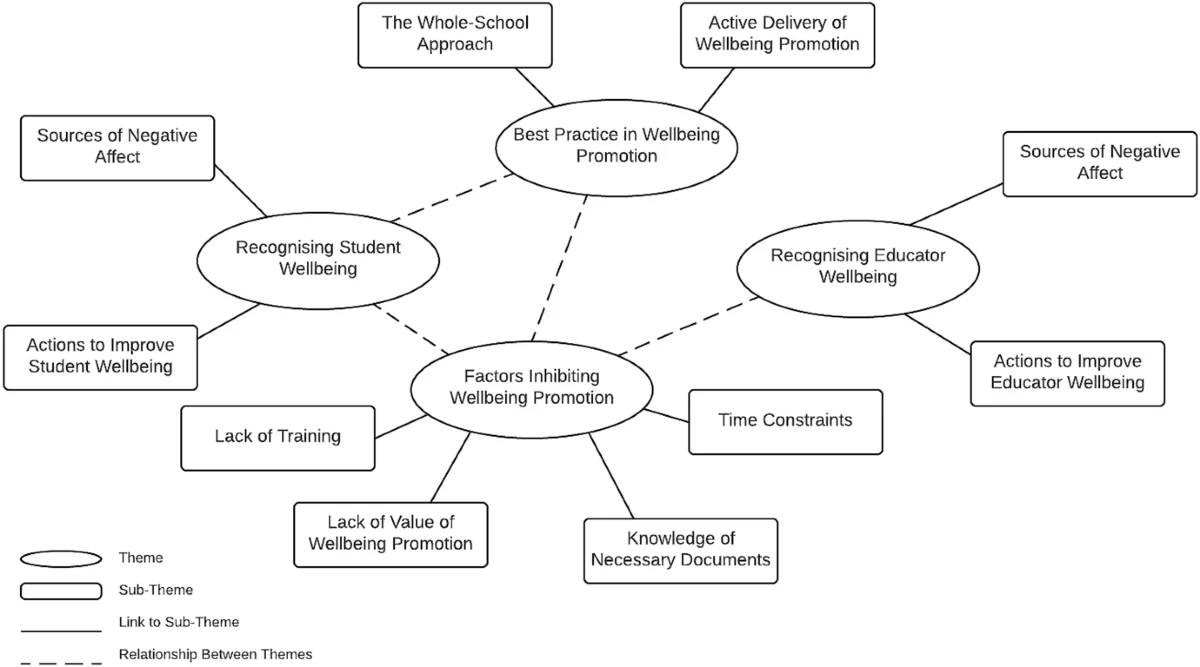
The initial thematic map from Byrne's study, showing the four candidate themes and their relationships. Source: David Byrne, Figure 1 of the original article [2]; the original figure is unmodified and is used under a CC BY 4.0 license.
On review, Byrne found that this candidate theme was too broad in scope and that the different materials could hardly form a coherent account. He went back to the codes and interview excerpts, reorganized the meanings in them, and developed three themes, concerning time, incompletely theorized agreements, and the value of wellbeing promotion. The thematic map as a whole was also adjusted from the initial four candidate themes to the final five themes. [2]
In these, the analysis concerning time no longer stops at the barrier of "not enough time": existing time pressure limits the work of wellbeing promotion, and adding this work may in turn eat into the time for the core curriculum. This interplay offers a common account for the different excerpts. Another part of the data prompted Byrne to distinguish educators' views of how educators themselves and how students value wellbeing promotion, rather than putting all these views down to a lack of value. [2]
When checking candidate themes, look back on the one hand at the excerpts placed under them and judge whether they can jointly support the meaning proposed; on the other hand, look back at the whole dataset and judge whether the themes leave out important content and whether they are clearly distinct from one another. On meeting an excerpt that does not fit, one can reconsider the scope of the theme, adjust the codes, or develop a new interpretation. Movement back and forth among familiarization, coding, forming themes, and review is often needed. [2]
Define the themes and write the analysis up
Write a paragraph of definition for each theme, stating its central meaning, what it includes, and how it differs from the other themes. Then give the theme a name that conveys this meaning. If the title is just "experiences" or "barriers", or is almost identical to an interview question, the researcher can go back to the definition and check whether the answers are still being sorted by topic. [1][2]
In writing, put the claims about a theme together with interview extracts: first explain the theme's contribution to the research question, then select excerpts that help to show the shared meaning and its variations, and explain why these words support the analysis. Readers need to see how the researcher got from the interviewees' accounts to the theme, not just a set of labels and quotations. [2]
Reflexivity runs through the whole process. Researchers can record how their own experience and theoretical perspective influenced what they noticed, which excerpts prompted a change in an earlier judgment, and why one interpretation was kept and another dropped. Linking these reflections to specific analytic decisions in the report lets readers understand how the themes took shape. [1][2]
When several people take part in the analysis, interpretation can be enriched by discussing different understandings and probing one another's assumptions. Reflexive thematic analysis regards the researcher's perspective as an analytic resource, and so it does not take inter-coder agreement rates, or an insistence on consensus, as the standard for demonstrating a single correct interpretation; if the aim of the research is to sort and compare data consistently by fixed categories, an approach to thematic analysis that matches that aim should be chosen. [1][2]
References
-
Virginia Braun, Victoria Clarke. Toward good practice in thematic analysis: Avoiding common problems and be(com)ing a knowing researcher. 2022-10-25.
-
David Byrne. A worked example of Braun and Clarke’s approach to reflexive thematic analysis. 2021-06-26.
-
Research Methods · Rituals can be imitated; understanding cannot be faked
-
Compiled and published by the Scholay one-stop academic platform. If anything here infringes your rights, please let us know and it will be taken down.
-
Also published on EnterScholar, a community for scholars in the age of intelligence