A confidence interval can reliably cover the true value within an allowed range and still find it hard to rule out other parameters near that truth. Hugo Freeman's July 12, 2026 preprint Local Asymptotic Power of Honest Confidence Intervals studies that cost: when researchers reserve protection against hard-to-test bias, the size of the bias upper bound relative to sampling error decides how fine a local difference a test can see.[1]
Consider a concrete 95% bias-aware interval: β̂ ± (B + z₀.₉₇₅·SE). Here β̂ is the estimator, SE the standard error, z₀.₉₇₅ about 1.96, and B the allowed absolute bias bound. Compared with an interval whose width follows sampling error alone, it leaves an extra B at each end to accommodate bias inside the allowed range. B is an upper bound, not the bias that actually occurs; even if the true bias is zero, the interval is still widened by B.[1]
Two different questions are in play. First, under a given true bias, how likely is the interval to exclude a specified wrong parameter? Second, can the interval keep its promised coverage uniformly for the entire allowed class of biases and data-generating processes? The latter requirement is called honesty. The paper takes data as generated under a true parameter β₀ and then examines the probability that a perturbation β₀+c·SE falls outside the interval. That probability is the exclusion rate for the perturbation and the local power of the corresponding test; it is not a result already observed in a particular empirical study.[1]
Local power is governed by the relative speed of two scales
Dividing the half-width by SE yields z₀.₉₇₅+B/SE. As the sample grows, what matters is therefore not only whether SE falls, but how B/SE changes. If B/SE tends to zero, bias protection fades on the standard-error scale; if it tends to a positive constant, the widening persists on that scale; if it tends to infinity, a fixed-c perturbation becomes ever smaller relative to the bias bound. Under the conditions discussed in the paper, that last case can drive the exclusion rate of a specified widened interval for these local perturbations to zero.[1]
A Gaussian example that can be computed exactly illustrates the three scales. Let true bias be zero, β̂=β₀+SE·Z with Z standard normal and SE=n⁻¹ᐟ²; set B=n⁻⁰·⁷⁵, n⁻⁰·⁵, and n⁻⁰·²⁵. These choices make B/SE tend to zero, stay at 1, and tend to infinity. For a perturbation β₀+c·SE, the exclusion rate equals Φ̄(1.96+B/SE−c)+Φ(−1.96−B/SE−c), where Φ is the standard normal cdf and Φ̄ its upper tail.
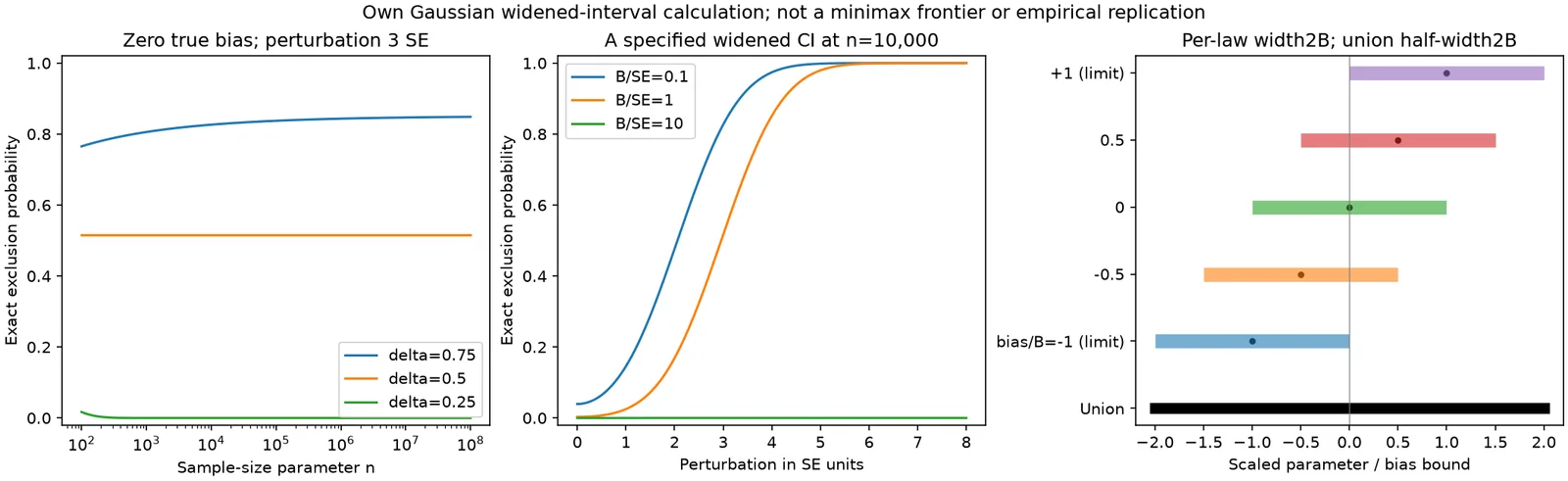
Exact exclusion probabilities of the widened interval for local perturbations when the estimator is Gaussian and true bias is 0; the right panel sketches per-bias windows and their union in a noise-negligible limit, not the paper's optimal frontier or an empirical replication.
For example, with n=10,000 and c=3, the three settings give B/SE of 0.1, 1, and 10; using a more precise normal critical value, the exclusion rates are about 82.64%, 51.60%, and 1.62×10⁻¹⁹. The standard error is the same in all three, but a larger bias bound makes it harder for the interval to exclude a perturbation three standard errors from the truth. The last probability is extremely small in this finite-sample setting, yet not exactly zero.
A window under one bias, and the union over all biases
The right panel briefly shrinks sampling noise to a negligible scale to show how windows form. Let the true bias be qB with q between −1 and 1. Taking β₀ as the origin, the parameter window retained by the specified widened interval is [(q−1)B,(q+1)B]: each fixed-q window has width 2B and half-width B. When true bias is zero it is [−B,B]; when true bias nears the positive endpoint the window shifts right.
Letting q traverse the whole allowed range, the union of these windows is [−2B,2B], with half-width 2B relative to β₀. That union shows every location covered by some true-bias window; it does not mean every fixed bias has the same half-width-2B window. Nor is it the flat region of the finite-sample Gaussian exclusion curve on the left, which still includes random sampling noise.[1]
When can one say every honest procedure faces a limit?
Low exclusion rates for a specified widened interval do not by themselves prove that every honest procedure is equally powerless. The paper further uses a condition of observational indistinguishability: for some combinations of different parameters and allowed interference, the induced distributions are close enough in total variation. Under this extra Assumption 3, uniform coverage implies that for the relevant local perturbations one can always find allowed interference that keeps any honest procedure's exclusion rate asymptotically no larger than the nominal level α. That minimax statement is a limit under worst-case interference, not a claim that exclusion is zero under every true bias.[1]
The paper also discusses exact confounding in a normal location model: different parameter-and-bias pairs can induce the same observational distribution. That strongest form needs the further Assumption 4; it does not follow from a bias expansion of the estimator or from B exceeding SE alone, and it cannot be copied unchanged to every semiparametric problem that only has approximate confounding.[1]
The contribution is to place the cost of a coverage promise on the parameter scale the reader cares about: first state how large a bias is allowed, then compare it with the standard error and the effect to be distinguished. If B shrinks more slowly than SE as the sample grows, adding observations alone may not make a one-standard-error difference easy to exclude. Reporting the bias bound together with the scale it implies helps readers see which differences remain inside the protected range; extending that judgment to every honest procedure still requires checking the corresponding indistinguishability conditions.[1]
References
- [1] Freeman, Hugo. Local Asymptotic Power of Honest Confidence Intervals. arXiv:2607.10558v1, 2026-07-12.